
Reminder: I am using multiple translations; my main reading is from the hardbound copy of the Mansfield translation. When I refer to page numbers it’s to the Mansfield translation, and when I want to pull quotes that are longer I’ll use the online Schleifer translation, so the text may not match exactly but they are close (and I also read French so I calibrated across the translations to get comfy with Tocqueville’s word choice).
Democracy in America, Volume 2, Part I, Chapters 13-21
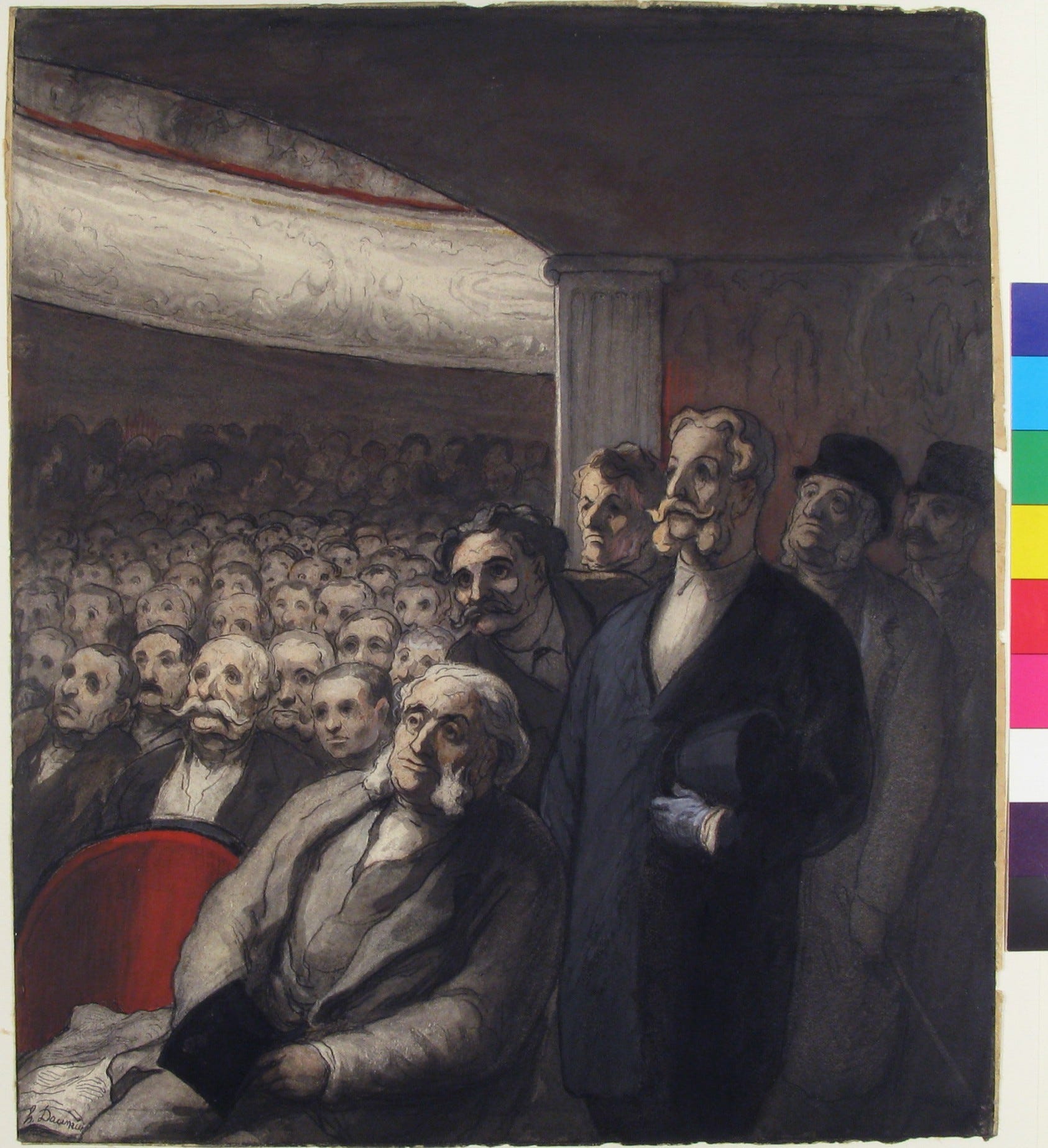
Honoré Daumier, A Theater Audience, nd but mid-19th c. Source: Metropolitan Museum of Art
One feature of mass culture is the democratization of cultural distinction. #BookTok offers a good example: readers who are neither critics nor editors now propel authors, genres, and old books onto bestseller lists. In 2025, TikTok reported that books recommended through #BookTok generated more than 50 million sales across several European markets. Literary reputation emerges increasingly from dispersed reader enthusiasm rather than from established gatekeepers.
Aristocratic societies attached distinction to inherited rank and closed elites. Democratic societies open distinction to competition. Writers, artists, performers, and celebrities can rise from almost anywhere, but their standing depends on attracting large audiences. Reputation becomes fluid, accessible, commercial, and unstable.
In the closing chapters of Volume 2, Part I of Democracy in America, Tocqueville turns from science and the practical arts to literature, language, poetry, and theater (and history and political rhetoric, which I won’t discuss here). He could not have imagined modern celebrity culture or the technologies that sustain it, but he grasped the social logic behind mass culture, asking throughout what equality of conditions does to the habits of mind from which culture grows.
His answer resists the straightforward conclusion that democracy debases the arts (when in Tocqueville is anything straightforward?). Aristocratic culture venerates refinement, continuity, and form; democratic culture encourages movement, abundance, and novelty. Tocqueville wants to know the tradeoffs between them, and whether a democratic society can preserve artistic excellence without recreating aristocratic hierarchy.
Literature for a larger world
Aristocratic literature grows within a small world: writers and readers share an educated class, its conventions, and its standards of taste. Writing for connoisseurs who expect precision rewards patience and polish.
Democracy breaks that world open. Education spreads, ranks mix, and the number of readers grows. Writers come from varied backgrounds and address larger, busier, less homogeneous audiences. Tocqueville expects the resulting literature to be more prolific, less polished, more irregular, and more energetic — qualities he summarizes as an “absence of rules, scorn for style, rapidity, fertility, liberty” (Chapter 13, note a, in Schleifer translation but not in Mansfield translation).
The openness that makes literature more fertile also makes it faster and less rule-bound, and abundance changes the incentives writers face as a growing audience creates an expanding market for cultural production. In Chapter 14, Tocqueville calls the result the “literary industry” (p. 450): democracy carries the taste for literature into the industrial classes while carrying the industrial spirit into literature itself. A large reading public continuously demands something new, and writers can acquire money and reputation without producing lasting work. Democratic literature “swarm[s] with sellers of ideas” (p. 450).
Tocqueville is describing an early form of mass culture. Mass literacy enlarges demand, writers respond, and competition rewards novelty and output alongside excellence. Cultural distinction becomes available to more people even while it grows subject to the demands of a large and shifting audience; abundance’s tradeoff is the cost of the constraints that once pushed writers toward craftsmanship.
Counterweights to democratic taste
Tocqueville does not propose restoring the aristocratic literary world. He looks instead for practices that supply what democracy struggles to generate on its own — a search for counterweights that carries forward his method from earlier in the book.
Given this diagnosis, his defense of Greek and Latin literature comes as a surprise (Chapter 15). Ancient literature emerged from societies that Tocqueville regards as fundamentally aristocratic. Its writers lacked the variety and bold generalization that characterize democratic culture, but they displayed “admirable art and care in the details,” (p. 451) pursuing form and ideal beauty with unusual discipline.
Democratic writers are likely to neglect those qualities, which is what makes classical literature valuable as a counterweight: “They prop us up on the side where we lean” (p. 452). [Note: I like the wording of this sentence in the Schleifer translation: “They support us as we lean over the edge.”]
He does not want democratic education to become universal classical education; a commercial, industrial society needs scientific and practical learning. Instead he wants excellent institutions where people drawn to literature can encounter standards of craftsmanship their surrounding culture will not supply reliably. Democracy generates movement, novelty, and intellectual risk on its own. Education should cultivate patience, precision, and form.
A democratic language and imagination
Equality also changes language. New occupations, technologies, and administrative practices create experiences that require new names, and people borrow specialized terms and push them into ordinary speech. Their language grows flexible and inventive as their world does.
Tocqueville is particularly interested in the democratic taste for abstraction (Chapter 16). Equality weakens old distinctions of rank, teaching people to look past particular persons toward broader categories — society, humanity, progress, equality. Abstract words let people gather many phenomena under a single idea, enlarging the range of thought while making it easier to slide past inconvenient distinctions.
Poetry moves in the same direction (Chapter 17). Aristocratic poetry finds its subjects in particular people and inherited worlds: great families, legendary heroes, princes, ancient customs. Equality erodes those fixed social types, and democratic poets turn instead toward larger, more universal subjects — the future, the nation, humanity, God, the inner life of man. Democracy makes poetic subjects “less numerous and more vast” (p. 463). As inherited distinctions fade, the human being himself becomes a grander imaginative subject, and a poet finds in a single soul passions shared across ranks and nations.
Art after aristocracy
The theater completes the argument because it reveals, more clearly than any other art, how directly art depends on its audience (Chapter 19). Dramatic literature must satisfy people assembled together in real time. Democratic playwrights loosen inherited conventions, accelerate the action, and seek stronger effects, sometimes neglecting artistic rules, Tocqueville writes, “in order to go faster or to strike more forcefully” (in the Schleifer translation but missing from Mansfield p. 468).
Democratic virtues and defects, as elsewhere in Democracy in America, arise from the same source. The theater becomes more immediate and responsive to contemporary life, and less constrained by inherited form; innovation buys its benefits with real costs.
Across these chapters, Tocqueville doesn’t laments lost aristocratic culture, nor does he celebrate mass culture. Democracy enlarges the cultural world: more people read, write, speak, imagine, and shape taste, and distinction becomes less inherited and more open to competition. The danger lies in letting movement substitute for achievement and abundance for excellence. Tocqueville’s answer is to carry selected aristocratic virtues into democratic culture without carrying aristocratic privilege along with them. A democratic civilization needs spaces where slowness, form, and discernment survive alongside experimentation.
[Claude AI note: I used Claude to help me edit this article, as I often do. I have not included this disclaimer in the past but will do so hereafter.]
Fischer Black described the same structure in finance. Noise. Noise trading is what makes markets possible, and it is also what makes them imperfect. Without noise there is no one to trade against. With it, price departs from value, and nobody can distinguish noise from information when it matters.
The marketplace of ideas works the same way. The so-called social media platforms, a propaganda name, are attention markets. They are the most democratic markets for ideas ever built, which means the most liquid, which means the most noise. Some writers move to thinner markets like Substack, smaller audiences where a signal has a better chance of being priced. The noise follows because the competition for attention follows.
More access. More choice. More noise. Trade-offs are inescapable.
The answer was never to restore the gatekeepers. They were noise with a monopoly. Keep entry open and let readers build their own filters.