
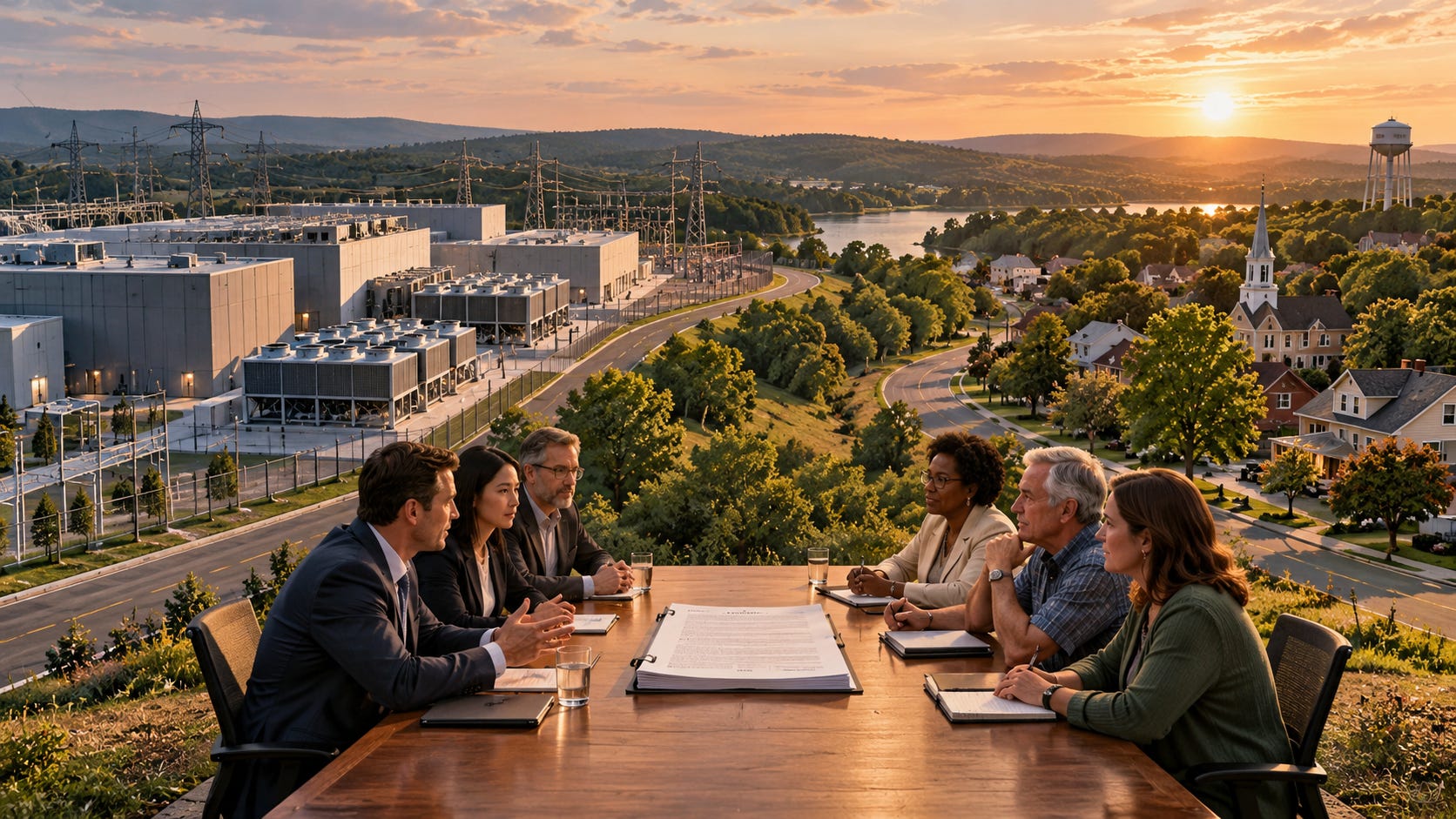
Source: ChatGPT suggested that it generate this image after doing my CBA research and reading my analysis
A large data center campus can bring billions of dollars of investment and a windfall of tax revenue. It can also use large quantities of electricity and perhaps water, run banks of backup generators, hum continuously, and change the character of the place around it. Communities have responded with zoning, environmental rules, utility regulation, taxes, and sometimes outright opposition.
Increasingly, they also bargain, negotiating agreements in which the developer accepts obligations meant to benefit the host community. Some carry the formal name Community Benefits Agreements (CBAs); others appear as development, infrastructure, or annexation agreements, memoranda, or tax-incentive packages with similar economic structure. My inventory of U.S. data-center community-benefit arrangements contains 52 records as of October 4, 2026 (compiled using ChatGPT-6 Astra). Those records include proposals, superseded versions, and unresolved cases, plus non-CBA contracts with material community payments, environmental protections, or infrastructure commitments.
Community Benefits Agreements are Coasean Bargaining Agreements. Viewed through the work of Ronald Coase, a CBA is an institutional mechanism for Coasean bargaining, through which parties whose activities interfere with one another negotiate over scarce resources and the division of gains from development.
The reciprocal nature of the problem
Coase’s framework applies to any setting in which two parties have conflicting uses of a shared resource. A river can carry a factory’s effluent or sustain a downstream fishery; a radio frequency can carry one broadcaster’s signal or another’s; a quiet evening can belong to the neighbors or to the machinery next door. Once the law assigns a right over the contested use, that right becomes a tradable asset, giving each party a reason to reveal what the use is worth to it. If the party without the right values the use more highly than the rights holder does, it can offer a payment large enough to compensate the holder for giving it up, and both walk away better off. If the rights holder values the use more highly, no acceptable offer exists, and the right stays where it started. In Coase’s own example, a rancher whose straying cattle trample a neighbor’s crops either pays the farmer for the damage or receives payment from the farmer to keep the herd smaller, depending on who holds the right. Either way, the herd ends up the same size. Bargaining moves each contested use toward whoever values it most, and the legal assignment decides only who pays whom.
Real bargains rarely run so smoothly. Coase devoted most of “The Problem of Social Cost” (1960) to the frictions that impede them: incomplete rights, asymmetric information, and affected parties who cannot simply sit down together and strike a deal. Finding counterparties, learning what each values, negotiating, and enforcing promises all cost something, and those transaction costs can decide whether a mutually advantageous deal happens at all. His deeper point was institutional: markets, courts, firms, regulation, and contracts each carry costs, so analysis should compare imperfect alternatives with one another instead of comparing reality with an imaginary costless ideal.
Data centers provide a concrete application of this idea. Suppose a proposed facility generates considerable value but creates noise for neighboring homes. The obvious framing treats noise as a cost the developer imposes. Coase looks one step deeper, treating quiet and data-center operation as competing uses of the same environment. Stricter noise limits benefit neighbors while raising the cost of cooling equipment, backup generation, or site design; looser limits lower those costs while shifting the burden to neighbors. The problem is reciprocal: users of a scarce common-pool resource whose uses of it conflict are imposing costs on each other. The question Coase posed is: Which institutional arrangement/assignment of rights generates the greatest joint value, and do institutions exist that let the parties discover it? The same logic applies to the other purported local effects of data centers: water, emissions, traffic, and electricity affordability.

What is being traded?
A data center bargain is more complicated than Coase’s example of a rancher buying the right to let cattle stray across a farmer’s field. The project sits inside a web of property rights, zoning, nuisance law, environmental and utility regulation, and political discretion. The developer wants construction permission, infrastructure, speed, and predictability. The community wants quieter operation, lower water use, pollution protection, jobs, investment, and compensation for hosting. Those divergent wants create room for exchange.
Lancaster, Pennsylvania offers a clear example. Its CBA for the Chirisa AI Hub (draft, not executed) includes a proposed $10 million economic-development fund and a separate $10 million sustainable-development and clean-energy fund, plus a 20,000-gallon-per-day water limit for each campus, noise testing and low-noise equipment, generator testing and emissions limits, and local-workforce provisions.
The breadth of that package reveals two functions that often coexist in a CBA. Some provisions mitigate identifiable external effects: a water limit constrains resource use, a noise standard changes operating behavior, and generator restrictions reduce local pollution. Other provisions divide the surplus from development, and a community fund, school payment, or workforce grant does not have to match any particular harm dollar for dollar. Both are negotiable, but it’s useful to separate externality mitigation from surplus sharing instead of counting every dollar as the same kind of benefit.
Creating a counterparty
A developer can bargain with one landowner, but it can’t bargain separately with thousands of residents affected in different ways by noise, water use, traffic, and changes in the tax base.
A CBA’s most important institutional function may therefore be creating a codified counterparty. A city, county, neighborhood coalition, nonprofit, or some combination aggregates many affected interests into one negotiating entity, replacing thousands of potential bargains with a single agreement. The agreement also translates vague objections into contractible terms. “Too much water” becomes a daily withdrawal limit. “Too much noise” becomes a measurement standard, testing protocol, and operating restriction.
Festus, Missouri shows how extensive that bundling can become. The approved framework for CRG’s proposed campus includes $40 million in community payments over ten years, noise mitigation and buffers, Tier IV generator specifications, infrastructure commitments, and possible fire-station support. The water provisions are not yet approved.
Lowering transaction costs
CBAs look most Coasean in how they address the classic transaction costs. Information is asymmetric and information costs are high; the developer knows far more about cooling technology, generator operations, water use, and construction schedules, while residents know far more about which impacts they value most. Reporting, monitoring, independent testing, and disclosure narrow that gap. Bargaining costs fall when parties set rules in advance. Enforcement costs determine whether a promise means anything at all. A pledge to “support sustainability” means little if nobody can tell whether it was kept.
Lancaster stands out on enforcement. Its framework couples substantive obligations with a public project and complaint website, annual energy reporting, letters of credit, notice-and-cure procedures, judicial enforcement, and successor requirements. Pima County, Arizona’s Project Blue memorandum, by contrast, provides $15 million in phased educational and community support and annual verification of a renewable-energy undertaking, yet backs that undertaking only with meet-and-confer procedures, a corrective plan, and nonbinding mediation, offering neither damages nor specific performance. Calling both arrangements “community benefits” conceals the material difference: who can verify a promise, who can enforce it, and what happens when performance falls short.
When bargaining becomes rent extraction
An agreement’s existence does not establish its desirability. Bargaining can also redistribute rents, privilege organized interests, and invite strategic holdup.
Representation comes first. Local officials’ electoral and fiscal incentives may diverge from those of nearby residents, and a community fund can flow to visible organizations while the households bearing noise and traffic receive little. Liberty, Missouri’s Metrobloks CBA contemplates $27.75 million in developer and tenant contributions over 25 years to the Liberty Institute for Science and Ethics, with annual reporting, but as summarized in my inventory it gives residents no independent enforcement rights. That gap shows how “the community bargained” can hide a principal-agent problem in which the negotiators, the beneficiaries, and the people bearing the costs are three different groups.
The initial allocation of rights matters too, because Coase always held that it determines who pays whom. Compare two otherwise identical projects. In one, zoning clearly permits a data center and the developer needs little discretionary approval; in the other, the city can withhold rezoning, infrastructure access, or another indispensable approval. The public holds far more leverage in the second case. A “community benefit” might then reflect the value of a legal entitlement held by the public, the compensation residents require to accept an external cost, or the scarcity value of political permission, and those three differ economically.
Holdup poses the harder case. Developers sink large relationship-specific investments in land, engineering, interconnection studies, and permitting long before a facility opens. Once enough of those costs are sunk and not redeployable, moving becomes expensive, and a government that can introduce new discretionary demands late in the process can capture part of the developer’s quasi-rent. Anticipating that capture, firms invest less in the first place.
Three tests help separate exchange from extraction. Nexus asks how closely a concession relates to the project. Noise monitoring for a noisy facility and water investment for a thirsty one clearly qualify, while unrelated demands look increasingly like rent extraction. Proportionality asks whether the size of a concession bears a defensible relationship to the burden mitigated or the entitlement exchanged. Timing and predictability ask whether bargaining occurs before irreversible investment under rules known in advance, or after a developer is locked into a site.
The risk runs both ways. Developers pit jurisdictions against one another for tax abatements, infrastructure subsidies, and other incentives, and a $20 million community contribution means little if the same package returns far more to the company. Cedar Rapids makes the point visible. Its executed QTS agreement pairs qualifying-job requirements and a Community Betterment Fund of up to $18 million with performance-based property-tax rebates; its Google agreement pairs a Community Betterment Fund of up to $36 million with a 20-year property-tax exemption, an electricity-franchise-fee rebate, and other incentives. Both may create substantial gains for each side, but the relevant object is the net negotiated package: what each side gives and receives, which risks shift between them, and what would have happened without the agreement.
A jurisdiction that extracts a large CBA sets an example its neighbors may imitate by manufacturing new discretionary checkpoints at which to demand concessions. A bigger transfer on one project can mean less investment and higher political transaction costs across many future ones. Coase’s comparative institutionalism cuts both ways, with transaction costs justifying institutions that facilitate bargaining and those same institutions generating their own transaction costs and rent-seeking.
Designing better bargains
What institutional design makes CBAs useful? A strong agreement makes clear who represents affected interests and how those representatives are chosen. It distinguishes mitigation of identifiable harms from broader surplus sharing. Its obligations are measurable, its monitoring and reporting specified in advance, its enforcement rights and remedies clear, and its commitments binding on successor owners. Transparency should cover both sides of the bargain, showing community payments alongside the tax abatements and infrastructure support negotiated with them.
Some standardization would help. Model provisions for monitoring, reporting, successor liability, and enforcement would spare each jurisdiction the cost of reinventing the agreement while preserving room for local variation. Clear rules announced before developers make site-specific investments would also shrink the opportunity for holdup. Good institutions make bargaining cheaper, more transparent, and more credible.
Building the bargaining table
CBAs occupy a space between conventional regulation and ordinary market exchange. Government often establishes the bargaining positions and may sit on one side of the table, yet the final package emerges through negotiation. That structure makes CBAs Coasean in Coase’s own sense: affected parties are numerous, rights are incomplete, information is asymmetric, representation is imperfect, and enforcement is costly. Bargaining in that world can create joint gains, divide legitimate surplus, or capture rents, and the test of any CBA is whether it reduces those frictions enough to reveal otherwise unavailable bargains without opening larger opportunities for holdup.
The data center and its neighbors will affect one another regardless. A well-designed CBA governs that interdependence by building the table at which bargaining occurs, with rules that keep the table from becoming a tollbooth.
Acknowledgements
This post emerged out of a conversation I had over the weekend at the Institute for Regulatory Law & Economics Annual Workshop for Regulators. Thank you, you know who you are :-).

Lynne. this is really, really, really good stuff.
Two things in particular stand out: first, not needing to reinvent the wheel. What was negotiated concluded as satisfactory in Cedar Rapids and Lancaster? These are first-rate counterparties (as is Google).
Second, you spell out everything that has to be kept in mind. There is not a recipe, but there is a process. I was not surprised to read at the end that your context was a conference for regulators.
The content is both practical and comprehensive. It is excellent. It strongly aligns with my 20 years of experience in siting energy projects in communities.
Thank you for sharing.
Lynne, I think you missed the most important aspect I think Coase would recognize. Who holds the right to the data? It is an unassigned right. I did a video explaining this titled Theft Without A Thief. And that cost falls on everyone whose data was taken from them. Which is everyone.