
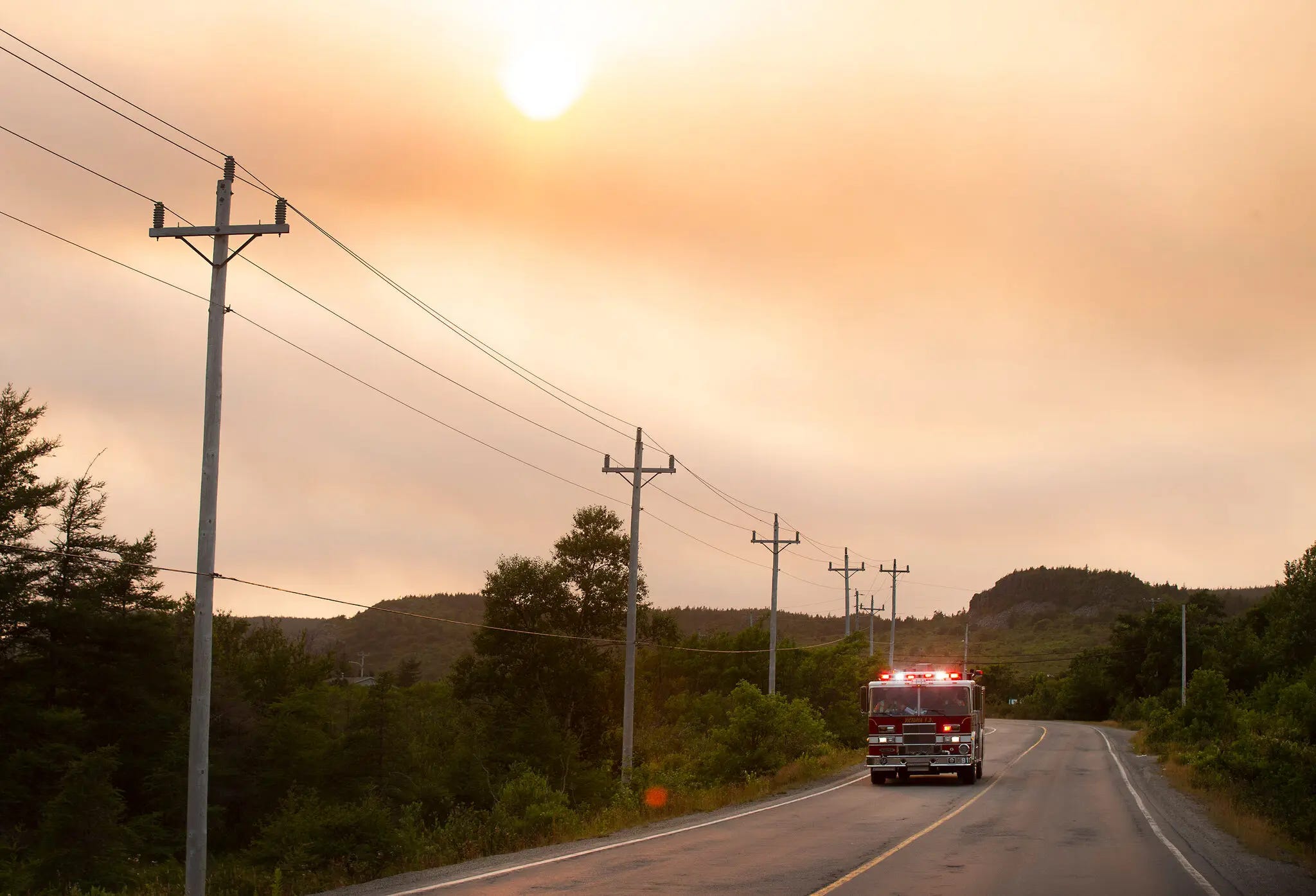
Source: Canada’s Wildfire Season is One of Its Worst Ever, and It’s Not Over Yet, New York Times, August 13, 2025
Active Wildfire Season in Canada
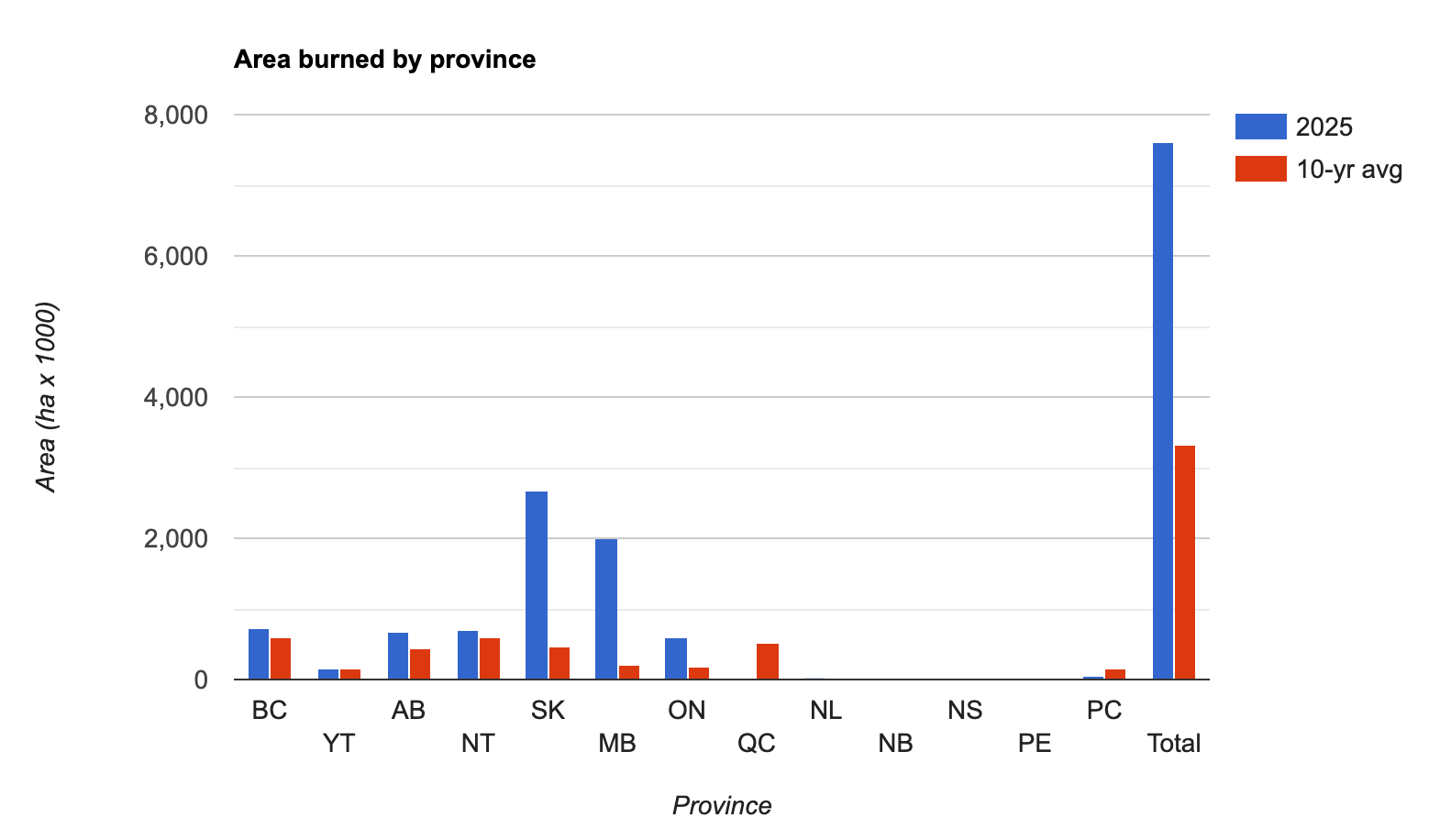
The summer of 2025 has been another harrowing season for wildfires in Canada, testing the country’s landscapes and communities and also its firefighting capacity and institutional resilience (and has had my eyes burning frequently this summer). By late August, official reports tallied more than 4,600 fires burning across the nation, with over 7.6 million hectares burned, an area more than twice the seasonal average and second only to the record-breaking devastation of 2023. Wildfires are no longer episodic disasters contained to a bad week in July, but sustained national phenomena extending over months, requiring coordinated responses across provinces, international partners, and federal resources.
The epicenter of the 2025 season has been the Canadian Prairies, particularly Saskatchewan and Manitoba. Together they account for the majority of the area burned this year. By early August, NASA satellites were tracking nearly 160 active fires in Manitoba and more than 80 in Saskatchewan, many designated “out of control”. At their height, these blazes forced evacuations, closed highways, and stretched provincial firefighting agencies to their limits. Large complexes also flared in northeast British Columbia, in the Northwest Territories, and in northern Ontario, and in mid-August activity surged unexpectedly in the Atlantic provinces.
Source: National Wildland Fire Situation Report Weekly Graphs
Timing matters as much as geography. The season began to intensify in mid-May, with the first wave of evacuations occurring by the end of that month in Saskatchewan and Manitoba. Weekly data from Natural Resources Canada show major spikes in burned area in late May and June, followed by renewed flare-ups in July and again in August. This rhythm reveals the underlying challenge: even as some fires are brought under control, hot, dry weather reignites activity elsewhere, ensuring that firefighting resources remain under maximum pressure for weeks on end. Federal agencies have already cautioned that conditions across southern British Columbia, Alberta, and Saskatchewan could sustain burning into the fall, meaning the 2025 season is not yet over.
The Firefighting Effort
If the scale of fire has been daunting, the scale of firefighting has been equally striking. By late August, Canada had extinguished approximately 4,300 of the 4,600 fires recorded this year, an impressive 94 percent success rate in numerical terms, though not in hectares saved. The arithmetic is straightforward: out of thousands of ignitions, only about 280 remained active in mid-August, divided among categories from uncontrolled to under modified response. This ratio reveals both the intensity of the effort and the limits of what “success” means in the face of massive fires that defy suppression and must be left to burn in remote areas.
Fighting on this scale has required mobilization at the national and international level. Canada’s National Preparedness Level was raised to the maximum, triggering full coordination through the Canadian Interagency Forest Fire Centre. Hundreds of firefighters and dozens of aircraft have been shuffled each week across provinces, depending on where the greatest need emerged. International aid has been essential: more than six hundred U.S. firefighters deployed north of the border, supplemented by contingents from Australia and New Zealand.
On May 31, the U.S. Department of Agriculture announced that the Forest Service had deployed an air tanker to Alberta and was mobilizing over 150 firefighters and support personnel, along with sprinkler kits, pumps, and hose packages. By mid-July, the National Interagency Fire Center (NIFC) reported that the United States had mobilized one air tanker, twenty 20-person hand crews, five complex incident management teams, and 214 overhead personnel drawn across the federal wildland agencies (Bureau of Indian Affairs, Bureau of Land Management, U.S. Fish & Wildlife Service, National Park Service, and U.S. Forest Service). Oregon and Washington also sent firefighters and resources under the Northwest Compact, a standing legal framework that lets five western U.S. states and several western Canadian provinces move people and equipment across the border quickly when activity spikes.
The Smoke
These fires have generated smoke. A lot of smoke. Wildfire smoke presents serious respiratory health risks due to poor air quality from particulate matter (PM 2.5), as well as creating an aesthetically unappealing orangey haze. Eyes smart, people stay indoors and have to change outdoor plans, and may even buy air filters to keep the PM2.5 out of their homes and offices.
The geography of smoke largely mirrors 2025’s fire map: the Prairies and boreal interior produced the dominant plumes, with repeated south- and east-flow events that degraded air quality across central and eastern Canada and much of the U.S. Midwest and Northeast during late July and, especially, Aug 2–8. NASA’s Earth Observatory flagged a continent-scale smoke shield on Aug 5, noting that parts of multiple provinces were under air-quality warnings and that some sites hit the AQHI “10+” very-high-risk threshold.
In the US in particular, July and August have seen regional smoke plumes earlier in the summer in the Rockies and Plains and both months have seen frequent low air quality days due to smoke (a data point: I was in Grand Haven, Michigan for a long weekend in mid-July, and the air quality was very poor). A prolonged smoke pulse affected the Upper Midwest and Great Lakes Aug 2–6; the National Weather Service and local outlets issued Air Quality Alerts for Minnesota, Wisconsin, Michigan, Illinois, Indiana, Ohio, Pennsylvania, New York, and New England states, with PM2.5 the driver. In that window, Chicago and Northwest Indiana spent multiple periods in “Unhealthy for Sensitive Groups” (USG) on the U.S. AQI scale; Detroit registered AQI values >150 at times (i.e., Unhealthy) and, by Aug 5, ranked 5th most polluted major city globally in IQAir’s live table. Minnesota forecasters explicitly tied the weekend of Aug 2–3 haze and poor air to Canadian smoke, and NOAA’s drought/wildfire situational dashboard noted smoky skies extending into the Northeast through mid-August. Repeated smoke intrusions have nudged the calendar count of low air quality days higher than typical recent years.
Coase: The Problem of Social Cost
To get to the economics of this situation, let's focus on two facts: (1) the smoke that the wildfires produce is harming people in the US, and (2) the US is contributing some personnel and resources to firefighting. To me this sounds like a textbook example of Ronald Coase's argument in The Problem of Social Cost (1960).
A refresher on Coase's argument (one of the main reasons he was awarded the Nobel Prize in 1991): Coase reframes externalities as institutional questions about how we delineate and trade rights to engage in harmful or beneficial actions. He begins with a simple point that sounds modest but is actually radical: harm is reciprocal. A rancher’s wandering cattle damage the farmer’s crops, but preventing the damage may require fencing the cattle or fencing the crops or reducing either party’s activity. This reciprocity means that asking “who causes the harm?” is less informative than asking “which assignment of rights yields the greatest value of production once all real-world frictions are counted?”
Property rights sit at the center of that inquiry. Rights define who may do what to whom, whether the rancher has the right to let cattle roam or the farmer has the right to be free from trespass. With property rights clearly specified and enforceable, parties can bargain over them. Coase’s most famous result follows (although this is really George Stigler's framing of "the Coase Theorem", not Coase's): if transaction costs are zero—no costs to identify counterparties, measure damages, negotiate, write, and enforce agreements—then parties will bargain to the efficient outcome regardless of the initial assignment of rights. A railway that throws sparks can either pay farmers to accept occasional fires or pay to install spark arrestors; if bargaining is costless, the efficient mix of precautions and production emerges whether the law initially favors the farmers or the railway. This proposition is an efficiency claim, not a fairness claim; the final distribution of wealth depends on who holds the initial right.
The world, of course, does not operate with zero transaction costs. Coase’s deeper contribution is to direct attention to transaction costs and to the comparative performance of legal rules when bargaining is costly or impossible. This analysis emphasizes information problems, holdout risks with many affected parties, the expense of litigation, and the difficulty of monitoring behavior over time. When transaction costs are positive, the law’s assignment of liability will shape outcomes, because it changes who must initiate deals, who can refuse them credibly, and which remedies are feasible. Courts and legislators should therefore choose liability rules—property rights, nuisance standards, damages, injunctions—that minimize the total social cost: the foregone gains from trade plus the cost of avoiding, transacting over, and adjudicating harms.
The practical implications are subtle but revolutionary. First, define and enforce property rights as clearly as possible to lower bargaining costs. Second, recognize that where rights are diffuse and parties are many, bargaining will break down; in such settings, the legal system’s choice of liability and remedy is not neutral and should be evaluated by its effect on the value of production net of all transaction costs. Third, remember that efficiency does not settle distributional concerns; the initial assignment determines who pays and who must be paid.
This framework turns externality disputes into institutional design problems. The goal is not to punish a “polluter” in the abstract, but to select and enforce rights in ways that, given the frictions at hand, enable the least-cost accommodation of competing uses.

Is There a Coasean Bargain Here?
Coase gives us a theoretical framework for thinking about cross-border wildfire smoke: start with rights, then ask what bargains are feasible once we confront real transaction costs. The two relevant facts I highlighted—US residents suffer measurable harm from Canadian smoke, and US agencies send people and equipment to help Canada fight fires—are two sides of a Coasean problem in which the harm is reciprocal and the efficient adjustment could occur on either side of the border.
Do US residents have a “right” to clean air against Canada? In Coase’s terms, that question is shorthand for how the entitlement is defined across jurisdictions. Within the US, statutes and regulations create actionable interests against domestic emitters. Across borders, there is no simple, enforceable property right that lets American residents compel Canada to suppress naturally ignited fires or compensate for smoke. That absence does not mean the harm is trivial; it means the law does not assign liability in a way that invites straightforward litigation and damages. Coase would say: treat the entitlement as a policy choice and ask which assignment—Canada free to let remote fires burn under modified response, or the U.S. entitled to be free from transboundary smoke—minimizes the total social cost once negotiating, monitoring, and enforcement are included.
This framing forces us to recognize reciprocity. Preventing smoke in Michigan by suppressing a remote Saskatchewan complex may require costly aviation, difficult fire line construction, and exposure of crews to risk, with uncertain odds under extreme weather. Preventing health harm in Detroit may also be achieved, at least in part, by US actions: high-efficiency filtration in schools and homes, clean-air shelters on poor-air days, better targeting of public advisories, and flexible work/school schedules during peaks. Coase’s insight is not that one side “causes” the harm and must pay, but that we should implement the lower-cost mix of precautions on both sides, given the frictions.
Should Canada expend more resources to fight fires earlier and faster? Coase would resist answering in the abstract because the answer depends on marginal costs and marginal benefits at the time decisions are made. For some ignitions, earlier, heavier initial attack (IA) is cheap relative to the smoke damages avoided downstream; for others, fuels, topography, and weather make early success unlikely and expensive. Canada’s modified-response doctrine already encodes a kind of Coasean triage: concentrate on fires where suppression has a high probability of success and high values at risk, and tolerate free-burn in remote areas with higher risk to firefighting crews. If the US values reduced smoke highly and Canada faces binding resource constraints, a Coasean bargain would tilt some of that triage toward earlier, more aggressive IA on smoke-relevant fires. The key is targeting: paying for “more suppression” in general may buy little reduction in US exposures, while paying for time-critical IA on a few upwind, high-potential events could be a very cost-effective strategy.
Are U.S. deployments a payment to reduce harm at home? In Coasean terms they are an in-kind side payment. The United States supplies hand crews, incident management, and aircraft under reciprocal agreements not because it owes legal damages, but because adding capacity where it is most productive can reduce expected smoke damages that would otherwise be borne by US residents. The transaction is attractive because the institutional framework (the pre-negotiated operating plans, border-crossing protocols, interoperable command systems) reduces bargaining and enforcement costs. This is precisely Coase’s point: when rights are murky or diffuse, design institutions that lower transaction costs so mutually beneficial trades can occur fast.
Should the US, as a large beneficiary of smoke reduction, “pay more” to put out fires sooner and faster? Coase offers a conditional yes: if (a) the US marginal benefit from avoided smoke exceeds (b) the Canadian marginal cost of additional, well-targeted suppression, and (c) we can contract in ways that secure real performance, then side payments are efficient. Three practical hurdles matter.
First, attribution and measurement of costs and benefits are hard. This problem undermines Pigouvian neatness and Coasean bargaining alike. Policymakers need to know which fires are driving near-surface PM2.5 in specific US metros and how much earlier attack would have changed the plume. Without credible ex ante smoke-impact forecasts and ex post attribution, we end up paying for effort rather than outcome.
Second, scale and diffuse victims raise classic transaction-cost problems (much like the railroad-farmers example Coase uses). Millions of US residents suffer small to moderate health losses and changes to their daily lifestyles over many days; the beneficiaries are not a single counterparty who can bargain with a single provincial agency. We solve that by having the US federal government bargain on behalf of Americans and Canada’s federal/provincial system bargain on behalf of Canadians. That is already happening, but making side payments larger requires tighter formulas and governance to prevent free riding and moral hazard. That bargain will also never be perfect because of problems of scale and diffusion.
Third, intertemporal trade-offs are real. This season’s aggressive suppression may reduce today’s smoke but can increase fuels and the severity of future fires if not paired with fuels management and prescribed fire. A narrowly framed “pay more to put out fires sooner” risks creating a suppression trap. Coase would push us to compare a full menu of adjustments: more preseason prevention (cross-border detection, fuels work near likely export corridors), smarter IA on smoke-critical starts, and US investments that cut exposure (HVAC upgrades, filtration programs, etc.). The efficient portfolio almost certainly blends Canadian and US actions.
What does a Coasean policy package look like in practice? Assign the de facto right in a way that keeps bargaining simple, then lower transaction costs around targeted trades. Concretely, federal-to-federal agreements could create a pre-season “smoke contingency” fund the U.S. can trigger when models predict cross-border exposure above thresholds in designated U.S. airsheds. Triggers could authorize surge IA resources for specific Canadian fires upwind of those airsheds, with payment formulas tied to verifiable inputs (crew days, aircraft hours) and, where possible, outcome proxies (reductions in forecast near-surface PM2.5). Parallel investments on the US side, particularly in filtration technologies, should continue to occur, because sometimes the least-cost adjustment is on the receptor side. On smoky days I'm glad I paid for a HEPA filter, although I still incur the cost of having to do my workout indoors.
The right question is not whether Canada should always do more suppression or whether the U.S. should always pay more, but where the next dollar, whether spent on Canadian IA, Canadian fuels work, or U.S. exposure reduction, buys the largest reduction in total social cost once we count negotiation, verification, and future-fire consequences. Coase would tell us to build institutions that let that dollar find its best use quickly.
If you like this kind of Coasean analysis and want to get more familiar with his work, I wrote The Essential Ronald Coase in the Fraser Institute's Essential Scholars series. I hope it whets your appetite to apply Coase in your own thinking!
I would like to see technologies developed for more efficient fire fighting. I think the Initial Attack phase, in particular, has great potential for improvement. Excellent early detection coupled with development of fully autonomous aircraft with near instant reaction times could get more flame retardant delivered when the fires are much smaller. If the aircraft could do automatic refilling with water it would be even better.
I also wonder whether cutting of forest corridors by allowing zero tariff imports of the trees felled in those corridors would provide sufficient incentives for bigger corridors.
Interesting analysis. Not to distract from your core Coasean concepts, but air flows in many directions laden with smoke, various particles or rain. Washington forrest fire smoke tends to flow into BC. It's a global recognition of the value in sharing fire-fighting resources internationally. Canada frequently has fire fighters from Mexico and other countries as well. As every country resides on this planet it's likely why various countries have recognized the merits of prevention through internationally accepted Policy initiatives. But, politically this prevention commitment appears to be slipping. So, analyzing impact/action through an economic lens may be the best way to engage?