
NOTE: This is a longer read than what I usually write, so if you are a subscriber (thank you!), the email will probably truncate it and you’ll want to read on the app or website to get the whole thing.
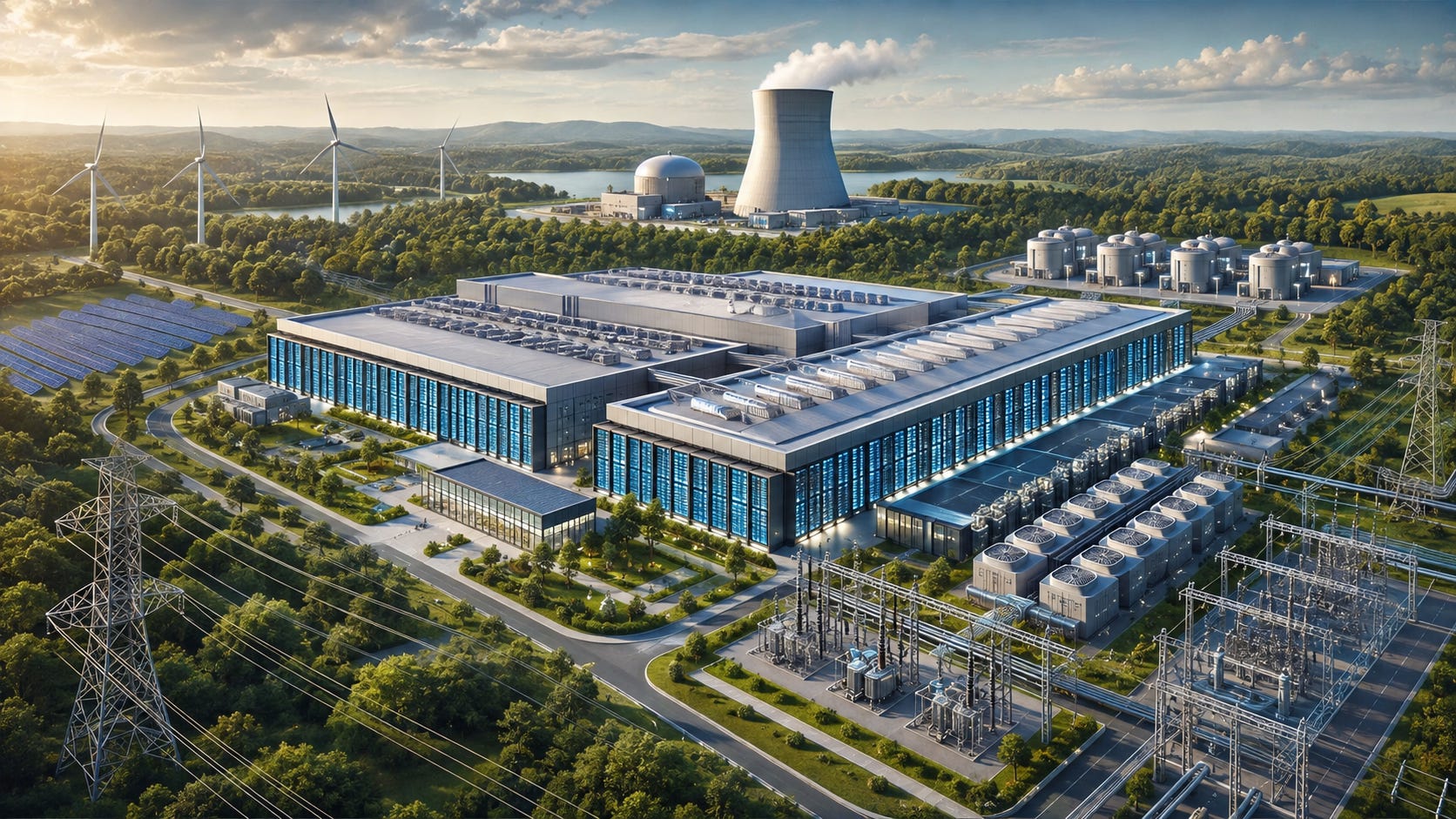
Source: I asked ChatGPT to update the image it generated two years ago and this is what it did. I love the technological diversity represented here, and I love a good, big transmission substation!
Two years ago today, I published “Data Center Electricity Use III: Make or Buy?,” applying transaction cost economics to a question then just emerging: how would data-center developers respond if electricity became more expensive, less reliable, or too slow to obtain through ordinary utility processes?

AI and cloud computing were driving electricity-demand forecasts upward. Grid operators and utilities were warning of generation shortages, transmission constraints, and long interconnection queues. Data centers could keep buying electricity conventionally, or pursue alternatives: long-term contracts with individual generators, co-location with nuclear plants, or on-site generation of their own.
The question was where firms would draw the boundary between purchasing electricity through markets and tariffs and exerting direct control over its production.
My conclusion was deliberately Coasean: “the answer to the make or buy question is ‘it depends.’” The choice would turn on price, but also on uncertainty, contracting costs, asset specificity, the value of reliability, and the managerial difficulty of producing power internally.
A great deal has happened since then. Microsoft has backed the restart of a retired nuclear plant. Meta has signed a twenty-year agreement to keep another running. Google and Amazon have become sponsors of advanced nuclear technology. Developers have proposed gigawatts of dedicated natural gas generation. Federal regulators have spent two years working out how data centers may connect directly to power plants without shifting costs unfairly onto other customers.
The evidence supports my original hypothesis and refines it. Data centers are not simply choosing between buying from a utility and owning power plants. They are building a spectrum of organizational forms on a continuum between those poles. The decision may be better described as make, buy, or ally.
The cost of electricity now includes the opportunity cost of waiting
Data centers carry an unusual economic feature: an enormous opportunity cost of delayed service.
A completed data center embodies billions of dollars in land, buildings, cooling systems, and servers. Until it receives electricity, that capital produces no revenue. A two- or three-year delay is more than an inconvenience; it can be the largest cost in the entire project. The relative magnitude of opportunity cost changes what counts as economical power.
A generation arrangement that looks expensive in dollars per megawatt-hour may prove attractive if it brings a facility online years earlier. Conversely, nominally cheap grid power may prove extremely costly if it requires waiting through successive rounds of transmission upgrades, substation construction, and regulatory approval.
This is why “time to power” has become central to data-center development, and why comparing grid service to self-supply cannot reduce to levelized cost alone.
In the original article, I wrote: “Technological change will shift the margin between buy and make.” Institutional change shifts that margin too, alongside interconnection delays, permitting risk, transmission shortages, rate uncertainty, and disputes over who pays for grid expansion. As the cost of waiting rises, firms pay more to control the timing of their supply.
Nuclear contracts moved data centers toward quasi-integration
One visible response has been a new set of long-term nuclear agreements.
In September 2024, Microsoft and Constellation announced a twenty-year power purchase agreement supporting the restart of Three Mile Island Unit 1, now the Crane Clean Energy Center. The 837-megawatt reactor closed in 2019 for economic reasons; Constellation now expects to return it to service, subject to federal approval, with Microsoft purchasing power for its PJM-region data centers. Constellation’s announcement is here.
Microsoft did not buy the plant, and it will not operate the reactor, so it’s not vertical integration. Yet this is no ordinary arm’s-length purchase. The commitment of a large, creditworthy customer makes restoring the plant financeable, giving Microsoft the economic role of anchor investor while leaving nuclear operations to a company with the requisite expertise. It gains predictability and control without becoming a regulated utility.
Meta adopted a related arrangement in June 2025, signing a twenty-year agreement with Constellation for the output of the 1,121-megawatt Clinton Clean Energy Center in Illinois. The contract supports the plant’s continued operation after state subsidies expire, its relicensing, and a planned increase in output. Constellation describes the agreement here.
The two transactions differ in detail—one restarts a retired plant, the other retains an operating one—but share an organizational logic. The technology company makes a long-duration commitment tied to a specific asset; the generator gains the revenue certainty needed for a highly specific investment; ownership and operation stay with the energy company, while the data-center company gains a more dependable claim on future output.
Oliver Williamson called arrangements of this kind hybrid governance structures, lying between anonymous market exchange and complete vertical integration and retaining specialized capabilities while using long-term contracts to coordinate investment and limit opportunism. That characterization describes the nuclear agreements well: data centers have not integrated upstream by acquiring plants, but they have integrated contractually in the way that Klein, Crawford, and Alchian (1978) theorized.
Co-location exposed the regulatory complexity of “buying” directly
Co-location offers a still closer relationship between computing and generation.
Amazon’s arrangement involving the Susquehanna nuclear plant in Pennsylvania became the most prominent example. The appeal was clear: place a large data center beside an existing generator and serve much of the load directly, avoiding the wait for new grid infrastructure.
But transactions that look physically simple can be institutionally complicated. A data center beside a power plant may still depend on the regional transmission system during outages; the generator remains synchronized to the wider grid; the arrangement may draw on grid services for frequency control, reserves, and black start. Regulators must therefore determine how much transmission service the data center actually uses, which costs it avoids, and whether those avoided charges shift onto other customers.
FERC rejected the amended interconnection agreement tied to the proposed expansion in November 2024, then opened a broader proceeding in February 2025 to examine whether PJM’s rules adequately addressed co-located loads. In December 2025, FERC ordered PJM to develop transparent rates and rules for data centers and other large loads sited beside generators. FERC’s summary of the December order is here.
The resulting framework recognizes that a controllable co-located load may need less transmission service than a conventional customer. A 1,000-megawatt data center served by a 900-megawatt adjacent generator, for example, might contract for only 100 megawatts of firm transmission service; PJM would plan and procure capacity for that smaller grid withdrawal rather than the facility’s full load, with the data center bearing curtailment risk if it draws more than it purchased. FERC Commissioner David Rosner explains the framework here.
This hybrid contractual arrangement is a promising attempt to align charges with actual use while still letting data centers bring their own generation. Yet the dispute confirms the transaction-cost argument: connecting a private wire between a reactor and a server farm is the easy part. Defining withdrawal rights, outage obligations, reliability-service responsibility, and transmission cost allocation is the hard part.
FERC Commissioner Judy Chang raised another important point: a co-located generator and data center are not truly independent of the grid unless electrically islanded. Even facilities drawing little energy from the transmission system benefit from being synchronized with it, which is why she argued for a minimum charge reflecting that dependence. Her concurrence is here. “Behind the meter” is not the same as “outside the system”.
Hyperscalers became sponsors of advanced nuclear technology
The past two years have also moved small modular reactors from the margins of discussion toward commercial contracting.
In October 2024, Google announced an agreement with Kairos Power to support multiple advanced reactors, the first intended for service around 2030, with additional projects through 2035 totaling as much as 500 megawatts. Google’s announcement is here.
Amazon announced several advanced nuclear agreements that same month. Its arrangement with Energy Northwest contemplates an initial four-reactor project of roughly 320 megawatts, expandable to 960, and Amazon also invested in X-energy, whose reactor design the project would use, describing a broader ambition to support more than five gigawatts of new SMR capacity by 2039. Amazon’s project description is here.
These projects remain prospective; they do not show that every data center will arrive with a reactor in the parking lot. They do show that large technology firms are becoming active participants in generation innovation, acting not only as future consumers but as technology sponsors, project enablers, equity investors, and anchor customers—a role economically significant even when the hyperscaler never owns or operates the completed reactor.
Advanced energy technologies face a familiar commercialization problem: early projects are expensive and uncertain, but costs may fall through repeated construction, learning, and supply-chain development, and a long-term commitment from a large buyer can bridge the gap between a promising technology and a financeable project. Here again, the arrangement sits between make and buy. The hyperscaler does not simply select a product from a competitive market; it helps create the future supply it expects to purchase.
Natural gas became the fastest near-term “make” option
Advanced nuclear power may matter during the 2030s. Data-center developers need electricity sooner, which makes natural gas an attractive near-term option despite its emissions and fuel-price risks.
In January 2025, Chevron, Engine No. 1, and GE Vernova announced plans for as much as four gigawatts of natural-gas generation for U.S. data centers. The initial projects were designed to operate outside the existing transmission grid, with the possibility of supplying surplus electricity to it later, targeting service by the end of 2027. Chevron’s announcement is here.
The partnership illustrates the growing importance of alliances. Chevron contributes fuel and energy-market capabilities; GE Vernova supplies turbines and generation technology; Engine No. 1 contributes investment and project-development expertise; data-center customers provide concentrated, long-term demand. No single participant must build every capability internally, yet the arrangement coordinates fuel, equipment, capital, construction, and demand more tightly than conventional utility procurement would.
Some companies have gone further. xAI deployed mobile natural-gas turbines to speed development of its Colossus computing facility in Memphis, demonstrating how on-site generation can compress schedules—and demonstrating that self-supply does not eliminate regulation. The project generated disputes over air permits, emissions, and effects on surrounding communities.
This experience qualifies the make-or-buy framework in an essential way. Vertical integration can reduce dependence on utilities and transmission planners, but it moves other costs and risks inside the project boundary. A company producing its own electricity must confront fuel logistics, emissions regulation, equipment maintenance, land-use politics, and environmental liability. There is no regulatory-free electricity (not even Customer Regulated Electricity is fully regulatory free!).
Utilities are redesigning the “buy” option
The movement toward dedicated generation does not mean ordinary utility service will disappear. Utilities and state regulators are instead changing the terms under which large data centers can buy power.
Ohio offers a prominent example. In July 2025, the Public Utilities Commission of Ohio directed AEP Ohio to establish a data-center-specific tariff as part of lifting restrictions on new connections. The structure requires stronger financial commitments from large customers, reducing the risk that other ratepayers absorb the cost of infrastructure built for projects later delayed, downsized, or abandoned. The commission’s announcement is here.
These provisions respond to a genuine planning problem. A utility may field requests for several enormous connections, each requiring new substations, transmission upgrades, or generation, while developers apply at multiple sites intending to build only one, or revise plans as technology and capital markets shift. Treating every request as certain risks overbuilding; passing the cost of unused infrastructure automatically into ordinary rates shifts speculative risk onto residential and small-business customers.
Minimum bills, collateral requirements, exit fees, take-or-pay clauses, and enforceable ramp schedules place more of that risk on the customer requesting the investment. In transaction-cost terms, these tariffs redesign the buy option: utility service remains available, but it is becoming more contractual, giving the customer a path to large-scale service while giving the utility greater confidence that the investment will be used and paid for. This is not the disappearance of the regulated utility model—it is that model adapting to a new class of customer.
From make or buy to a continuum of contractually-defined control rights
The developments since August 2024 show that the make-or-buy choice is not binary. Data centers now obtain electricity through several increasingly integrated arrangements:
Ordinary utility service. The data center pays the applicable tariff and depends primarily on the utility and regional grid.
Specialized large-load service. The customer remains utility-supplied but accepts minimum bills, collateral requirements, exit charges, or other long-term obligations.
Long-term power contracts. The customer purchases electricity or environmental attributes under a multiyear agreement supporting a particular generator or portfolio.
Asset-specific nuclear agreements. A technology company’s commitment enables the restart, continued operation, uprating, or relicensing of a particular plant.
Co-location. A data center locates near a generator and contracts for much of its electricity directly while retaining limited grid access.
Joint development. Technology companies, utilities, equipment manufacturers, fuel suppliers, and investors coordinate the construction of new generation.
Behind-the-meter self-supply. The data center develops or controls generation on or near its site, using the grid only for supplementary or backup service.
These arrangements allocate control differently. Who decides which generation gets built? Who bears construction and fuel-price risk? Who operates the equipment and controls the schedule? Who pays if the data center never materializes, or when the generator is unavailable, or for the grid services that remain necessary regardless?
The clearest emerging pattern: data-center companies increasingly seek control over investment, financing, and timing without seeking operational control. Microsoft need not employ nuclear operators to influence whether a plant restarts. Google need not manufacture reactors to accelerate an advanced design. A hyperscaler can sponsor a dedicated gas plant without maintaining the turbines itself. This is quasi-vertical integration: control without complete ownership.
Transaction cost economics holds up well
Two years of evidence reinforce the transaction-cost framework I used in my original article.
Electricity supply for data centers carries several features that make simple spot-market procurement difficult. The investments are highly specific: a substation, transmission line, reactor restart, or dedicated gas plant built for one cluster of data centers has less value if those customers disappear. The environment is uncertain, with future loads, prices, fuel costs, and regulatory rules all hard to forecast. The contracts are complex, addressing construction delays, outages, curtailment, transmission service, environmental attributes, credit risk, and cost allocation. And the consequences of failure are large: a data center without power is an extraordinarily expensive building full of idle machines.
Williamson showed that greater asset specificity, complexity, and uncertainty would push firms toward more coordinated governance than simple market exchange—exactly what we now observe. But coordinated governance need not mean bringing every activity inside one corporation. It can take the form of a twenty-year contract, a joint venture, a co-location agreement, a dedicated tariff, or a strategic investment in new technology. The boundary of the firm has grown more permeable and more varied, not irrelevant.
Three qualifications
The evidence supports the original analysis, with three qualifications.
First, complete upstream vertical integration remains unusual. The largest technology companies generally prefer working with utilities, independent power producers, reactor developers, turbine manufacturers, and fuel suppliers rather than becoming fully integrated electricity companies; specialized energy firms retain valuable capabilities.
Second, natural gas currently holds a substantial timing advantage over advanced nuclear power. The nuclear announcements matter, but many target operation during the 2030s, while gas generation can often deploy sooner—though turbine shortages, pipeline constraints, and air permitting may narrow that advantage.
Third, dedicated generation does not necessarily reduce total system costs. It may lower costs for the individual developer while shifting or creating costs elsewhere, requiring regulators to distinguish legitimate reductions in grid use from arrangements that let large customers avoid paying for services on which they still depend. That is why cost causation has become central to the co-location debate: data centers should not be charged for transmission facilities they do not need, nor should they receive reliability and synchronization services without paying an appropriate share.
Good rate design has to avoid both errors, and this is why cost allocation is the burgeoning frontier of regulatory economics.
“It depends” has acquired more detail
The central conclusion of the 2024 essay still holds: there is no single efficient electricity model for data centers.
A facility in a region with available generation and transmission capacity may rationally use conventional utility service. Another may sign a specialized tariff and commit to paying for new infrastructure. A hyperscaler seeking round-the-clock carbon-free energy may support an existing nuclear plant or an advanced reactor. A developer facing an acute time-to-power constraint may install natural-gas generation despite the environmental and commodity risks.
What has changed is our understanding of the variables behind “it depends,” which now include not only the price and reliability of electricity but also the cost of delaying operation, the availability of utility and transmission capacity, the credibility of the load forecast, the ability to finance generation with long-term contracts, the allocation of grid and reliability costs, the availability of turbines, pipelines, and nuclear components, the regulatory treatment of co-location, and the value a company places on controlling its own development schedule.
The electricity input has become too important, too constrained, and too closely tied to the timing of data-center investment to remain a routine procurement decision. Data centers are becoming active designers of the institutions, contracts, and technologies through which their electricity gets produced. The make-or-buy boundary has shifted toward greater contractually-enabled control. It has not shifted toward a single organizational form for implementing that control.
For the grid how to get realistic prices or information that is at least closer for to the realistic prices that would at least enable better regulatory decisions? I've watched the debate about cost shifting and I wonder if there are regulatory changes that can be made to make accurate costs more visible? The big data center build-out makes the problem seem more acute. But if we want to tackle it more smartly do regulators have enough information to do so? It seems very hard to say how much each power generator or power buyer benefits from the grid and how much they should pay or are willing to pay.
Also, we have grid owners who do not want to reconductor because they would rather build a new line for which they can get some guaranteed rate of return. So this is bigger than just data centers wanting to plug in. The way the grid is funded seems quite deficient. How to change the incentives so that the most cost effective grid updates get built? The pricing mechanisms would not even need to be perfectly accurate if they at least enabled more rapidly decisions and increased the total amount of CapEx possible to use to solve problems in shorter periods of time.
How to put in more market forces?
Lynne,
The part that does the most work here is the opportunity cost of waiting, and I think it is more general than the data-center case. Time to power is what you get when a scarce resource is rationed by queue rather than by price. The interconnection queue allocates by position, not by willingness to pay, so the value of moving up the line has to appear somewhere else. It appears as firms paying above levelized cost for arrangements that arrive sooner. That premium is the price of time the tariff was not allowed to charge. The whole spectrum you describe, from specialized tariffs through co-location to self-supply, can be read as firms buying their way out of a non-price rationing mechanism.
More broadly, the workarounds are evidence about the institution itself. Coase taught us to watch what firms do when transaction costs become important. Here, firms repeatedly incur higher private costs to escape the queue. That is information. It suggests the queue is allocating a scarce resource differently than a market would. The workaround is not merely a response to the rule. It is evidence about the rule.
Which makes Commissioner Chang's point the one I would develop further. If a co-located load benefits from synchronization it does not pay for, the difference is borne by everyone else, and the FERC framework has to determine administratively what a controllable load actually uses. You call the framework a promising attempt, and it may be, but the failure mode deserves naming. The regulator is being asked to discover administratively what competitive prices ordinarily reveal, and nothing in the process will tell it when the answer is wrong.
Your line that there is no regulatory-free electricity is the honest one, and I would put even more weight on it. Memphis did not escape regulation by generating on site. It traded an interconnection queue for an air permit. The firm changed which regulator it answers to. The make option is a substitution of constraints rather than an exit from them.
The Williamson framing holds up because you use it to explain rather than decorate. Control over investment, financing, and timing without operational control is an accurate description of what Microsoft bought, and anchor investor is exactly the right term.
Coming back two years later to grade your own hypothesis against the evidence is rarer than it should be.
Jeffrey