
Flexibility is the buzzword du jour in electricity. Don’t read that as criticism; buzzwords often become buzzwords for the same reason that clichés are usually grounded in truth. The problem is that buzzwords have to do too much work before anyone has agreed on what they actually mean. Such is the case with flexibility.
Since AI development’s acceleration in late 2022, one question has loomed over electricity policy: can the decidedly twentieth-century electric utility industry build infrastructure fast enough to meet the speed-to-power expectations of hyperscalers and AI companies? Data centers can be planned, financed, and built on timelines that make utility planners blink twice and reach for another cup of coffee. Transmission lines, substations, turbines, interconnection studies, certificates, permits, and rate cases do not move at software speed.
That timing mismatch produces a second question: can data centers reduce their electricity use when the grid is stressed? The answer is “sometimes,” which is both less satisfying and more analytically useful than yes or no. The better question is what kinds of flexibility different types of data centers can provide, under what conditions, at what cost, with what effect on reliability, and through what institutions.


Flexibility as Elasticity
Flexibility is fundamentally an economic question of elasticity — how responsive electricity demand is to changes in price, grid conditions, utility instructions, or reliability events. Infrastructure is a question of supply elasticity: how responsive quantity supplied is to changes in expected demand and prices.
Embedded in both is the variable of time. Alfred Marshall’s fish-market example is useful: in the immediate run, supply is fixed by the boats and fishers already at sea; in the short run, more fishers may go out with the same number of boats; in the long run, people can build more boats. Electricity infrastructure has the same structure, albeit with fewer nets and way more acronyms.

For data centers, many important questions are long-run: how much generation, transmission, and distribution infrastructure should be built, and how energy-efficient can chips, servers, cooling, and data center designs become? Other questions are short-run: where does the grid have unused capacity, during what hours, and at what locations? Can digital load move across time or place before new infrastructure arrives?
The locational dimension is crucial. Grids have different conditions not only at different times but at different places at the same time. At 5 p.m. on a hot August afternoon, PJM may be near its operating limits while cooler weather in the Midwest leaves MISO with excess capacity. A company with data centers in both regions may shift compute from PJM to MISO, maintaining service while reducing stress on the constrained grid and lowering its energy cost.
Defining Flexibility
That example points to a definition:
Data center flexibility is the operational capability to modify the timing, location, magnitude, or source of electricity consumption in response to grid conditions, prices, utility instructions, or reliability events, without unacceptable degradation of the data center’s core services.
The four moving parts are timing (moving work from a stressed hour to a less stressed one), location (shifting workloads between regions or facilities), magnitude (reducing total power draw), and source (drawing from grid, batteries, fuel cells, or on-site generation). The definition’s final phrase matters because a data center is not an aluminum smelter or an irrigation pump — some digital work can move; some cannot. Uptime, latency, customer contracts, and quality-of-service obligations all matter. For a good definitional framework for flexibility, see this impactECI February 2026 report.
Flexibility is therefore broader than curtailment. Curtailment (reducing consumption below the level that otherwise would have occurred) is one form of flexibility, but flexibility also includes shifting, substitution, self-supply, and orchestration. A data center can be flexible at the meter while keeping computation running.
That distinction matters for business models. OpenAI, a pure-play AI company, and AWS, a cloud hyperscaler, both operate large compute infrastructure but face different control problems. A pure-play AI company has direct authority over its training workloads — deferring training, prioritizing urgent inference, slowing fine-tuning, or shifting compute geographically when software architecture allows. In contrast, AWS provides cloud capacity to many customers (including AI companies like Anthropic) whose workloads it cannot simply pause for the good of PJM. AWS flexibility comes less from curtailing customer workloads than from managing infrastructure and contractual portfolios: batteries, on-site generation, internal workloads, opt-in customer products, regional orchestration, and meter-level operating envelopes. The utility may see a 500 MW load request, but inside that request are layers of property rights, contracts, control rights, software, and reputational risk.
Data center flexibility is thus not a generic attribute. It depends on workload, ownership, contracts, design, location, telemetry, incentives, and institutional rules. EPRI’s 2025 Grid Flexibility Needs and Data Center Characteristics paper distinguishes data centers by size, reliability requirements, workload, and ownership model, emphasizing that flexibility requires a common taxonomy among power providers, grid operators, and data center stakeholders.
Evidence on Flexibility
Over the past two years, a body of work has clarified these distinctions. The Norris et al. (2025) Rethinking Load Growth analysis asked how much large flexible load the existing U.S. power system could accommodate by tapping latent grid headroom, finding that 76 GW of new load could be integrated if those loads could curtail for only 0.25 percent of maximum uptime. The result rests on important assumptions and does not eliminate the need for transmission, ramping, and reserve analysis, but it suggests small amounts of well-timed flexibility can have outsized capacity value — unsurprising in a nonlinear complex system. Subsequent work at Duke University has continued to develop these analyses.
EPRI’s DCFlex initiative contributes a power-system taxonomy, framing flexibility as the ability to adapt across time scales from seconds to decades and identifying where flexibility comes from inside data centers: compute assets, balance-of-plant systems, and power assets. The framework moves the conversation from “can data centers turn down?” to “which subsystems can provide which services under which rules?”
ACEEE’s 2025 and 2026 reports widen the aperture. Data center policy should not be only about emergency demand response “programs”, a category into which too many imaginative demand response opportunities have been shoehorned. Efficiency remains the first demand-side resource; improving chips, algorithms, cooling, software, and utilization reduces the baseline from which flexibility begins. Data centers, ACEEE reminds us, are the flashiest part of a larger load-growth problem driven by electrification, industrial development, and manufacturing, not the whole circus.
GridLab and Telos take the question into resource planning. Their NV Energy case study, reviewed in LBL’s 2025 large load literature survey, found that 1–2 GW of data center flexibility produces NPV savings of roughly $300–400 million over 2025–2050 when incorporated into integrated resource planning rather than treated as an afterthought (LBL March 2026 update). Most utilities still plan for large loads as firm, inflexible demand — understandable, since planners are paid to keep the lights on rather than ruminate on optionality. But treating dependable flexibility as fully firm leads to overbuilding.
Camus, encoord, and Princeton’s ZERO Lab push the analysis into interconnection architecture, arguing that flexible grid connections and “bring your own capacity” structures can speed interconnection while protecting other customers from cost shifts. Their analysis suggests that traditional firm-only interconnection adds $764 million in system supply costs per GW of new data center demand, while conditional firm service plus BYOC could reduce costs by roughly $400 million per GW, and a 500 MW data center using both could reach full operation three to five years faster. The approach demonstrates how to operationalize flexibility: not a handshake promise, but planning models, telemetry, contracts, verification, and enforcement that together make flexibility legible to the grid.
The newest operational evidence comes from Emerald AI, EPRI, National Grid, and Nebius. Their March 2026 UK demonstration tested whether AI infrastructure could operate as a “power-flexible” asset without disrupting mission-critical workloads. Over five days, a 96-GPU NVIDIA Blackwell Ultra cluster at Nebius’s London AI Factory responded to 22 live dispatch events, including surprise emergency signals, reducing power by 30 percent in under 40 seconds. Emerald’s Conductor platform, prioritizing urgent workloads while absorbing flexibility through lower-priority work, hit 100 percent compliance across more than 200 power targets while preserving SLAs. Small relative to gigawatt-scale demand, but a real operational proof point.
So what should we make of all this? Data center flexibility is real, valuable, heterogeneous, and institutionally fragile. Real because demonstrations and planning studies show some loads can respond. Valuable because relatively small reductions during constrained hours can avoid expensive capacity additions or accelerate interconnection. Heterogeneous because OpenAI, AWS, a co-location provider, and an enterprise data center do not share business models or control rights. Institutionally fragile because technical capability does not become system value automatically.
The Flexibility Stack
The framework I use to make sense of all this is a flexibility stack. Power systems are layered cyber-physical-social systems of machines, software, markets, laws, regulators, firms, consumers, and communities. The stack metaphor helps us see that flexibility is not just a technical feature of servers, batteries, or cooling systems. Those technologies matter, but they operate within an institutional architecture that determines who may act, who gets paid, who bears risk, and who is accountable when things go sideways.
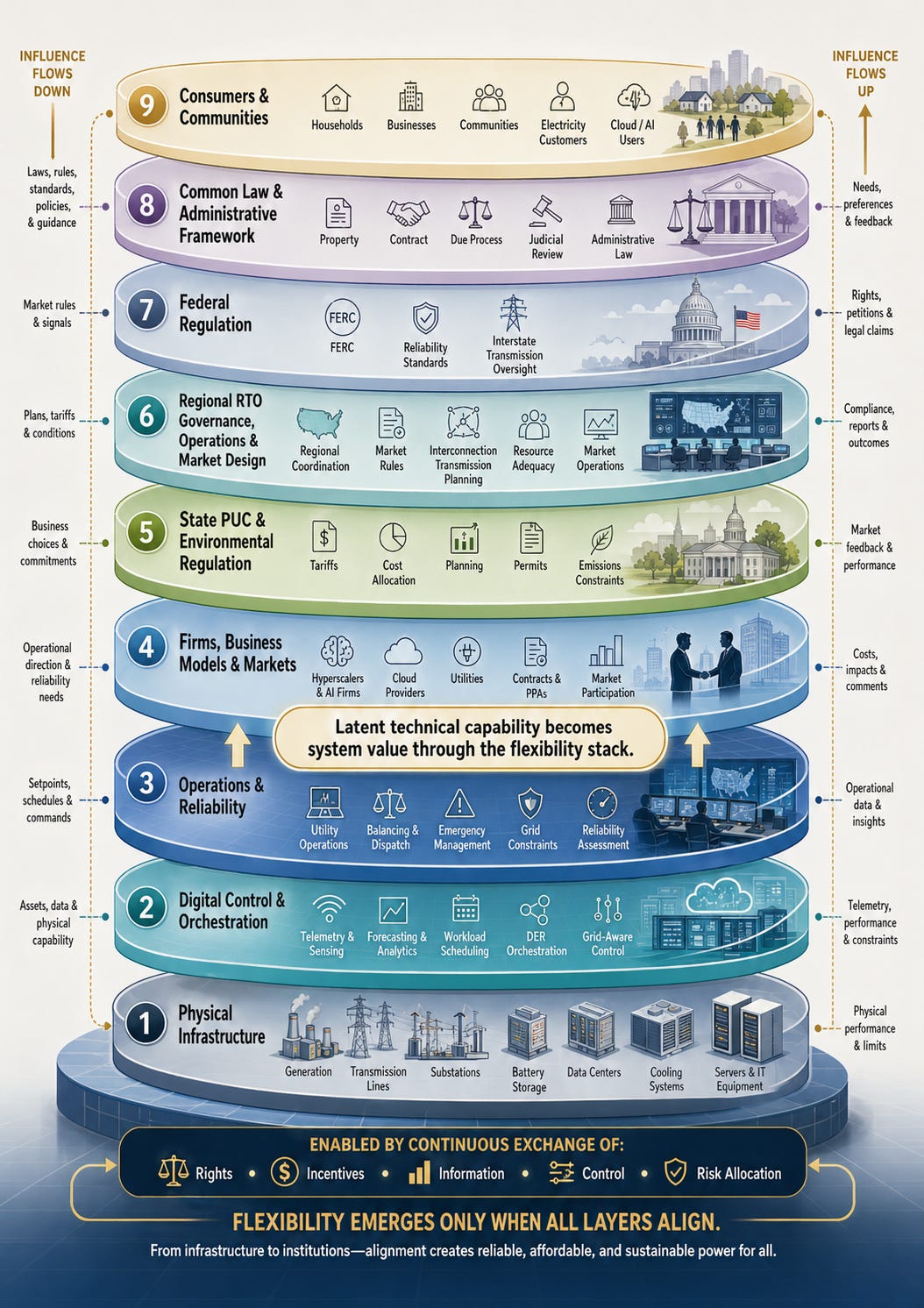
Source: A thorough iterative conversation with ChatGPT about my flex stack idea.
At the bottom are physical assets: generators, wires, substations, batteries, data centers, cooling systems, sensors, and controls. These define the physical possibility frontier. Above sits the digital-control layer—telemetry, forecasting, workload orchestration, AI scheduling, DERMS, and automated controls—which turns physical possibility into operational capability. A battery is only potential flexibility until integrated into a dispatch platform; a shiftable AI workload becomes usable flexibility only when software can classify, defer, migrate, and verify it.
The firm and business-model layer comes next. Ownership and contracts determine control: a pure-play AI company, a cloud hyperscaler, and a co-location provider each control different parts of the workload, facility, and service obligation. Flexibility is partly technical but also a function of governance inside the firm.
Markets and tariffs determine whether flexibility is rewarded. Energy, capacity, ancillary services, demand response, congestion pricing, and bilateral contracts all shape its value. A tariff is more than a price schedule; it is an institutional technology reflecting risk allocation, curtailment rights, cost causation, collateral, and service quality.
The regulatory layer operates across jurisdictions. State public utility regulation shapes retail tariffs, integrated resource planning, and cost allocation, raising questions like whether data centers should pay minimum demand charges, post collateral, receive conditional service, or bring accredited capacity, and whether other customers should bear the risk if forecasts are wrong. Regional RTO governance and market design shape wholesale participation, capacity accreditation, transmission planning, interconnection, and scarcity pricing, where location matters: a megawatt of flexibility in the wrong place may have little value, while a smaller reduction at a constrained node may be highly valuable. Federal regulation and environmental rules together govern interstate transmission, reliability, and whether flexibility can rely on diesel, gas, batteries, fuel cells, or clean procurement.
Consumers and communities sit at both top and bottom: they use electricity, cloud services, and AI tools, but they also pay rates and live near infrastructure. Regulatory legitimacy depends on making the bargain explicit—who benefits, who pays, who bears risk, who has recourse.
Implications
Flexibility can fail at any layer of this stack. A workload may be technically shiftable but prohibited by customer contracts. A utility may want conditional service the tariff doesn’t offer. An RTO may value flexibility but lack a market product that fits. A data center may have backup generators its air permits won’t allow it to run. A regulator may approve a flexible tariff that, without telemetry and penalties, can’t be verified.
Flexibility is not a resource until the stack makes it actionable. A flexible workload, a battery, or a data center willing to help during grid stress is only potential flexibility. To become a grid resource, flexibility must be defined legally, measured technically, compensated economically, dispatched operationally, and enforced contractually.
The architectural challenge is to move beyond a binary model of service — connected or not, firm or non-firm, load or resource. Data centers could instead buy modular service bundles combining firm and conditional capacity, self-supply obligations, demand-response commitments, clean-energy requirements, and verification-and-penalty structures, with the bundle depending on location, workload, business model, and grid constraints.
The current evolution of power systems is an institutional coordination problem under technological change. Data centers make it visible because they are large, fast-moving, geographically concentrated, digitally controllable, and politically salient. They stress the old architecture but also reveal where it can evolve. The flexibility stack is the architecture through which latent technical capability becomes reliable system value.
The practical question at the center of data center energy policy is not whether data centers can be flexible; it is whether our institutions can make their flexibility real.
As always, great piece, Lyn. Like many others, I am very interested in the idea of data centers as “flexible assets.” But I do wonder whether there is some hype, or at least very high expectations, about how flexible data centers can actually be/are willing to be in ways that maintain/enhance grid reliability.
Your post made me think of a LinkedIn post by Margarita Patria (https://www.linkedin.com/feed/update/urn:li:activity:7403784074554716160/) on how utilities view data center flexibility. The bottom line was: "data center flexibility is limited and can’t be relied on for resource adequacy planning or reliability. "
Nobody expects perfect flexibility from DCs (what would perfect even be? The layered system is complex!) as flexibility depends on a host of DC-specific features (workload, location, incentives, ...) and, as a whole system, on layers. But I wonder whether we may be giving DCs too much credit for their willingness to be flexible. Will planners and operators be able to reliably count on/enforce this flexibility?
When I think about the “five nines” reliability expectations that data-center founders/CEOs love to emphasize, alongside the pacing problem of a twentieth-century grid trying to adapt to twenty-first-century players, it feels like there is still a missing institutional piece. Or, to put it as a question, can we expect those layers to align to the point where this flexibility from data centers can be extracted to enhance system-wide reliability? The technical DC capability to be flexible may be there, but can it be converted into **dependable** system value? I