
Reminder: I am using multiple translations; my main reading is from the hardbound copy of the Mansfield translation. When I refer to page numbers it’s to the Mansfield translation, and when I want to pull quotes that are longer I’ll use the online Schleifer translation, so the text may not match exactly but they are close (and I also read French so I calibrated across the translations to get comfy with Tocqueville’s word choice).
This week’s chapters touch on long-standing debates over federal power and go into detail on the structure and jurisdiction, and moral force, of the Supreme Court. Although this year’s Supreme Court decisions have just occurred and have occasioned the inevitable analysis, and rancor, I leave it to you to associate Tocqueville’s analysis with the modern structure and decisions of the Supreme Court.
Happy semiquincentennial, y’all.
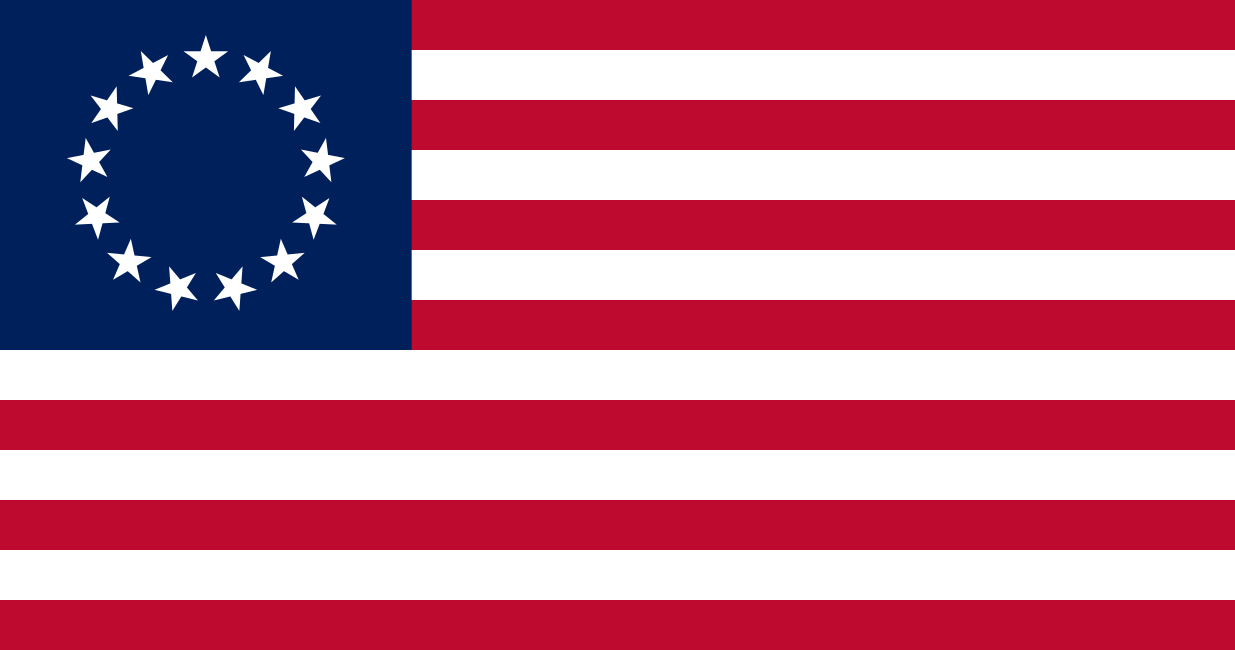
The Betsy Ross flag. Source: Wikipedia
Democracy in America, Volume 1, Part I, Chapter 8 from “On the Federal Courts”, Part II, Chapters 1, 2, 3
In a work celebrating its semiquincentennial this year, Adam Smith placed the division of labor at the center of political economy. Dividing production into distinct tasks lets people specialize, and specializing lets them coordinate through exchange rather than command. The result is greater output, yes, but also a complex order that no single participant designs, performs, or controls.
Near the end of Part I of Democracy in America, Tocqueville reaches for a parallel phrase: the “division of sovereignty” (p. 153). He never makes the comparison to Smith explicit, but the resemblance is suggestive. Just as the division of labor assigns different tasks to different workers, the division of sovereignty assigns different political functions to different governments. The federal government and the states govern the same citizens, but they specialize in different kinds of public action.
This arrangement lets Americans combine political goods that usually appear incompatible: national strength with local liberty, large-scale coordination with small-scale self-government, constitutional authority with a multiplicity of independent institutions. Division also creates complexity and conflict, though. The Constitution can allocate powers on paper, but paper cannot guarantee that the allocation stays clear, that federal laws get obeyed, or that competing authorities respect one another’s boundaries. Tocqueville therefore turns first to the federal courts, which give divided sovereignty its legal form, and then to the political culture—popular sovereignty, parties, and the press—that sustains it.
Making federal power real
“The greatest difficulty,” Tocqueville writes, “was not to know how one would constitute a federal government, but how one would make its laws obeyed” (p. 131).
A constitution may describe a federal government and enumerate its powers, but such a government remains an abstraction until it can enforce its laws. Under a traditional confederation, the central authority addresses commands to member states, and those states must then carry them out. The central government thus depends on the very governments it may someday need to restrain.
The American Constitution adopted a different principle. Rather than governing states as corporate bodies, the Union governs individual citizens directly, with federal officers executing federal laws and federal courts adjudicating them. If an individual violates a federal law, the Union proceeds against that individual, not against the state that failed to prevent it.
Tocqueville regarded this structure as a major discovery in political science. The Constitution divided authority between two governments without reducing the federal government to a diplomatic council of sovereign states. Both the Union and the states could make laws, administer programs, collect revenue, and adjudicate disputes, each within its own sphere.
The individual citizen becomes the point where these sovereignties meet: a resident of a state and a member of the Union at once, subject to both governments and entitled to the protection of both. The Constitution divides sovereignty institutionally, then reunites it in the person of the citizen.
Courts at the boundary
Necessarily, this arrangement creates disputes. Tocqueville describes the Constitution as establishing “two distinct, opposing sovereignties,” (p. 133) each able to expand only at the other’s expense. If state courts alone interpreted federal law, its meaning could shift from state to state, with judges beholden to state governments deciding the limits of federal power. The Constitution therefore created an independent federal judiciary to settle questions of national concern.
The Supreme Court occupies the most delicate position of all. It must interpret the Constitution, distinguish federal from state authority, and adjudicate conflicts between the two, so its jurisdiction reflects the changing scope of federal power itself: “The jurisdiction of the courts of the Union extends or contracts as the sovereignty of the Union itself contracts or extends” (p. 137).
The point matters: jurisdictional disputes are never merely technical. When courts decide whether an issue belongs to the Union or to the states, they help set the practical distribution of political power. The boundary may be written into the Constitution, but it acquires meaning through interpretation, precedent, and political development.
Yet courts have few means to enforce their judgments on their own. Their authority rests on what Tocqueville calls “moral force” (p. 131)—the public’s belief that courts are legitimate interpreters of law. Federal judges may look powerful, but “they are omnipotent as long as the people consent to obey the law” (p. 142).
This combination of strength and dependence gives the Supreme Court its peculiar character. Arbitrating conflicts between sovereignties requires independence and broad authority, but the more extensive that authority grows, the more consequential its errors become. Tocqueville warns that a Court composed of “imprudent or corrupt men” (p. 142) could expose the Union to anarchy or civil war. The danger does not arise from faulty institutional design; it arises from the problem the institution exists to solve. Divided sovereignty requires an authoritative referee, and an authoritative referee can always abuse the position.
The Court does not abolish conflict between governments; at its best, it converts a contest of force into a question of law. Its success depends on the willingness of citizens and governments alike to accept decisions they oppose.
Political specialization
Tocqueville’s defense of federalism goes beyond the familiar claim that it checks tyranny. Division of sovereignty is also productive: different levels of government carry different capacities, information, incentives, and comparative advantages.
The Union performs tasks that require scale: national defense, diplomacy, regulation of matters of common concern, the strength to resist foreign powers. Large nations can mobilize resources, circulate ideas across broad territories, sustain commerce, and project influence abroad.
States and local governments carry different advantages: they stay closer to citizens and more attentive to local circumstance. Freed from primary responsibility for national defense and territorial expansion, they direct their energy toward “internal improvements,” (p. 153) debating plans in town meetings and state legislatures, airing those debates in newspapers, and searching continually for ways to improve their communities. Tocqueville argues that this activity channels ambition away from the conquest of national power and toward the more ordinary pursuit of well-being.
The states are more than administrative subdivisions executing national policy; they are political communities in which citizens acquire the taste and practice of republican government, as Tocqueville notes in Chapter 5. Towns and provincial assemblies developed the habits the federal republic required; the national capital did not impose them.
Federalism therefore combines the advantages of different political scales. Tocqueville summarizes the achievement in one of his most elegant sentences: “The Union is free and happy like a small nation, glorious and strong like a large one” (p. 154).
The pattern is the political analogue to specialization in the economy. The federal government concentrates on functions where size and uniformity pay off; states and towns take functions where proximity, variation, experimentation, and participation pay off instead. Neither level is simply superior—their capacities differ because their scale and position differ.
The cost of complexity
Specialization creates interdependence, and interdependence creates friction. The most visible defect of federal systems, Tocqueville observes, is the complication of their means, or the mechanisms by which government acts. Two sovereignties stand face to face, and no matter how carefully lawmakers define their spheres, they cannot keep those spheres from touching.
A consolidated government offers an appealing simplicity: one territory, one government, one chain of command. Federalism asks more of its citizens—to understand overlapping jurisdictions, to distinguish among several kinds of political authority, to decide whether a given failure belongs to a town, a state, Congress, the President, or the courts, and to tolerate disagreement over where the boundaries actually lie.
The federal system therefore requires what Tocqueville calls “the daily use of the light of their reason”—a demanding condition, and he is not sentimental about the cost: “An idea that is false, but clear and precise,” he warns, “will always have more power in the world than a true, but complicated, idea” (p. 155).
Federalism cannot be exported simply by copying constitutional language. Americans could sustain it partly because they had long practiced local government and had already built habits of political judgment. Geography helped too: weak neighboring powers and relative security from invasion reduced the need for centralized military authority. The system depended not only on laws but on experience, circumstance, and mores.
The Constitution can divide legal authority. It cannot manufacture the habits of mind needed to live under divided authority.
One people, many centers of power
Here the argument turns, moving from Part I of Democracy in America to Part II. Part I describes the formal machinery of government; Part II turns to the passions, opinions, and political practices that animate it.
Tocqueville begins with an apparently contradictory claim: in America, the people govern. If sovereignty belongs to the people, how can sovereignty also be divided between state and federal governments?
The contradiction dissolves once we distinguish the source of sovereignty from its exercise. The people remain the ultimate source of legitimate authority, but they exercise that authority through multiple governments and institutions—popular sovereignty is unitary in principle, plural in operation.
Political parties help organize that pluralism: they assemble citizens into coalitions, attach beliefs to candidates, and translate dispersed opinion into political action. Tocqueville distinguishes great parties, which struggle over fundamental principles, from small parties, which chase personalities, offices, and immediate advantage. Parties divide the sovereign people in order to make its rule effective, but the quality of that division varies—it may clarify competing principles, or it may reduce politics to factional ambition.
The press performs a related function. Tocqueville calls popular sovereignty and freedom of the press “two entirely correlative things” (p. 174): citizens cannot govern themselves if another authority controls the information and arguments from which they form their judgments.
Freedom of the press brings predictable abuses: falsehood, coarseness, sensationalism, partisan fury. Tocqueville nevertheless denies that a government can capture the benefits while shedding the costs. Once censorship begins, it must keep advancing, because thought escapes every partial effort to suppress it. Courts may “arrest the body,” but “the soul escapes them” (p. 173).
The structure of the American newspaper market reinforces this freedom. Newspapers are numerous, cheap to start, and scattered across the country. Most focus on local affairs while still connecting readers to national political debate. No single editor or metropolitan paper can easily corner public opinion—a point Tocqueville makes with an economist’s eye for market structure, decades before anyone called it that.
The press thus creates something like a federalism of opinion, distributing political judgment across many communities and institutions. Like constitutional federalism, it produces noise and conflict—and, like constitutional federalism, it makes domination harder.
Tocqueville’s America is governed by one people through many centers of authority. Its constitutional achievement lies not in resolving the problem of sovereignty once and for all, but in dividing its exercise without dissolving its legitimacy.
The system channels political conflict into jurisdictional disputes, lawsuits, elections, parties, and public argument. It gains resilience from the diversity of its institutions and the specialization of its governments, but it stays fragile because every part depends, ultimately, on citizens accepting complexity, restraint, and the legitimacy of authorities they do not fully control.
The division of sovereignty, then, is more than an arrangement among governments. Like the division of labor, it is a system of differentiated functions and mutual dependence, one that lets the republic do more than any single center of power could do alone. It also requires habits of cooperation, judgment, and trust, without which specialization collapses into paralysis, and division into disunion.
Next week’s chapters: Volume 1, Part II, Chapters 4 and 5 (5’s a banger and there will be lots to discuss!)