
Why does electricity suddenly seem to matter so much again? This week, I dig into two of my favorite topics: the technological and economic history of electricity, and the economic theory underlying how we regulate an industry that serves nearly 250 million Americans. The fundamental technologies and regulations have changed little over the past century, but the innovations of recent decades are upending that stable relationship. That said, the American electricity industry still runs through institutions built for a world of large, centralized, capital-intensive power systems, and the rush of data center-driven demand is revealing just how hard it is to govern a new electricity economy with an old regulatory operating system.
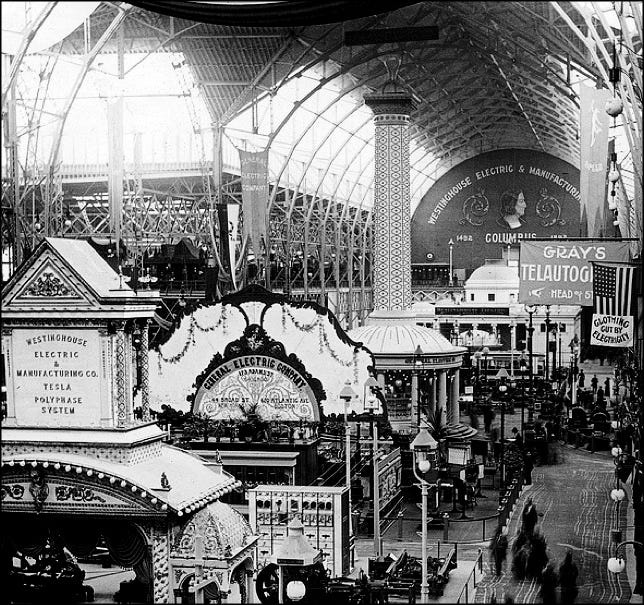
Electricity Building at the 1893 World’s Columbian Exposition in Chicago (Source: Chicagology)
The Stress Test
Electricity used to be easy for most people to ignore. It was the quintessential background technology: vital, expensive to build, occasionally maddening, but mostly invisible unless the power went out or the monthly bill jumped. That invisibility has ended. Between the rapid growth of data centers, the surge of interest in AI, the electrification of vehicles and buildings, and a string of uncomfortable reminders that reliability is neither free nor automatic, more people are paying attention to the electric grid and asking a sensible question: Why does this system seem so hard to change?
That question has become more urgent as utilities, regulators, large customers, and ordinary ratepayers argue over how to serve large new loads, how quickly to build generation and transmission, and who should bear the costs and risks. Data centers are not the only reason these tensions exist, but they have become a powerful catalyst because they are revealing a deeper reality: The American electricity industry still operates through institutions built for a very different technological and economic world. The old system emerged for some good (and some not so good) reasons, and for a long time it worked tolerably well. But the status quo has a habit of lingering long after the conditions that created it have changed.
To understand why today’s electricity debates are so consequential, you have to go back to the beginning, which in the United States is 1882. The electric industry began as a messy burst of entrepreneurship, experimentation, technical rivalry, and races to the patent office, only later evolving into what looked like a neat monopoly blessed by economic theory. In the late 19th century, inventors and firms were racing to turn the strange, invisible, physical phenomenon of electric current into something commercially useful. Electric lighting was the glamour product of its age, and early systems were local, improvised, and expensive. Thomas Edison’s Pearl Street Station in lower Manhattan is the iconic example, but it was only one node in a broader network of invention and commercial trial and error. What eventually mattered most was the form in which electricity could be delivered. The “war of currents” victory of George Westinghouse and Nikola Tesla’s alternating current (AC) over Edison’s direct current (DC) was decisive because AC, combined with transformers and high-voltage transmission, made it possible to generate power at large scale and move it over long distances. That technical architecture favored centralization and created the modern grid’s basic logic: large generating plants, extensive wires networks, and one-way delivery from producer to consumer.
That architecture had powerful economic implications. Electricity required large upfront investments in generation, transmission, and distribution, while the cost of serving additional customers once the system was built was relatively low. It was an industry of high fixed costs and strong economies of scale, so for a long time one network appeared cheaper than many overlapping ones. From that cost structure came the intuitive case for monopoly; if duplicating infrastructure was wasteful, the least-bad option might be to grant one firm an exclusive territory and regulate it to prevent abuse. That logic became the foundation of the early 20th-century public utility model: a legally protected monopoly with an obligation to serve, overseen by state commissions. The natural monopoly theory that economists later formalized gave this arrangement a conceptual vocabulary, but the institutions themselves were already emerging in the Progressive Era as both an economic solution and a political bargain.
That bargain had two economic stories behind it, and both matter. The public-interest story holds that regulation emerged to protect consumers from monopoly abuse and to ensure safe, reliable, affordable service. The public-choice story holds that firms often sought regulation because it stabilized earnings, reduced competitive pressure, and lowered the cost of capital. Samuel Insull, the founder of Commonwealth Edison and an early leader in the utility industry, captured both dynamics: He expanded electric service aggressively, but also recognized that a regulated franchise could provide the stability needed to finance massive infrastructure investments, and he lobbied for such regulation. The result was an institutional settlement among governments, firms, and reformers, forged in a world where large centralized systems seemed both technologically necessary and economically efficient.
The practical mechanism for governing this settlement was rate-of-return, or cost-of-service, regulation. The basic logic is simple. Because the firm is a monopoly, it cannot be left to charge whatever the market will bear—a concern that grew as electricity became essential to daily life and economic activity. At the same time, because the firm must make large, long-lived capital investments, it must have a reasonable opportunity to recover prudently incurred costs and earn an allowed return on the capital devoted to public service, its rate base. Regulators therefore review the utility’s costs, determine which assets belong in its rate base, and authorize rates designed to cover operating expenses plus a reasonable return.
This model did some important things well. It supported capital formation in a capital-intensive industry during a century of fairly steady demand growth. It reduced some kinds of investor risk. It provided a framework for universal service and reliability. And for much of the 20th century, it fit reasonably well with the dominant “iron in the ground” technologies of the industry: large central stations, long-lived network assets, and a relatively standardized product.
Still, the model came with its own incentive structure, and that structure matters enormously today. Rate-of-return regulation creates a capital bias in utility decisions: It is easier to put poles, wires, substations, or power plants into the rate base than to earn on digital grid management, operational improvements, demand-side flexibility, or organizational innovation. That bias toward the tangible and depreciable was less troubling when the goal was to build a standardized network at scale. It is more problematic now, when the greatest value often comes from coordination, information, software, flexible demand, decentralized resources, and other ways of doing more with existing assets. The regulatory model was built for a static industrial system, while electricity has increasingly become a dynamic one.
That static character was built into the theory. The classic natural monopoly model assumes stable technology, reasonably predictable demand, a clear definition of the product being sold, knowledge of costs, and regulators capable of approximating the public interest. Those assumptions were always simplifications, but for decades they were close enough to reality to be useful. The 20th-century electric system was centralized, standardized, and largely one-directional. Demand grew, but its growth was comparatively legible. Utilities built more generation, more wires, and more substations, and regulators reviewed those investments through familiar legal and economic frameworks. The institutions and the technologies co-evolved, and were more tightly coupled than many people realized.
Since the 1990s, that fit has weakened, especially as new generation technologies changed the sector’s economics. Combined-cycle gas turbines reduced efficient scale, lowered capital costs, and made wholesale competition more feasible in some places. Wind and solar introduced very different cost structures and operating characteristics from traditional thermal plants. Storage and digital control technologies improved the ability to shift, monitor, and coordinate supply and demand, while smart grid technologies and distributed energy resources reduced transaction costs and made new organizational forms more plausible. In earlier decades, bundling energy, wires, and retail service within a vertically integrated utility had a strong technological rationale. As technologies changed, so did the efficient boundary of the regulated utility: Activities that once had to occur inside a monopoly organization could now be coordinated through contracts, markets, platforms, or decentralized control.
This development is where the pacing problem enters. Technologies can change quickly; institutions usually do not. In electricity, that asymmetry is especially pronounced because the system is physically consequential, legally dense, and politically salient. Utilities and regulators are understandably risk averse, since reliability failures are visible and customers are unforgiving. But caution is costly too. When institutions remain calibrated to older technologies and policy goals, they can become ill-equipped to meet new conditions, slowing adoption, preserving legacy organizational forms beyond their useful life, and raising the cost of experimentation. Governance can thus lag behind technological possibility, and that lag can become a source of inefficiency and conflict in its own right. Even governance rules meant to protect reliability can harden into barriers that slow entry, adaptation, and coordination under new conditions.
Regulatory restructuring in the 1990s and 2000s only partly addressed this mismatch. In some states, generation became competitive while transmission and distribution remained regulated monopolies; in some places, retail choice emerged, while in others it did not. Regional transmission organizations and independent system operators assumed important wholesale coordination functions, but they did not erase the deeper institutional inheritance of the public utility era. What emerged was not a clean replacement of the old model, but a layered hybrid: Parts of the system were liberalized while monopoly governance persisted in others, and unevenly across states and regions. That patchwork can work, but it means today’s disputes over regulation and the role of the utility unfold within a complicated structure of historical compromises, nested rules, and reliance on past practices. The old model was not overthrown. It was refurbished, patched, and in some places tastefully wallpapered over. The wiring underneath is still old.
This historical background makes the current data-center debate revealing. Data centers are not merely large loads. They are often lumpy, geographically concentrated, highly time-sensitive, and unusually demanding in their expectations of reliability. They can require substantial new investment in generation, transmission, distribution, or all three. They also sharpen the old regulatory questions that rate-of-return systems have always struggled to answer neatly. Who should pay for infrastructure built partly to serve a small number of very large customers? Should incumbent utilities build ahead of demand, or should they wait for firmer commitments? How should risks be allocated if projected load growth does not materialize, or materializes in a different place or form? Should utilities own and rate-base the assets needed to serve these customers, or should more of the coordination occur through contracts and competitive supply arrangements? Beyond merely engineering questions, these are questions about governance, incentives, and risk allocation.
Rather than creating the electricity sector’s institutional tensions, data centers exposed them, and at scale. AI’s arrival collides with a system still shaped by assumptions from an earlier era: that demand growth is gradual and predictable, that the product is relatively homogeneous, that large infrastructure should be socialized through monopoly regulation, and that adapting to change can proceed at the stately pace of the regulatory docket. But the world arriving at the grid’s doorstep is more heterogeneous, more digitally coordinated, and more impatient than the one those assumptions reflected. Meanwhile, the grid itself remains a shared network in which one party’s decisions affect many others, so governance and exclusion rules still matter. Reliability is not something markets can simply wish into existence. The real question is whether our existing institutions preserve reliability while also enabling adaptation.
That is the deeper lesson. The current electricity debate is not simply about whether data centers are good or bad, or whether they are raising rates for other customers, or even whether AI is worth the power it consumes. It is also a larger debate about whether institutions designed for 20th-century centralized power systems can govern a 21st-century electricity economy with a vastly different architecture and technology set. The natural monopoly model solved real problems, and it should not be caricatured as institutional sclerosis or rent-seeking (although both are present). It helped build one of the most important infrastructure systems in human history. But it was technology-contingent in ways that data center innovation is making apparent, reflecting a particular set of technologies, costs, and policy priorities. As those conditions change, the case for preserving every inherited boundary, every bundled function, and every regulatory habit grows weaker.
What matters now is matching governance more honestly to present conditions and designing institutions that can adapt better as those conditions change. In some parts of the system, monopoly still makes sense. In others, competition, contracting, and decentralized coordination can do valuable work. Regulation should focus less narrowly on approving capital and more broadly on enabling performance, adaptation, and intelligent risk allocation.
That shift will not be easy, and no clever slogan will spare us the hard institutional work. But the alternative is worse: trying to govern a changing electricity system with categories designed for a world that no longer exists.
And that, in the end, is why data centers matter so much. They are not just another source of load growth. They are a stress test. They reveal where the grid is strong, where it is brittle, and where its regulatory operating system has begun to show its age.
Originally published in the Dispatch Energy newsletter: Is Our 20th-Century Grid Up to the Current Task?
The sentence that stops me: "trying to govern a changing electricity system with categories designed for a world that no longer exists." That's the AI hardware problem stated perfectly. The grid's regulatory operating system is vintage 1920. The GPU's thermodynamic operating system is vintage 1970. Both are running out of runway simultaneously. The question is which gets reformed first.
Love this piece, and sudden changes definitely stress test the existing physics and economics. The uncertainty around future data center demand also greatly complicates the planning. How long will that transformational spread (value of compute per cost of mwh) hold? If it doesn't last as long as planned, stranded assets and write-offs are in someone's future. Remember fiber optic capacity markets?