
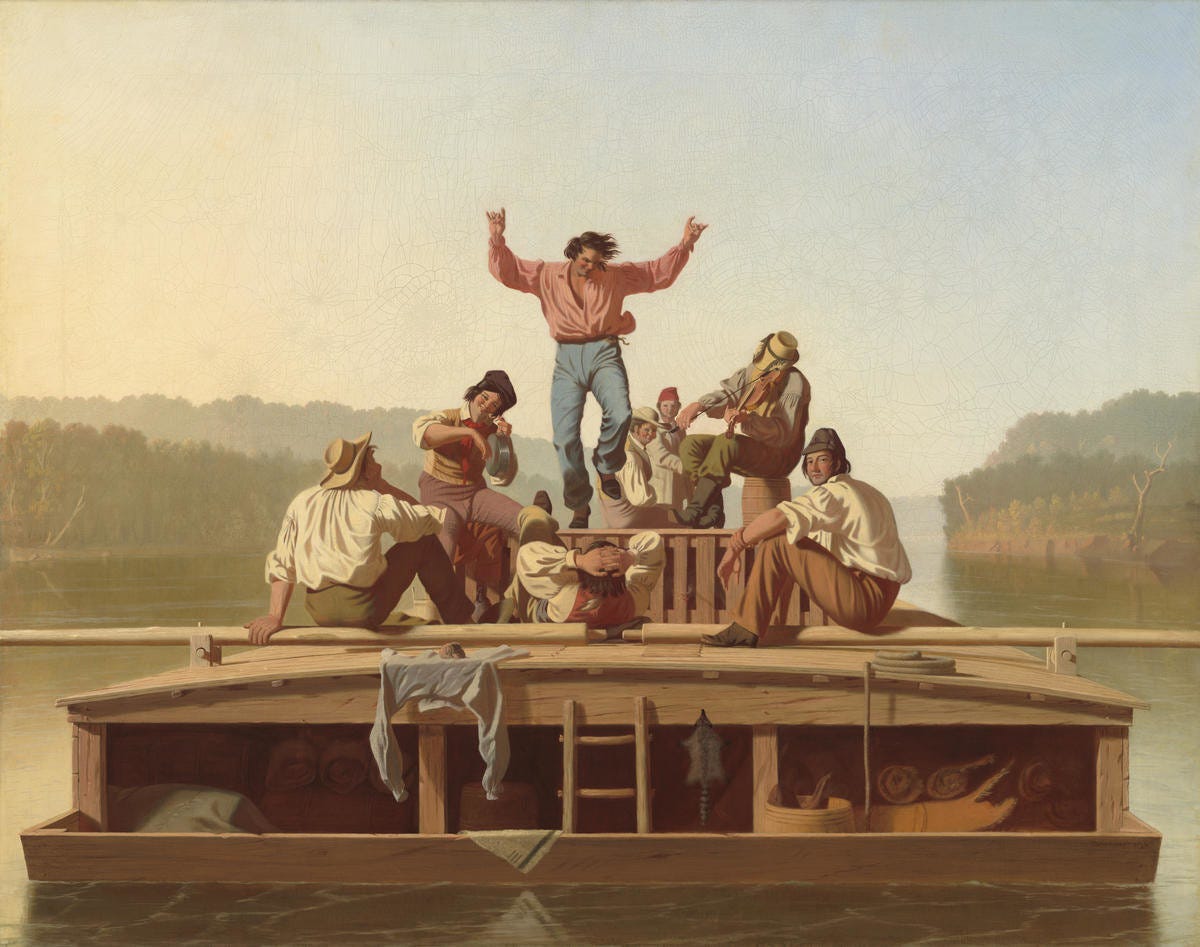
George Caleb Bingham, The Jolly Flatboatmen (1846). Source: National Gallery of Art
Reminder: I am using multiple translations; my main reading is from the hardbound copy of the Mansfield translation. When I refer to page numbers it’s to the Mansfield translation, and when I want to pull quotes that are longer I’ll use the online Schleifer translation, so the text may not match exactly but they are close (and I also read French so I calibrated across the translations to get comfy with Tocqueville’s word choice).
Democracy in America, Volume 2, Part III, Chapters 1-15
In the previous part of Democracy in America, Tocqueville examined the moral psychology of democratic life: individualism, material ambition, restlessness, association, and the idea of self-interest well understood. In Volume 2, Part III, he adds a sociological layer. What happens when these democratic individuals encounter one another? How does equality change the relationships among people?
He begins with a strong claim: as conditions become more equal, mores become “milder”.
The French word Tocqueville uses is douceur: gentleness, softness, a diminution of harshness in social conduct and feeling. His claim is not simply that democratic people are nicer. He is trying to explain why equality makes people less capable of regarding the suffering of others with indifference.
His mechanism is sympathy: “[T]here is real sympathy only among people who are alike,” (p. 536). Taken literally, that claim seems too strong.
Adam Smith, writing nearly a century earlier in The Theory of Moral Sentiments, gives us a richer account. For Smith, sympathy is our capacity for fellow-feeling with another person. We cannot enter directly into another person’s mind or experience what she experiences. Instead, we use imagination. We place ourselves, as best we can, in her situation and ask what we ourselves might feel there.
Although our imaginative capacity enables us to engage in this process, that sympathetic identification is always imperfect. Smith emphasizes the distance separating spectator and sufferer: I can imagine your grief, but I cannot actually experience it as you do. Moral life therefore requires us to bridge an irreducible gap between persons.
Tocqueville seems to be making a related argument about democracy. Equality does not create the human capacity for sympathy. Rather, it shortens the imaginative distance across which sympathy must operate.
This mechanism becomes clearer when Tocqueville contrasts democracy with aristocracy. Aristocratic societies create powerful bonds within ranks. A lord and his dependents can be joined by durable relationships of loyalty, protection, obligation, and service, the aforementioned “great chain of being”. Members of the same class recognize one another immediately and understand the duties that attach to their respective places in the social order.
But those same distinctions can make people in different ranks seem fundamentally unlike one another. Tocqueville pushes the point almost to an extreme: when social conditions differ radically and permanently, members of different castes may scarcely appear to belong to the same humanity (p. 537). Aristocratic society can thus produce generosity without mildness, with attachments that may be strong but narrow.
Equality works differently. When ranks cease to be fixed by birth, another person’s position no longer seems wholly alien to me. I might rise to where he stands; he might fall to where I stand. Our circumstances differ, but the difference no longer appears to express two fundamentally different kinds of human being.
Tocqueville’s democratic individual can therefore be self-interested and still sensitive to and feeling for the difficulties of others: “Although the Americans have so to speak reduced selfishness to a social and philosophical theory, they do not show themselves any less accessible to pity” (p. 538). Equality encourages people to recognize their own vulnerability in others.
This sympathetic mechanism helps explain one of the paradoxes running through these chapters. Democracy loosens social bonds, but it also facilitates mutual aid. Tocqueville explicitly connects this point to his earlier discussion of individualism. Equality makes individuals feel independent, but it simultaneously reveals their weakness. Democratic people ordinarily expect to manage their own affairs. Experience teaches them that accidents, illness, misfortune, and uncertainty can suddenly make assistance necessary. Each recognizes in another’s dependence a condition that could easily become his own.
The result is douceur: mildness. That change in moral perception accompanies a broader transformation in the structure of social relationships.
Tocqueville’s discussion of servants and masters illustrates the point well. Under aristocracy, master and servant occupy enduring social positions. Their relationship is embedded in a hierarchy that extends beyond the particular tasks the servant performs. Under democracy, the relationship becomes contractual. Why does one equal person have the right to command another? Tocqueville’s answer is “the temporary and free agreement of their two wills” (pp. 549-550). Within the contract, one commands and the other obeys. Outside it, “they are two citizens, two men.”
His chapters on land leases and wages extend the same logic into economic life. Relations that once carried layers of inherited social obligation become increasingly contractual and pecuniary. Status gives way to bargaining.
But Tocqueville does not assume that contract produces substantive equality automatically. His broader discussion of industrial society already suggests the problem. A worker who must sell his labor immediately and an employer who can afford to wait may be formally equal while possessing radically different bargaining power. The disappearance of hereditary rank does not eliminate dependence.
The family reveals another aspect of the same transformation: “Democracy loosens social bonds, but it tightens natural bonds. It brings relatives together at the same time that it separates citizens” (p. 563). Aristocratic family relations are intertwined with property, inheritance, rank, and paternal authority. The father is not only a father but the head of a lineage and the guardian of its position. Democracy strips away some of these institutional functions. The relationship can consequently become more personal. Affection matters more because prescribed hierarchy matters less. Again, Tocqueville is tracing a movement from imposed status toward relationships grounded more directly in choice, affection, and personality.
His chapters on women show both the reach and the limits of his argument. Tocqueville is impressed by the education of American girls precisely because such education cultivates self-government. A young woman is taught early to think for herself, speak freely, judge dangers without illusion, and rely upon her own reason. Democratic society cannot depend entirely on guardianship and enclosure; it needs individuals capable of exercising judgment.
Yet Tocqueville stops well short of extending this independence fully into marriage. He bluntly says that the American woman’s independence is “irretrievably lost” within marriage, and he defends a strict division of functions between men and women (p. 574). He conceives equality between the sexes as equal dignity combined with differentiated roles, not as similarity of social function. The tension here reveals that Tocqueville understands remarkably well how equality undermines inherited claims to authority, but he does not apply that insight consistently.
By the time he turns to manners and the “multitude of small particular societies” into which Americans divide themselves, the larger picture is clear (p. 579). Equality does not eliminate social distinctions, but it does make them more fluid. Instead of a few durable ranks, democratic societies generate shifting circles based on wealth, occupation, taste, education, and personal choice. There is less of a common code of manners because no stable aristocratic class can impose one.
Across these chapters Tocqueville is describing a transformation in the social architecture of everyday life. Aristocracy organizes relationships through rank, inheritance, and prescribed obligation. Democracy increasingly organizes them through similarity, contract, consent, choice, and natural affection.
Equality reduces the imaginative distance between persons. It makes another person’s suffering easier to recognize as the suffering of someone fundamentally like oneself. In that sense, democratic equality humanizes social relations. But Tocqueville doesn’t let that gain obscure the tradeoff. The old bonds could be oppressive, but they could also be durable. Democratic relationships may be more humane while also being thinner, less stable, and more contingent.
That is the puzzle at the center of these chapters, yet another instance of Tocqueville’s tensions and contradictions. Equality makes us more capable of seeing strangers as fellow human beings while dissolving many of the inherited structures that once bound people together.
Smith helps illuminate Tocqueville’s mechanism. Sympathy always requires an imaginative movement from oneself toward another. Democratic equality makes that distance easier to cross.
Quote: "For Smith, sympathy is our capacity for fellow-feeling with another person. We cannot enter directly into another person’s mind or experience what she experiences. Instead, we use imagination. We place ourselves, as best we can, in her situation and ask what we ourselves might feel there." But in the Old Testament too: https://docs.google.com/document/d/1Rw94JIwiYIAtIiwa_xAMXP2PgROexnFojGvxmC7IglQ/edit?usp=sharing
In other words, the Golden Rule, no doubt a result of Protestant Christianity.
Tocqueville sees a 19th Century America of roughly similar ethnic, linguistic and ancestral characteristics (Blacks being aside from this section of his writing). From these data points he can infer a democracy that enables mutual sympathies. As American demographics and class structure have subsequently become more complex — including the legal, and increasingly political, emancipation of Black citizens, but also the immigration of different ethnicities — the gap that must be bridged between “equal” individuals has become wider, the links more tenuous. When stress is applied to these gaps and links, as economic stresses have materialized across our history (and for our purposes, especially over the last half century), divisiveness is enabled while sympathetic bonds grow weaker. This divisiveness invites those who would exploit it, from organized labor movements and civil rights movements (which we may admire) to more intense racial animus and resentment of elites (which we may deplore, but MAGA welcomes). Democracy must somehow contain more, and more diverse, multitudes, than it did during the less differentiated earlier history of the republic.