
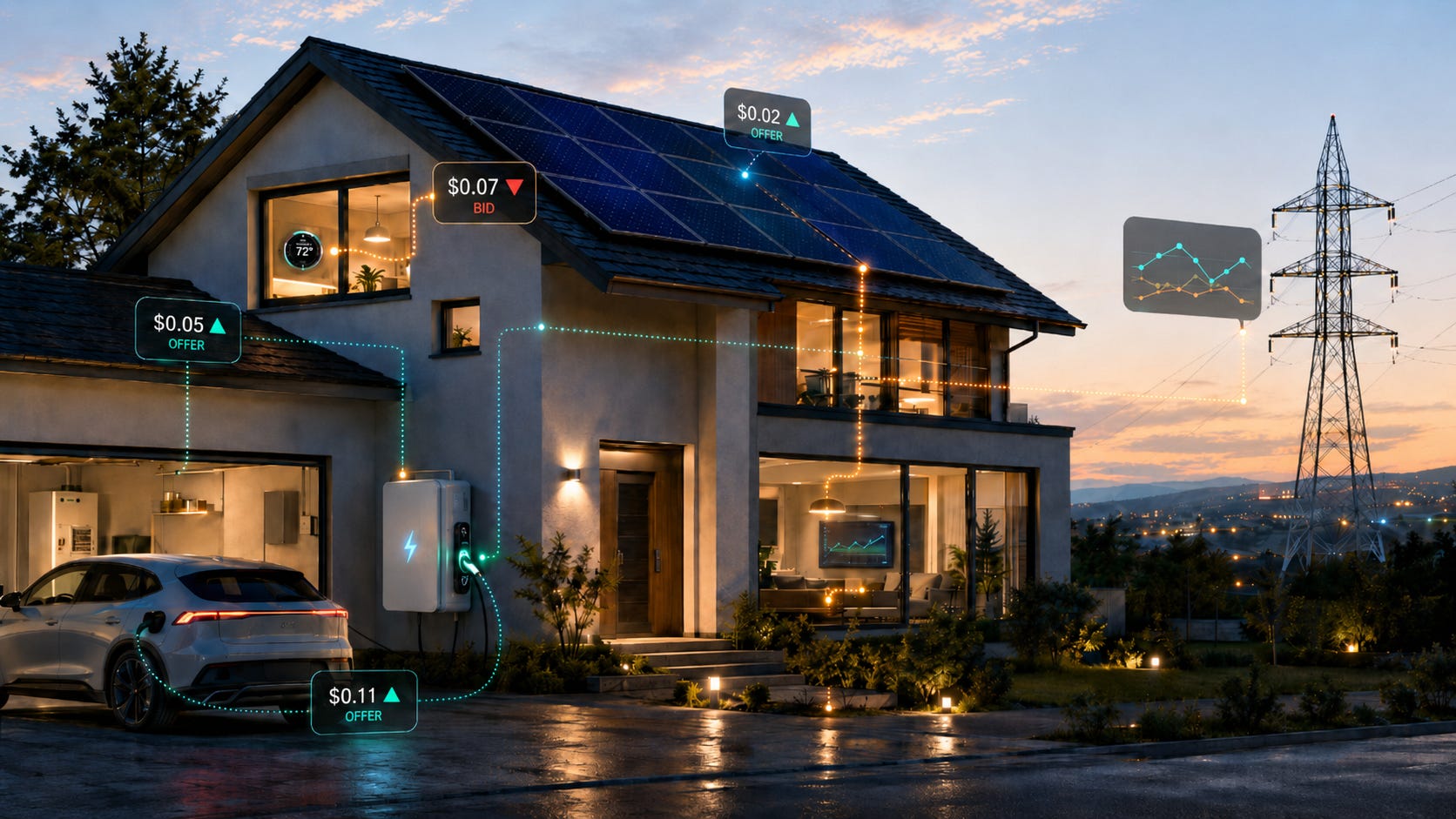
Source: After I had it read the draft of this article, I asked ChatGPT for an image of a transactive house. I’ve wanted an image like this for almost 20 years, and I’m thrilled that AI has the capability to deliver. I did have to tweak the details because the AI doesn’t “know” economics so some of the numbers didn’t make sense.
In the first article in this series, I reviewed my writing about real-time pricing over the past 24 years and then traced the intellectual history of real-time electricity pricing, from Marcel Boiteux’s work on marginal-cost and peak-load pricing through Fred Schweppe’s spot-price-based electricity marketplace. That history connects the changing marginal value of electricity to decisions about consumption, production, investment, and risk.

My impetus for writing about this topic was a LinkedIn essay by Andrew Schein responding to a Substack article from Matt Yglesias. Yglesias argues that variable prices elicit flexible demand more efficiently than conservation appeals or centralized control, while letting households with different needs and preferences respond differently. Schein agrees about the value of prices but argues that real-time pricing and virtual power plants (VPPs) are complements: VPPs can automate household responses, aggregate small resources, pool performance risk, and coordinate participation across wholesale and local grid programs.
Both arguments are persuasive as far as they go. Prices communicate scarcity and accommodate heterogeneous preferences. Aggregation reduces transaction costs and makes small amounts of distributed flexibility useful to utilities and system operators. Automation spares consumers from watching prices and manually adjusting thermostats, vehicles, batteries, and appliances.
But saying that prices and VPPs are complementary does not resolve the most important institutional question: How does the signal that governs an automated device come into being?
A thermostat may change its setting because it receives a market price that emerged from bids, offers, costs, and network constraints, or because a utility or aggregator sends it a dispatch instruction after solving an optimization problem. In both cases the thermostat responds automatically, and demand becomes more flexible either way—but the two arrangements convey different information and allocate different decision rights. One uses a market process to form the control signal; the other delegates control to an intermediary that may itself respond to prices upstream.
This distinction is central to transactive energy, which combines automation with economic agency: consumers and devices express preferences through bids and offers, participate in price formation, and respond automatically to the resulting market-clearing price. It coordinates distributed resources without requiring constant human attention or comprehensive knowledge and control at the center.
Here I examine that architecture through two projects I have worked on: the GridWise Olympic Peninsula Demonstration and the more recent Transactive Energy Service System, or TESS. I then compare transactive energy with the VPP model and return to the arguments made by Yglesias and Schein. The flexible grid will certainly use automation and intermediaries; the issue is whether automated devices just follow commands or participate, on their owners’ behalf, in market discovery.
What transactive energy adds: price discovery
The GridWise Architecture Council defines transactive energy as managing electricity generation, consumption, or flow through economic or market-based constructs while respecting grid-reliability constraints.
The important words are “economic or market-based”.
In a strong form of transactive energy, the customer, or more accurately an automated device or agent acting on the customer’s behalf, expresses preferences through a bid or offer rather than simply receiving a utility command to curtail. A thermostat may bid to consume electricity based on indoor temperature, desired comfort, and willingness to pay. A battery may offer to discharge when the market price exceeds the owner’s reservation value. An EV may bid for charging that incorporates a required departure time and minimum state of charge.
A market mechanism combines those bids and offers with supply costs and network constraints, clears, and produces a price. Devices then respond automatically, subject to the limits their owners have established.
The market price thus becomes an engineering control signal, but only after participants’ preferences, costs, and constraints have contributed to its formation.
That feature distinguishes transactive energy from both simple dynamic pricing and direct load control. It is neither a volatile number displayed on an app nor a utility control room sending identical commands to thousands of devices. Instead it’s an institutional architecture for converting decentralized economic information into physically feasible decentralized coordination. My recent paper with Brennan McDavid and David Chassin provides a good overview of transactive energy.

The Olympic Peninsula experiment
The GridWise Olympic Peninsula Demonstration, conducted in 2006 and 2007, offered an early real-world test. I participated in the project with a team from Pacific Northwest National Laboratory that built a first-of-its-kind transactive retail market, with prices recalculated every five minutes and coordinating residential, commercial, and municipal loads along with distributed generation in response to wholesale prices and a modeled distribution-capacity constraint.
Residential participants chose among a traditional flat rate, a time-of-use arrangement with critical-peak pricing, and a real-time transactive contract designed as a double auction, using connected thermostats and, in some homes, water heaters and dryers. Customers specified their preferred temperatures, their willingness to deviate from them, and their tolerance for fluctuating prices; algorithms turned those specifications into personalized market bids, and the devices handled the routine response.
The average participating household saved roughly 10 percent over the year, and households on the real-time market saved more, while in aggregate the participants reduced stress on the constrained distribution system.
The lesson was not the percentage saved but that pricing, automation, and consumer choice worked together.
Customers did not need to monitor five-minute prices continuously, nor did a central operator need to know the comfort preferences and schedules of every household. The customer established the terms, the device represented those preferences, the market formed a price, and the technology responded.
The Olympic Peninsula project also complicates the idea that automation requires a VPP. Automated response can be decentralized and price-mediated; an aggregator may help, but it is not the only way to solve the attention problem.
TESS and local price formation
The current Transactive Energy Service System (TESS) project extends that logic further into the distribution system. TESS is designed to coordinate flexible devices and distributed resources beyond thermostats. The Maine Transactive Energy Project (MTEP), a collaboration between Post Road Foundation and Efficiency Maine Trust, “is a groundbreaking two-year pilot that uses existing equipment, like heat pumps, air conditioners, water heaters, home batteries, and electric vehicles, to manage grid stress and surplus solar and wind power in a way that is less expensive than new power plants, transmission lines, and substations”.
TESS lets households establish the conditions under which flexible devices consume, defer consumption, or export electricity, recalculating market conditions at short intervals and automating device responses.
TESS does more than pass a wholesale price through to a household: wholesale prices may not reflect a constrained distribution feeder, a local voltage problem, or the value of avoiding a network upgrade, and they contain no information about a household’s willingness to delay charging or tolerate a small temperature adjustment. The objective is to discover a price where those forms of information meet.
In that respect, TESS descends from Schweppe’s spot-price-based marketplace, which used temporal and locational prices to reflect generation and transmission conditions. TESS asks whether a related economic architecture can operate deeper in the distribution system, where millions of heterogeneous devices and consumers hold flexibility that is technically observable but economically difficult to coordinate.
VPPs coordinate resources—but how?
A virtual power plant is generally understood as a connected aggregation of geographically dispersed distributed energy resources—batteries, EVs, thermostats, water heaters, solar installations, buildings, flexible commercial or industrial loads—that can provide grid services resembling those of a conventional power plant.
VPPs create real value: they reduce transaction costs, forecast aggregate performance, pool the risk that individual customers will not respond, manage settlement, and give small resources access to wholesale or utility programs. They can also combine energy, capacity, ancillary-service, and local network revenues that an individual household would find difficult to pursue.
As I discussed in Part 1, Schein is right to emphasize these advantages, and right that an ordinary pass-through retail tariff may communicate a national or regional energy price while failing to reflect local transmission or distribution scarcity. A VPP can potentially respond to several markets and coordinate resources quickly within the day.
But a VPP is not inherently a real-time pricing mechanism.
The VPP operator may observe a wholesale price, a utility request, or a distribution constraint, then send schedules, set points, event notifications, or direct commands to individual devices. At the customer level, the operative signal may be an engineering instruction rather than an economic price.
DOE’s recent work on distribution-grid orchestration (2024) makes the distinction explicit: under price-signal coordination, distributed resources respond to market-based prices; under control-signal coordination, they respond to dispatch instructions from a utility or intermediary.
A VPP can use either method or a mixture of them. The acronym doesn’t tell us which. This distinction is relevant because an optimization instruction and a market-clearing price contain different information and allocate different decision rights.
In a conventional VPP, the aggregator commonly determines which devices respond, when, and how much. Customer preferences enter through enrollment terms, device settings, opt-out provisions, or the aggregator’s model; the aggregator may face an economic price upstream, but the customer often sees a payment, rebate, or contract rather than the marginal value driving the dispatch.
In a transactive system, devices or their agents express their own willingness to consume, defer, produce, or sell, and those expressions contribute directly to price discovery. The market does not require a central coordinator to infer every customer’s preferences in advance.
The VPP solves an aggregation and control problem. Transactive energy solves a coordination and price-discovery problem. The problems overlap, but they aren’t identical.
Nor are the architectures mutually exclusive. A VPP could bid into a transactive market, operate an internal market among participating devices, or hedge customers against a transactive retail price by combining their bids into an aggregate position. Aggregators remain valuable for forecasting, risk management, cybersecurity, settlement, and market access.
The question is what kind of institution governs the intermediary. Does it face a transparent marginal price? Can consumers choose among competing contracts and agents? Are customer preferences represented through genuine bids or merely inferred by an optimization model? Does local scarcity emerge as a price or only as a utility command? Who receives the value created by flexibility? Can customers revise or revoke delegated authority?
Those questions determine whether automation enlarges the market process or just enlarges the reach of administrative control.
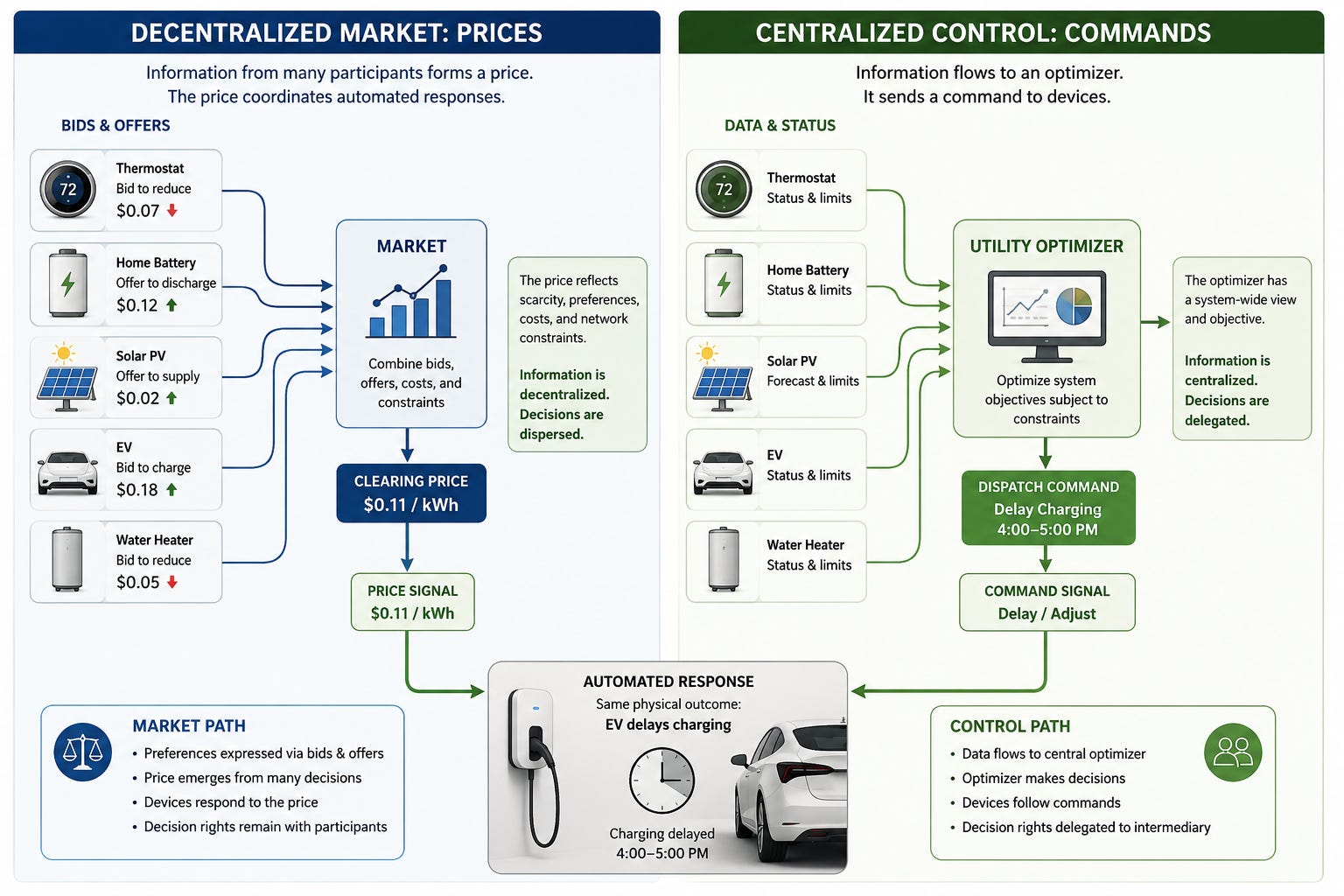
Source: The same rich conversation I had with ChatGPT.
Where Yglesias is right
As I discussed in Part 1, Yglesias correctly sees that flat retail prices suppress economically useful information: they make electricity appear equally scarce at every hour, even though the cost of serving another kilowatt-hour may vary enormously, and they weaken incentives to delay EV charging, pre-cool a building, discharge a battery, or accept a slightly different indoor temperature during a critical period.
He is also right that prices respect heterogeneity better than uniform appeals or commands: one household may value another degree of cooling greatly, another may barely notice it; one driver may need a full battery by 6 a.m., another may not need the vehicle until afternoon. Prices let those differences shape the response.
Yglesias is especially perceptive in worrying that VPPs can require people to surrender control to a third party. A centralized aggregator may optimize a portfolio, but optimization is not omniscience—it cannot fully know each customer’s changing circumstances and subjective priorities.
But “force everyone to pay the spot price” is not the best formulation of the alternative.
The stronger objective is to make marginal economic conditions available to retail markets and automated agents while letting consumers choose contracts that allocate risk differently: some will prefer direct price exposure, others will buy caps, hedges, subscriptions, managed charging, or fixed-price insurance, and still others may authorize an aggregator to manage devices under specified limits.
Spot-price foundations do not necessarily imply uniform spot-price contracts.
Where Schein is right
Schein correctly separates two political and practical objections to RTP: volatility and inattention. Caps, hedges, and simpler tariffs address volatility; automation addresses inattention. He is also right that time-of-use rates, critical-peak pricing, real-time prices, and VPPs can coexist rather than compete for a single place in the policy toolbox.
His strongest point is that power systems contain multiple layers of scarcity: a day-ahead wholesale energy price may not convey an intraday balancing need or a constraint on a particular distribution feeder, so simple wholesale pass-through is not a complete market design.
But Schein moves too quickly from inattention to VPPs. Devices can automate responses to prices without ceding all economic discretion to an aggregator: a thermostat can embody its owner’s preferences and submit a bid, an EV can incorporate a departure deadline while participating in a local market, a battery can respond to a reservation price. Automation can distribute agency instead of centralizing it.
Similarly, a VPP’s ability to respond to a local signal does not tell us how that signal was formed. A utility may determine that a feeder is constrained and issue a dispatch request—operationally effective, but not equivalent to a market in which the competing uses and values of local flexibility contribute to a clearing price.
Schein is right that prices and VPPs can complement each other. The next question is what lies between them: the market rules, contracts, decision rights, and control architecture that determine whether the system discovers value or merely administers behavior.
Prices or commands is the wrong final choice
The history from Boiteux to Schweppe, Olympic Peninsula, and TESS suggests a richer architecture. At the bulk-power level, SCED and locational marginal pricing can reveal time- and location-specific wholesale values. At the distribution level, transactive markets can incorporate feeder constraints, DER capabilities, and local willingness to consume or produce. At the retail level, competing contracts can translate those prices into different combinations of exposure, insurance, automation, and delegated control.
VPPs can participate at every level, aggregating small resources, managing risk, and simplifying participation—but aggregation does not eliminate the need for price discovery, consumer choice, and transparent institutions.
Real-time pricing has never been only about the number printed on a household bill. At its most ambitious, it connects the changing marginal value of electricity to the decisions of producers, consumers, and increasingly autonomous devices.
Yglesias is right about the power of prices, and Schein is right about the importance of automation and aggregation. Transactive energy helps reveal what each one leaves implicit: the signal sent to a device matters, but so does the process that produced it.
The central choice is not between prices and automation, but between automation governed by administrative commands and automation coordinated through prices that emerge from markets and stay connected to human preferences.
The questions at the end are the right ones. I would answer them.
Is the aggregator paid by a real market price? That depends on whether customers have other options. There is nothing wrong with an aggregator earning money for helping people manage devices, paperwork, and grid programs. Every market has middlemen.
The problem comes when the utility picks the aggregator and customers cannot choose another one. If other companies can compete, they have to offer better prices and better terms. If there is only one approved option, it can keep more of the value for itself.
Can customers choose a different company? In most places, no. The utility or its chosen aggregator is the only option. That is not really delegation. It is being told who gets to control your device.
Can customers leave? Technically, yes. But leaving may mean giving up the rebate or discount that paid for part of the heat pump, battery, or charger. Most people will not walk away from that money.
Who gets the value when a household shifts its electricity use away from a stressed period? Whoever wrote the contract. Competition gives customers a chance to keep more of it.
This is not a technology problem. Olympic Peninsula showed this could work in 2006 and 2007. Households saved about 10 percent. TESS is running another two-year pilot in Maine right now. Twenty years later, we are still doing pilots.
Why? Utilities make money by building things. Bigger wires, new substations, and other grid upgrades go into the asset base that earns them a return. A local market that avoids a grid upgrade can save customers money, but it can also mean the utility earns less.
Command systems are not just an accident. They are what the current rules reward utilities for building.
Those rules rest on the idea that delivering electricity is a natural monopoly. The idea is simple. Two companies stringing wires down the same street would be wasteful. So each utility gets an exclusive territory, and a commission sets prices in place of competition.
Walter Primeaux treated that as a claim to test, not a fact to assume. He studied American cities where competing electric utilities operated side by side, in some cases for decades. The studies found lower prices and lower costs, not chaos. And the utilities themselves lobbied for exclusive territories. Facts of nature do not usually need a lobbying campaign.
Hayek explains why a central planner cannot know what every household wants, needs, or is willing to give up. Mises adds a harder point. Without a market, no one can compare the cost of bigger wires with the value of avoiding them through flexible demand.
The utility can calculate what it earns either way. The regulator cannot see the value of local flexibility because there is no market price for it. And there is no market price because the monopoly system did not allow the market that would create one.
The rule blocks the test, then points to the missing results.
There is one question the article does not ask. Every version of this system, market or command, runs on data from inside the house. When people are home. When they sleep. When the car is charging and when it is gone. A bid-based system can work while revealing less, because a bid says what you will pay, not why. But less is not nothing, and the meter itself records enough to reconstruct a household's day.
So the question asked above about flexibility has to be asked again about data. Who owns what the household generates? Right now the answer is written into enrollment terms nobody reads, and in most states the government can take meter data without a warrant. The value of flexibility and the record of how a family lives are being assigned by the same contracts, at the same time, before anyone has been asked.
An agent that bids for you but reports on you is not your agent.
Coase would ask a simpler question. Why use commands instead of a market? Commands make sense when running a market costs too much. It once cost too much to meter every home in real time and match bids. It does not anymore. When the cost that once justified command is gone but command remains, something else is holding it in place.
Regulatory capture is what is holding it in place. Stigler and Peltzman.
If exclusive territories went away, nobody would need to decide whether these pilots should scale. Competitors would scale them. Twenty years of pilots is not proof that the model needs more testing. It is proof that the test was never allowed to count.
The harder question is who gets to choose the system, and whether they make more money from prices or from commands. And who ends up owning the record of how every household lives, because those contracts are being written now.