
I am fascinated by ride through, and if you read Knowledge Problem you, too, should be at least intrigued if not fascinated.
Ride through is an operational rule in power systems requiring that a customer’s load stay connected to the grid during a brief disturbance rather than disconnecting immediately. The physics of alternating current is the issue. In an AC system, voltage and current oscillate as a sine wave at a nominal frequency (60 hertz in the United States) and the grid operator has to keep generation and load in continuous balance, moment to moment. Frequency is the signature of that balance: it holds steady at its nominal value when generation and demand line up, and drifts up or down when they diverge. Voltage is a more local phenomenon, rising and falling at a given point on the network rather than across the system as a whole. When either quantity moves outside its normal range, protective relays are often set to trip a customer’s load off the grid entirely, shielding that customer’s own machinery from damage.
Most voltage and frequency deviations are small, correcting themselves within seconds through the grid’s own automatic controls. The trouble starts when a very large load reads a passing disturbance as a serious threat and drops hundreds of megawatts (MW) all at once, turning a manageable fluctuation into a systemic problem.
In the days of electro-mechanical technology, the arrangement between a utility and a large industrial customer like a steel plant was straightforward and well understood by both parties. If the plant’s machinery was at risk, its owner could set the plant’s protective relays to trip its connection and drop off the grid. That trip happened quickly by the standards of its era, but slowly compared with today’s digital controls, and it dropped a load far smaller than a modern data center’s. The grid operator, for its part, had well-defined contingency protocols of its own, built around disturbances that likewise unfolded at electro-mechanical rather than digital speed.
The contract between them, and the reliability it protected, was built for those technologies. Now the technologies have changed, and the contract has to change with them.
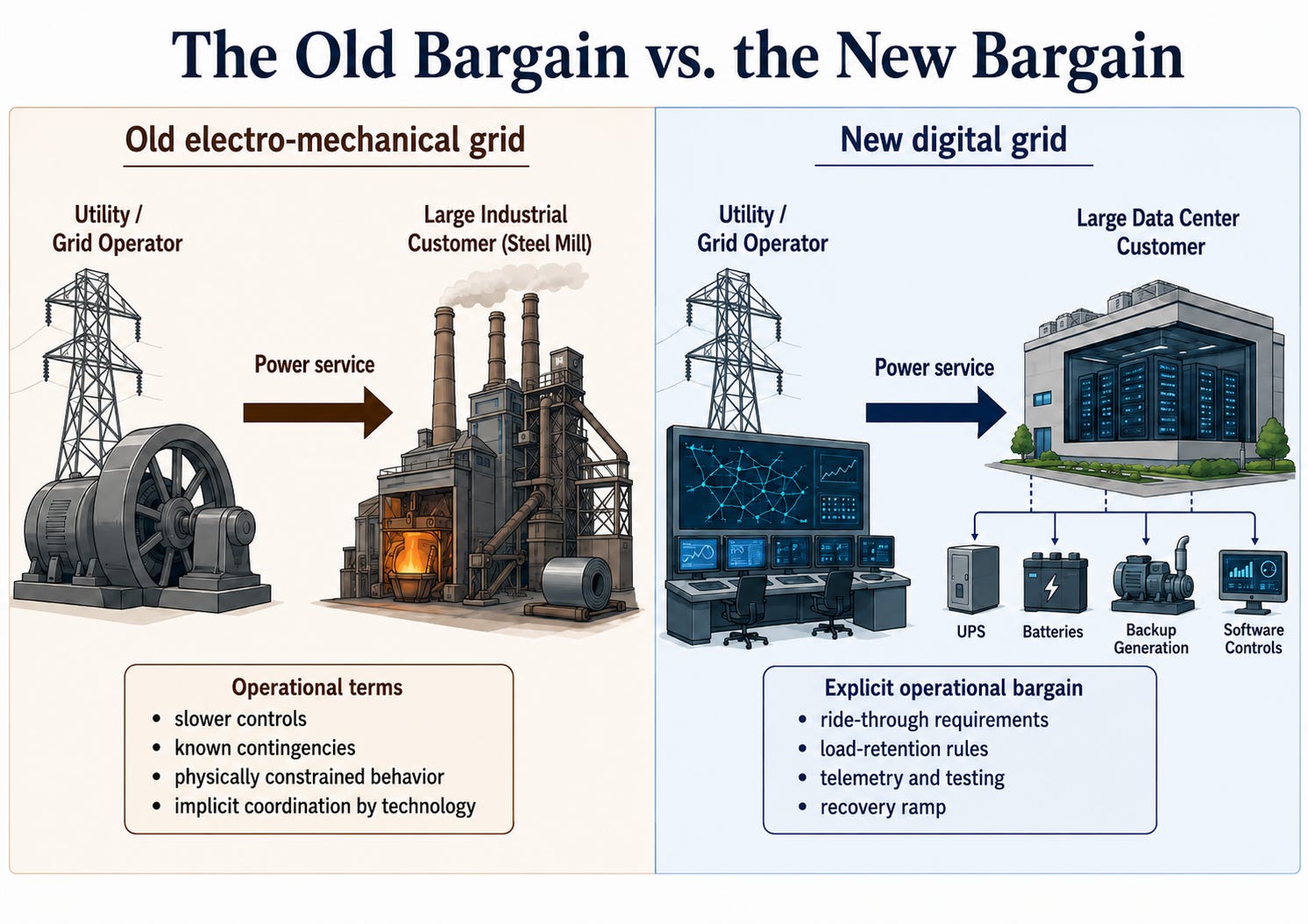
Source: My conversation with ChatGPT asking it to explain ride through to a non-engineer so I could characterize it well
Ride through and the new operational bargain between data centers and the grid
Data centers consume large amounts of electricity and can change how they consume it in an instant. That speed changes what a utility has to manage. Large industrial customers have always been part of the grid — smelters, steel mills, chemical plants — and their outages have never been trivial. Today’s data centers present a different problem: they are big, fast, electronically controlled, internally flexible, and often opaque to the grid operator watching from outside.
In July [edit: I originally said February, corrected to July], 2024, a lightning-induced fault on a transmission line caused a series of voltage depressions. Sensing these “voltage excursions”, 60 data centers in northern Virginia simultaneously and autonomously dropped off the grid and switched to onsite back and uninterruptible power supply (UPS) resources, reducing grid demand by 1,500 MW (based on the NERC analysis of the event). These responses appear to have been uncoordinated, customer-initiated load withdrawals caused by voltage-sensitive protection and UPS controls.
From the data center’s perspective, fast disconnection looks like prudent self-protection, while from the utility’s perspective, the sudden disappearance of a very large load looks like a major imbalance. If generation keeps producing while demand vanishes, frequency and voltage can rise, and if multiple facilities have similar controls and respond at once, the effect compounds well beyond what any single customer intended.
Ride-through requirements have consequently become serious business. A ride-through rule creates a tolerance window: within a defined range of voltage or frequency deviation, for no more than a defined time, the customer must not trip off or cut load sharply in an uncontrolled way. It may still protect its equipment, just not by exporting a sudden disturbance onto the rest of the grid. If you want more technical depth, this ESIG large load report from February 2026 discusses ride through and other operational strategies for large loads.
While it looks technical, the ride through question is fundamentally economic. Ride through is an engineering setting that is part of a new operational bargain between the utility and the large-load customer.
What the old bargain assumed
The older electro-mechanical grid’s bargain looked different because the technologies had different capabilities. Large industrial customers ran physical processes — rotating motors, furnaces — while utilities operated synchronous generators, carried more rotating inertia, and built practices around known contingencies. A steel mill tripping off was a serious event, but it could not sense a disturbance, transfer demand to batteries, shed selected systems, and recover by a programmed algorithm, all of which a data center can do. Behind the meter, it runs UPS systems, rectifiers, cooling, and backup generators, governed by control software whose aggregate response the utility cannot see unless interconnection demands disclosure and telemetry (remote measurements fed into control systems in near real time).
Why Coase is the right lens
Changing technologies change what good operating rules are, opening up a Coasean bargain between utilities and data centers.
Ronald Coase’s 1960 paper, “The Problem of Social Cost,” pointed out that harms are reciprocal — if a railroad’s sparks damage a farmer’s crops, stopping the railroad harms it in turn. The real question is how to assign property rights/liability for harms so the parties minimize their combined cost. When transaction costs are low, they will bargain to the cheapest approach and split the surplus.
Ride through has exactly this structure. A data center that trips or cuts load during a disturbance imposes costs on the grid and other customers, while a utility requiring it to stay connected imposes costs right back, in equipment, batteries, controls, testing, and telemetry. Neither party is guilty; their technologies simply interact to create new margins of cost and value. One assignment of rights lets the data center disconnect whenever its controls deem necessary, leaving the utility and other customers to absorb the risk; the opposite assignment requires it to ride fully through defined disturbances, leaving it to bear the cost of grid compatibility.
One of Coase’s insights was that with zero transaction costs, the initial assignment wouldn’t matter, since parties would bargain to the efficient result regardless. But transaction costs here are real: the utility knows the grid constraints, the data center knows its control architecture, neither fully knows the other’s exposure, and other affected customers aren’t at the table at all, leaving regulators to stand in for them.
The form of the bargain shapes the outcome, then, and so do its default rules. “The data center shall ride through grid disturbances” assigns rights too crudely to let the parties discover lower-cost ways of splitting the costs and the surplus. A more useful arrangement specifies rights with measurable precision: voltage and frequency conditions for staying connected, minimum load retained at interconnection, the rate and sequence of any demand reduction, circumstances permitting transfer to backup generation, and required telemetry and recovery ramp rate.
Complete versus partial ride through
Complete ride through means the facility stays connected and keeps drawing approximately its pre-disturbance power: a 300 MW data center facing a short voltage disturbance holds demand close to 300 MW, batteries and controls smoothing the event internally. Partial ride through means the facility stays connected while temporarily reducing demand in a controlled, bounded way — that same facility might drop to 220 MW, recover to 260 MW within seconds, and return gradually to 300 MW, an 80 MW reduction rather than a sudden disappearance. Partial ride through can be the efficient compromise, because (in Coasean terms) it can avoid the harm while reducing the combined capital and operating costs to both the data center and the utility.
Economically, partial ride through works because the parties can negotiate over control specificity. The data center says, in effect: I cannot promise full load under every disturbance, but I can promise not to disappear, and I can tell you how much I will retain, how fast, and how I will recover. That promise lets the utility operate with far less uncertainty, which has real cost: a utility assuming an entire campus could trip instantly needs more transmission investment and reserves than one planning around a bounded response. That avoided cost is part of the surplus the two parties can divide, whether as faster interconnection, lower upgrade charges, a different tariff, or a mutually acceptable allocation of reliability risk.
The central object of this bargain is the right to impose a particular dynamic load profile on a shared network, not energy consumption itself. Understood this way, it can resolve data center interconnection timing without necessarily increasing utility investment or residential customer costs.
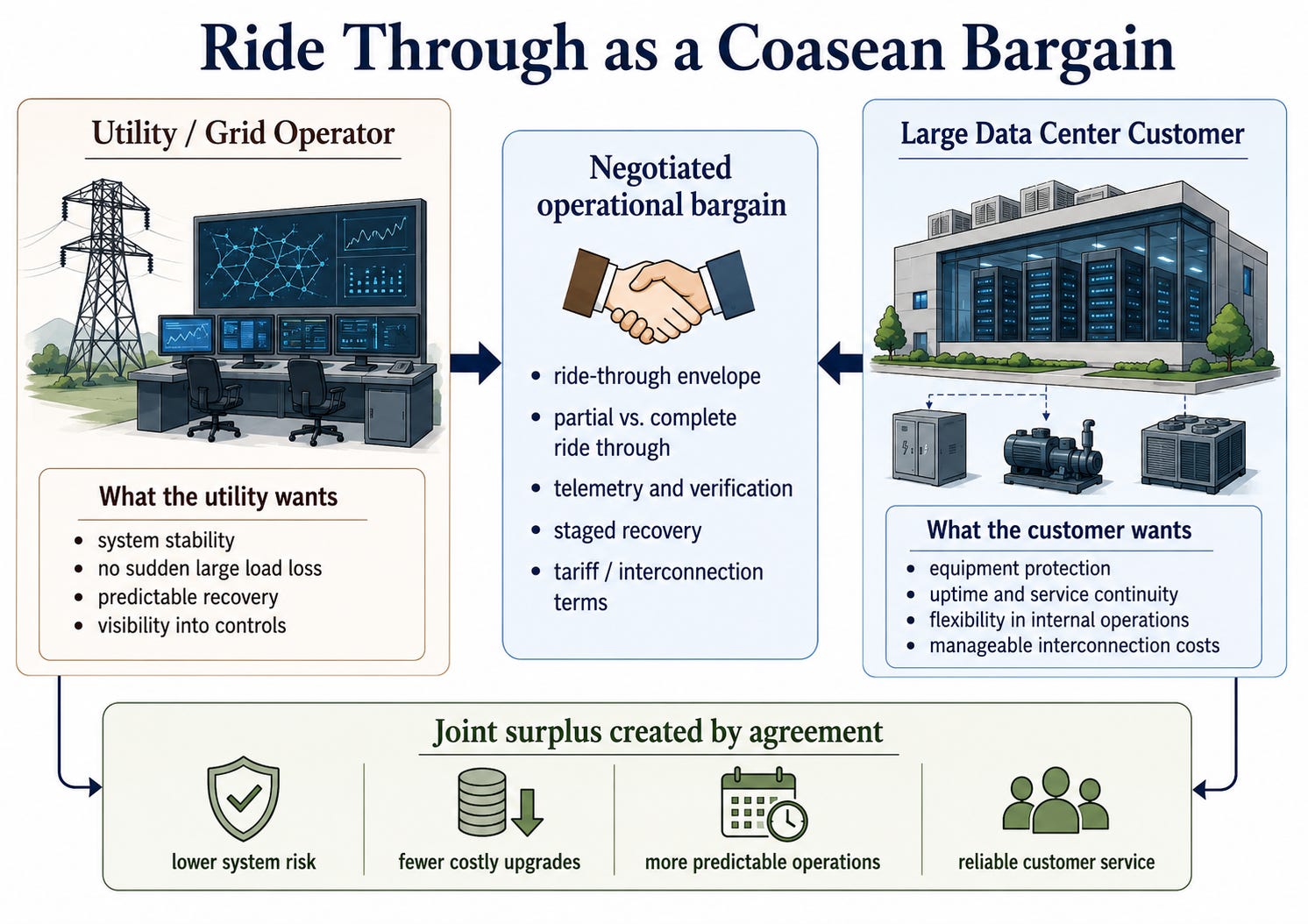
Source: Me explaining to ChatGPT the sense in which ride through is a Coasean bargain in our new technological context
The disappearance of tacit terms
In the older grid, some operational “contract terms” never needed writing down, since they were embedded in the technologies themselves. Physical characteristics narrowed the range of possible behavior, so no contract needed to say a large customer could not drop 800 MW in 120 milliseconds and restore it through a synchronized, software-controlled ramp. Those terms were tacit in the Michael Polanyi and Hayek sense: implicit and unstated, embodied in equipment, engineering conventions, and shared experience rather than in contract language.
Digitalization weakens that tacit coordination. Once behavior becomes programmable, a data center can decide, through control logic alone, whether to stay connected, reduce load, transfer to batteries, or recover in blocks — choices invisible to the utility unless disclosed and verified. “Large load” no longer tells the operator enough; the relevant context is now large load plus control architecture plus recovery algorithm. Ride-through requirements substitute for that lost tacitness: as the system grows more programmable, the contract has to grow more explicit alongside it.
A layered approach, not a micromanaged one
None of this calls for micromanaging every server rack. A well-designed bargain specifies performance at the interconnection point, articulates what the facility will do electrically when disturbed, and leaves flexibility behind the meter.
Of course, given my love of integrating systems theory with economics, I’m going to suggest a layered approach: an equipment layer, where the data center designs UPS systems, converters, batteries, and cooling to tolerate defined excursions; a facility-control layer, where it decides which loads stay at full power, which curtail, and how workloads adjust; and a grid-interface layer, where the contract specifies what the utility can observe — retained load, ramp rate, ride-through duration, telemetry, event reporting.
But the grid is a shared system, and many affected parties are absent when one utility and one large customer negotiate bilaterally, which is why minimum standards and regulatory oversight matter. Uniform rules have limits of their own, though: a 75 MW facility on strong grid infrastructure is nothing like a 1 GW campus at a constrained corridor’s end, and deep battery capability is nothing like backup architecture that produces a sudden full transfer away from the grid. The efficient arrangement often requires site-specific terms on general standards, since Coasean bargains are context-specific.
The most contentious policy work lies in that middle ground: too little specificity leaves the utility guessing and socializes risk, while too much regulation freezes technology in place. The goal is performance-based specificity — define what the grid needs, make it observable, and let both parties innovate around it.
The larger institutional point
Ride through, then, is a small technical phenomenon pointing toward a large institutional change: the old bargain relied on physical constraints and well-characterized contingencies, while the new one has to rely on explicit contracts, standards, telemetry, and adaptive governance. Digital controls create new gains from exchange as well as new reliability risks. A data center that can shape its load precisely during a disturbance is a source of flexibility with real value, not just a risk to be managed.
The Coasean opportunity is turning that flexibility into a bargain: the data center gains access, predictability, and credit for verifiable grid-supportive performance, while the utility gains a large load that is bounded and operationally useful rather than opaque and potentially synchronized with every other large load on the system.
Technological change does more than add devices onto an old grid—it changes the terms of coordination. When physics supplied more of the governance, contracts stayed thinner; as software expands the feasible activity space, more of the bargain has to be made explicit.
Ride through is one place where that transition is easy to see. Engineering settings become economic rights, private resilience meets system resilience, and the grid’s old tacit bargain gives way to one more explicit, more programmable, and more negotiable.
If we are going to get through this situation productively, we have to approach grid operations and regulatory policy looking for Coasean bargains.
A customer today cannot sue when the lights go out. The utility's terms exclude liability for interruptions. He cannot switch, because one company owns his territory. He cannot pay for better service or accept worse for less, because everyone pays the same rate. He can complain to a commission that also guarantees the utility gets its money back. Regulation removed his seat at the table.
Without a regulator, the utility pays when service fails. It will negotiate hard with any customer whose equipment can drop 1,500 megawatts in an instant. Today that loss lands on other customers. Make it land on the utility and the ride-through terms get written without anyone ordering them.
A hospital and a car wash now buy the same reliability at the same price. Let them choose. The hospital pays more for firm service with damages if it fails. The car wash takes cheaper service that can be cut. Each has told the utility what reliability is worth to him. That information does not exist today.
Insurance answers who checks the data center's controls. An insurer covering a large facility cannot price the risk without knowing how the equipment behaves, so it demands the data. Money at stake, no politics. Electrical safety standards were built this way, by fire insurers who needed to know what was safe.
Customers can own the utility. Nine hundred rural electric cooperatives already do. The customer and the owner are the same person.
Data centers already sell what they want guaranteed. Cloud companies sell uptime commitments and pay when they miss, under standards written privately. Large industrial customers have negotiated interruptible contracts for decades. Any customer big enough to bargain already bargains. Regulation stops everyone smaller.
Someone can benefit from a stable grid without paying for it. Access can be conditioned on behavior and withdrawn. A single large customer at a weak point on the network has leverage and can charge for behaving well. Nothing fixes that. It makes the charge visible instead of buried in a rate case.
Building your own generation, or a private line to a neighbor, is how a customer leaves. That is restricted nearly everywhere. Franchise monopolies, standby charges, rules against selling power across a property line. The regulator's main function is not speaking for the absent customer. It is keeping him from leaving.
This is a fascinating example of how a problem that is easy to imagine becomes much more consequential once the real operating details are visible. A data center dropping hundreds of megawatts almost instantly is not simply protecting itself; it can convert a manageable disturbance into a system-wide imbalance. Your distinction between complete and partial ride through makes the emerging bargain especially concrete.
I wonder, though, how this Coasean opportunity interacts with the political circumstances now surrounding many data-center projects. A local utility may be trying to negotiate telemetry, retained load, recovery ramps, and equipment responsibilities while simultaneously facing a hostile public, local officials considering a moratorium, and a hyperscaler perceived as having imposed the project from outside.
These are admittedly different issues, but they may collide institutionally. A temporary moratorium could create time for the utility and data-center operator to work through ride-through details. It could also push the parties further apart, harden political positions, and delay the bargaining needed to make the project safer.
Does the Coasean bargain work best before the political conflict reaches that stage—and should ride-through obligations become part of the public interconnection discussion rather than remaining largely technical negotiations between the utility and the customer?