
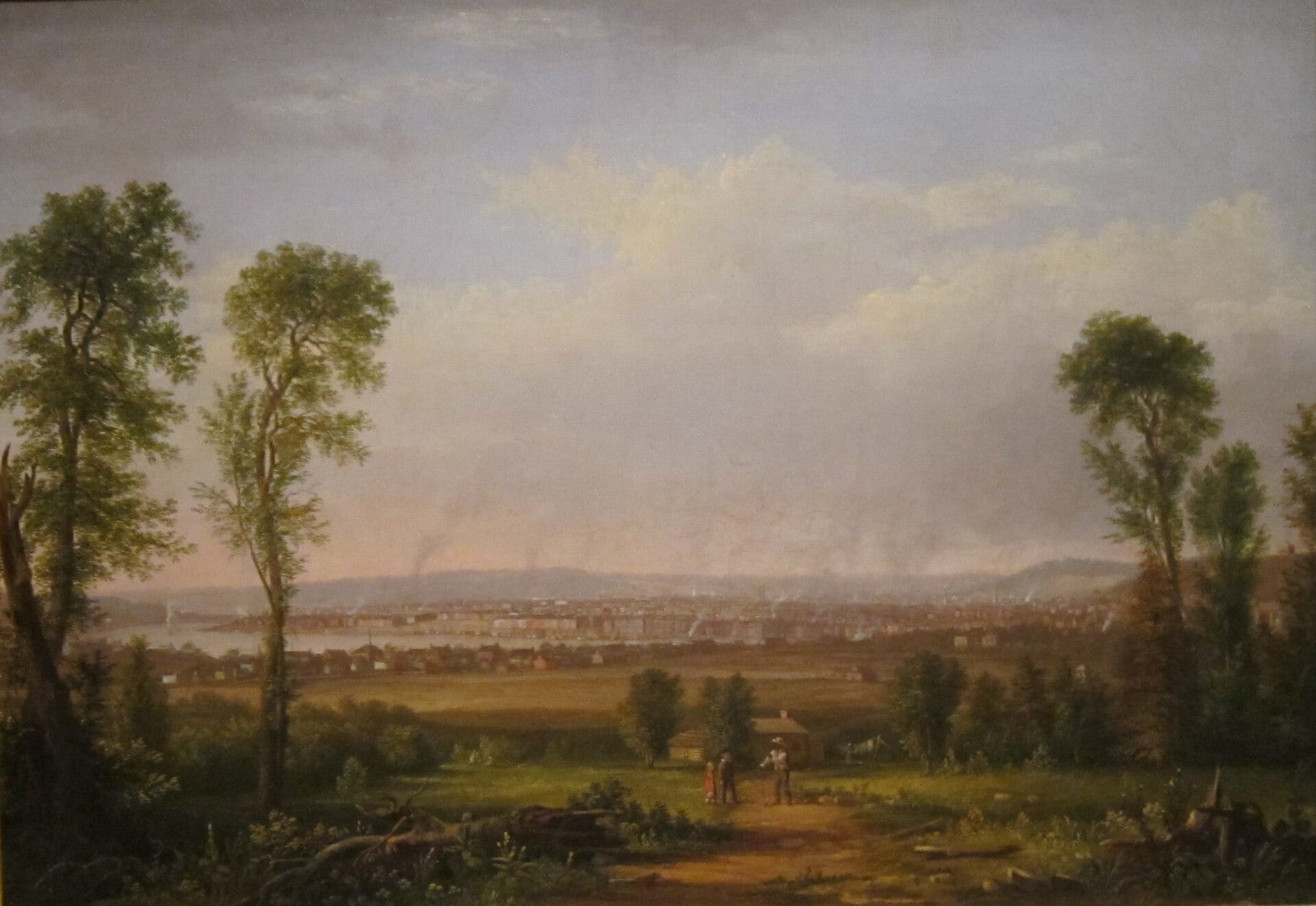
Robert Duncanson, View of Cincinnati, Ohio from Covington, Kentucky (c. 1851), Cincinnati Art Museum
Reminder: I am using multiple translations; my main reading is from the hardbound copy of the Mansfield translation. When I refer to page numbers it’s to the Mansfield translation, and when I want to pull quotes that are longer I’ll use the online Schleifer translation, so the text may not match exactly but they are close (and I also read French so I calibrated across the translations to get comfy with Tocqueville’s word choice).
Volume 1, Part II, Chapter 10, from “Position That the Black Race Occupies in the United States; Dangers Incurred by Whites from Its Presence” to end of chapter
The final sections of this chapter are challenging to read and write about. Tocqueville analyzes slavery, racial hierarchy, sectional conflict, the durability of the Union, republican institutions, and American commercial power, and the history between then and now inevitably presses upon the reader, as do the intervening changes in moral norms and language.
Still, these sections show Tocqueville’s consistent strengths as an acute observer, performing disciplined institutional analysis throughout by asking how laws, mores, incentives, beliefs, economic arrangements, and inherited practices interact over time. He treats institutions neither as formal rules that produce their intended conduct automatically nor as mere cover for material interest. Tocqueville is no determinist — the same structure can produce different outcomes as circumstances and conduct change. Structure constrains conduct without fully determining it.
His method is clearest in the analysis of slavery, which opens with one of the chapter’s most powerful passages: an evil that “enters into the world furtively,” beginning with an unnamed individual and “deposited like an accursed seed at some point in the soil” (p. 326), from which it feeds on itself and grows naturally with the society that receives it.
The image of the accursed seed captures the argument. Slavery begins in acts of domination, but once established it produces interests, expectations, habits, inequalities, and fears that help sustain it. The institution becomes embedded in property, labor, family organization, status, regional identity, and political power. Tocqueville is unequivocal about slavery’s evil, but he is equally interested in how it changes the society that receives it, narrowing the range of later choices and making reform increasingly difficult.
His comparison between ancient and modern slavery leads to one of the section’s central claims. In antiquity, slavery usually did not rest on a permanent and visible racial distinction; slave and master might belong to the same race, and once liberty was granted they could intermingle more easily. Modern slavery joined legal servitude to racial difference, so that where the ancients only had to change the law, “the real difficulty begins where in antiquity it ended” (p. 327): the moderns must also change mores, and mores move far more slowly.
This application of law-and-mores analysis to slavery is really an extension of Tocqueville’s analysis of democracy more broadly. Formal law and informal custom work together to structure political and social life, so abolishing slavery in law cannot by itself abolish the status hierarchy and prejudice slavery created. He catalogs the divergence between de jure rights and de facto exclusion: Black Americans may possess electoral rights in free states, but exercising them can be dangerous; the law may permit jury service, but prejudice excludes them; courts are formally open, but judges and jurors are white; schools, theaters, hospitals, and churches remain divided. His conclusion is paradoxical but shrewd: “inequality becomes imprinted in the mores as it fades in the laws” (p. 330). Legal change can remove an official barrier while leaving the wider structure of exclusion intact; indeed, as formal inequality disappears, custom may work harder to preserve social distance.
The institution of slavery freezes enslaved people in a static situation in which they cannot pursue their own paths for self-improvement. Slavery denies education, property, autonomy, and the opportunity to develop judgment and responsibility, and the results of that deprivation are then treated as evidence of incapacity and used to justify further exclusion — the vicious circle Tocqueville identifies, consistent with the importance he places elsewhere in the book on freedom as a condition for self-improvement.
His analysis also conveys compassion, both for the enslaved and for those who want to change the system but feel trapped within it. He acknowledges how difficult it is for those fortunate enough to have been born among people whom law recognizes as equals to understand the distance slavery creates — an expression of epistemic humility, an attempt to reason by analogy from outside an institution whose full human consequences he knows he cannot experience.
Tocqueville then turns to economics. His comparison of Kentucky and Ohio, separated by the Ohio River, operates as a sort of proto-natural experiment: Kentucky permits slavery, Ohio does not, and he finds a stark difference in population, prosperity, industry, and the meaning attached to labor — “there it is debased, here it is honored” (p. 332). He does not fully account for other causal factors, such as terrain or settlement patterns, but his institutional mechanism matters more than the experimental design: slavery changes not just the labor contract but the social meaning of work itself. Enslaved workers lack incentive to exert effort or improve method; masters grow idle; white laborers avoid work associated with servitude; free labor, by contrast, connects effort to advancement and dignity.
His economic argument here anticipates the seminal analysis in Robert Fogel and Stanley Engerman’s Time on the Cross (1974). Tocqueville challenges the apparent cheapness of slavery: the wage paid to a free worker is visible and immediate, while the cost of maintaining an enslaved worker is dispersed across food, clothing, childhood, illness, old age, supervision, and coercion, easy to overlook because no single payment ever makes it legible. In the end, he concludes, “the slave has cost more than the free man” (p. 332). The claim is about productivity and incentive as much as morality — institutions cultivate characteristic forms of conduct, and slavery degrades labor, weakens initiative, and makes idleness honorable.
Tocqueville extends this analysis to inheritance law. He has already identified inheritance rules elsewhere in the book as a factor shaping American life, and here he claims that no great institutional change occurs “without discovering, among the causes of this change, the inheritance law” (p. 334). Primogeniture in the South had preserved concentrated fortunes, inherited leisure, and a stable ruling class that maintained the prejudices and habits of slave society; partible inheritance, instituted in the Constitution, fragmented estates and weakened that aristocratic structure by changing the institutional ecology surrounding slavery. The analysis here is characteristic of Tocqueville’s method throughout: he studies slavery not in isolation but in interaction with landholding, labor markets, social honor, family structure, and regional political power.
His discussion of the difficulty of abolishing slavery in the South is morally exacting and analytically patient at the same time. Tocqueville refuses to justify slavery — “God keep me from trying... to justify the principle of the servitude of Negroes” (p. 346) — while also explaining why those living within the institution might find it culturally, economically, and politically difficult to abandon. He keeps two thoughts in view: the moral principle is clear, and the transition problem is extraordinarily difficult, because past injustice has already built a structure in which every remaining course looks dangerous. Structure constrains conduct here, but it does not eliminate individual agency or responsibility.
The section on the durability of the Union extends the same institutional analysis to federalism. Tocqueville does not assume a well-designed Constitution preserves itself; the federal government is a weak government that “needs the free concurrence of the governed in order to subsist” (p. 353). The Union rests on more than law — on material interdependence, shared belief, common political principles, habits of cooperation, and continued willingness to remain associated, since, as he puts it, “there is a society only when men consider a great number of objects” (p. 358) in roughly the same way. Americans disagree about policies and means, but Tocqueville believes they share a common political grammar: popular sovereignty, liberty, equality, freedom of the press, association, juries, and public accountability.
Slavery threatens the Union not only through conflicting economic interests but by producing divergent regional mores; it attacks the confederation “indirectly by its mores” (p. 361) rather than directly by its interests. Different labor systems produce different social relations, habits, and political judgments. Rapid national growth compounds the danger: new states introduce new interests, coalitions, and claims to power; population and influence move westward; older states may prosper in absolute terms while losing relative power. Tocqueville reaches another paradox: “the greatest danger that threatens the United States arises from their very prosperity” (p. 368). Prosperity changes the distribution of power, breeding ambition among rising states and envy, distrust, and regret among those losing influence; aggregate growth does not guarantee political cohesion.
Yet Tocqueville distinguishes the Union from the republican institutions of democratic self-government grounded in popular sovereignty, local liberty, rights, mores, and restraint. The federal arrangement may be fragile while republicanism remains deeply rooted in equality of condition, local self-government, and habits of participation. The Union is a constitutional structure; republicanism is embedded in the social state.
His final discussion of American commercial greatness shows the productive side of democratic mores. Geography gives Americans rivers, ports, resources, and access to trade, but physical advantages alone are not sufficient for commercial success, which grows from practical intelligence, mobility, risk-taking, adaptability, and decentralized initiative.
These concluding sections display Tocqueville’s political science at its best. He explains why slavery survives in mores after disappearing from law, why coercive labor shapes an entire society, why federalism depends on more than constitutional text, why prosperity can destabilize political power, and why free institutions can generate productive energy. He doesn’t treat people as deterministic followers of institutions or imagine they can simply will institutional consequences away: people inherit structures they did not create, and those structures shape their interests, fears, beliefs, and available choices, but institutions remain products of human action and judgment. Structure constrains conduct without fully determining it.
Links to the essays thus far in the Reading Tocqueville at 250 series:


Lynne,
The line I keep returning to is that inequality becomes imprinted in the mores as it fades in the laws. It generalizes well beyond its subject. Removing a formal barrier while leaving intact the structure that produced it does not end the exclusion; it relocates it. Once law and mores diverge, the adjustment shifts into informal institutions, where it becomes harder both to see and to challenge because there is no statute left to repeal. Tocqueville is saying the visible constraint was never the decisive one.
That connects to something in your durability section that deserves even more weight than it gets. A federal government that needs the free concurrence of the governed in order to subsist, together with a society existing only when men consider a great number of objects in roughly the same way, says the constitutional structure is downstream of the mores rather than the source of them. If that is right, the constitutional text was never doing the work we usually assign it. Which would explain why a document that has changed so little now supports a government that would be unrecognizable to the people who ratified it. The words held. The common political grammar underneath them did not.
Two smaller points.
The Fogel and Engerman comparison is the boldest move in the essay, and I think it needs one more sentence. Tocqueville anticipated their accounting question, that the cost of maintenance is dispersed across food, clothing, childhood, illness, old age, supervision, and coercion so that no single payment makes it legible. He did not anticipate their conclusion. They argued slavery was economically efficient. Anticipating the method while reaching the opposite conclusion is worth distinguishing.
On inheritance, the causal direction is left open. You report that primogeniture preserved concentrated fortunes and a stable ruling class, and that partible inheritance fragmented estates and weakened that structure. The alternative is that concentrated fortunes sustained primogeniture, and that the rule survived because the interests it served were strong enough to preserve it. Tocqueville's own method suggests the relationship is endogenous. Institutions create interests, those interests preserve institutions, and the causal arrows run both ways.
The Kentucky and Ohio passage is the best part. You concede the design problem before anyone can raise it and then show why the institutional mechanism survives the concession.
Jeffrey