
Our new paper asks a deceptively simple question: has participation in wholesale power markets shifted electricity generation in a lower-carbon direction? The answer matters not only for electricity economics, but also for how we think about climate policy, market design, and the institutional architecture of the grid.
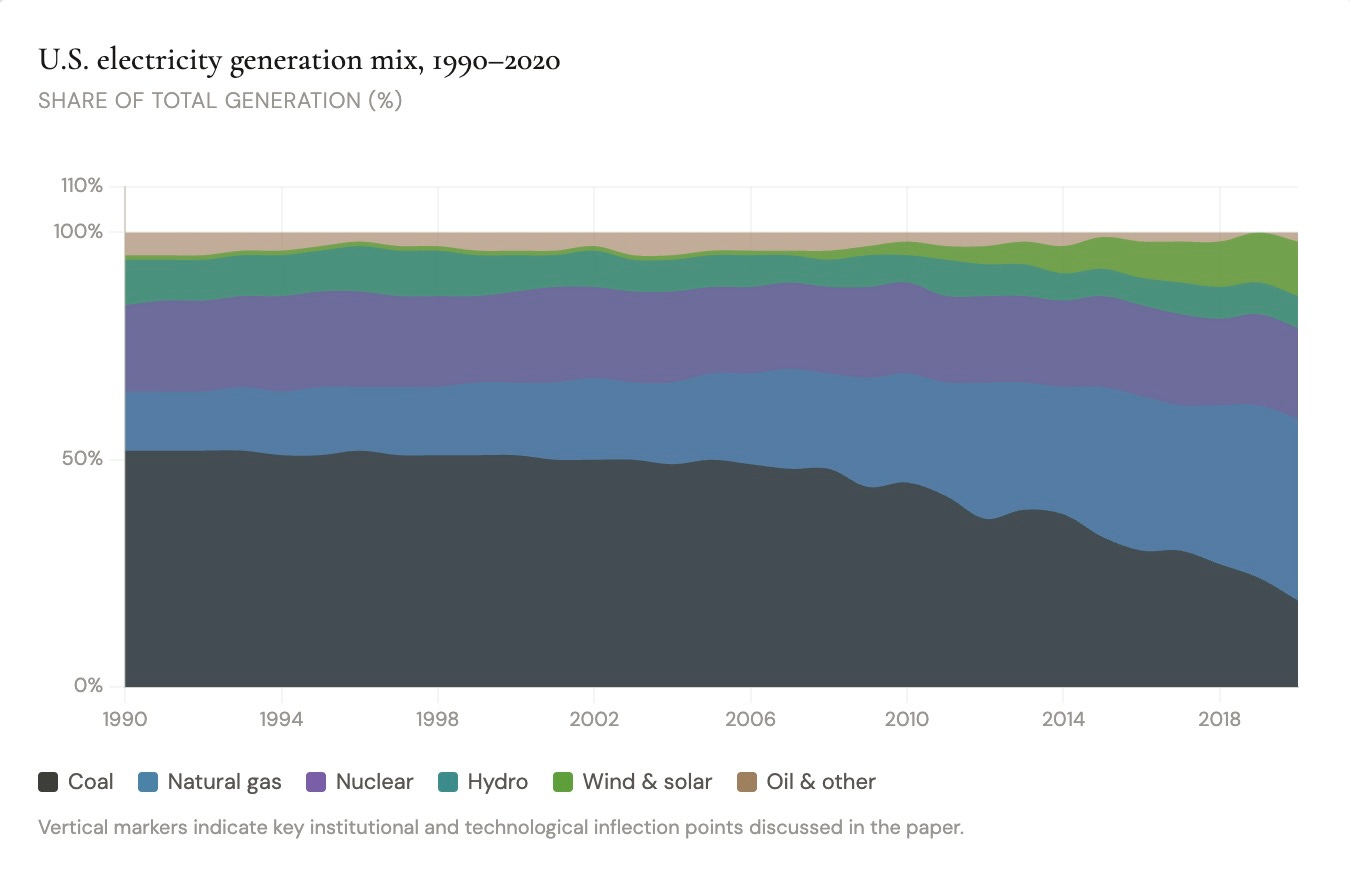
A recurring mistake in energy debates is assuming that decarbonization is only a technology story. Wind and solar got cheaper. Natural gas got abundant. Coal declined. Emissions fell. That story is not wrong, but it is incomplete. Generation technologies do not deploy themselves, and they do not operate in an institutional vacuum. They are built, financed, dispatched, and retired within rules, and those rules influence incentives, shaping the path of technological change along the way.
Has market participation fostered lower-carbon generation? That is the question my new paper with co-authors Joshua Rhodes and Samantha Zyontz, Do Power Markets Promote Decarbonization? Evidence from State-Level Data in the United States, takes up (ungated manuscript version). We ask whether participation in wholesale power markets is associated with a lower-carbon generation mix over time, especially in states that restructured and unbundled generation from traditional utility regulation. Using annual state-level generation data from 1990 through 2020, we compare restructured states to several different control groups across five distinct phases of wholesale market development, letting the institutional history guide the empirical strategy. Because the institutional history here is messy, staggered, and heterogeneous, we do not make strong causal claims. Instead, we use a block-treatment-window difference-in-differences strategy to study a comparative institutional question that has been surprisingly undertheorized in the literature.
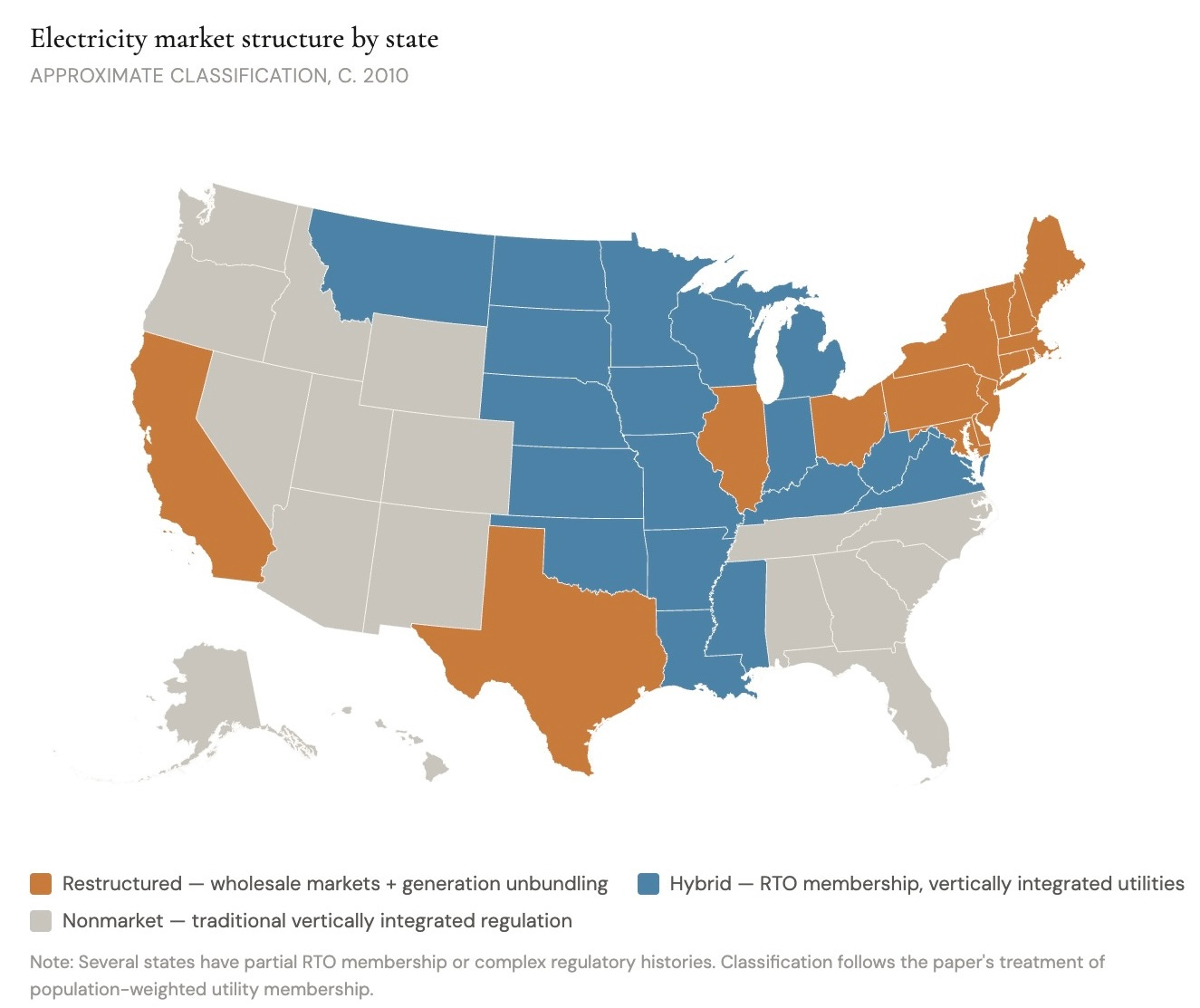
Three institutional categories drive this comparison. Nonmarket states retained the traditional model of vertically integrated, regulated utilities — a single company owning generation, transmission, and distribution, with a regulator setting rates and approving investments. Restructured states went further, requiring utilities to divest their generation assets to independent power producers and opening both wholesale and, to varying degrees, retail markets to competition. Hybrid states occupy the analytically interesting middle ground: they joined organized wholesale markets through MISO or SPP, gaining access to regional dispatch and market pricing, but retained vertically integrated utilities and did not require generation divestiture. This category turns out to be valuable precisely because it allows us to separate the effect of market participation from the effect of full restructuring, treating each as a distinct institutional feature rather than collapsing them into a single undifferentiated treatment.
The five phases reflect the uneven chronology through which these arrangements developed. The first two hypotheses compare early restructuring states — those beginning wholesale market operations between 1997 and 1999 — against nonmarket states, first through 2003 and then extending to 2012 to capture the effects of the shale gas revolution and falling wind production costs. The third and fourth hypotheses run the same comparisons, swapping the control group from nonmarket states to the original MISO states, asking whether restructured states look different from states that joined an organized market without unbundling generation. The fifth hypothesis extends the analysis through 2020, using the full set of MISO and SPP hybrid states as the control group, asking whether full restructuring produced a different generation mix than market participation alone. Running these five analyses in parallel, rather than forcing them into a single specification, allows the institutional history to do what it should: discipline the empirical strategy rather than be flattened by it.
The headline finding is straightforward, although its implications are not. In all five cases, market participation through restructuring is associated with more lower-carbon generation than in the control states. But the strongest and most consistent effect is the substitution of natural gas for coal and oil, not a sudden flowering of wind and solar alone, especially in the earlier years and through roughly 2012. In later years, restructured states and control states begin to look more similar, suggesting that the institutional advantage of restructuring has been narrowing as markets and policies have converged.
That pattern tells a more historically disciplined story about how electricity decarbonization has actually happened in the United States. Markets have helped move generation toward a cleaner mix, largely through how dispatch rules and investment environments enabled the gas-for-coal transition, while also producing weaker but still meaningful evidence in some cases for non-gas low-carbon generation.
The lesson is that market processes can and do align economic and environmental incentives, and that market design is itself part of sound policy.
That distinction matters because too much contemporary discussion treats decarbonization as if the only intellectually respectable endpoint is eliminating every last ton immediately. But power systems are complex, capital-intensive coordination systems operating under hard reliability constraints and political limits on cost. How do we build a power system that gets cleaner over time without making it less reliable or unnecessarily more expensive?
This system design framing is the deeper argument running through the paper. Decarbonization is an institutional and system design problem. Electricity markets determine how generators compete, how prices convey information, how dispatch works, how new technologies enter, and how investment incentives are structured. Those institutional features are part of the mechanism through which the generation mix changes.For that reason our historically grounded comparative institutional analysis that captures the messy reality of regulatory restructuring contributes to this ongoing literature and discussion.
The Paper’s Contributions
One original contribution of the paper is that it moves the literature away from a too-simple binary. Many discussions implicitly compare “markets” to “regulation,” as if the United States had two distinct categories and a referee with a whistle. It did not. Our analysis distinguishes among the three institutional arrangements described above: nonmarket states, restructured states, and hybrid states. Beyond being useful taxonomic housekeeping, that distinction captures a central feature of the U.S. electricity sector: organized market participation is not the same thing everywhere, and institutional architecture shapes incentives and shows up in variation in the generation technology mix.
A second contribution is that the paper integrates three strands of literature that are too often discussed separately: the literature on renewables and emissions, the literature on natural gas and emissions, and the literature on restructuring and economic efficiency. If institutions affect investment incentives and dispatch incentives, then institutions can also affect emissions through the technologies that get built and the plants that run. Yet much of the decarbonization literature still behaves as if fuel prices and technology costs do nearly all of the explanatory work, with market institutions entering stage left only as a control variable. Our paper argues that this approach misses something important. The path of decarbonization is an institutional story that includes markets as well as a technology story and a fuel-price story.
A third contribution is methodological, although here the contribution lies as much in restraint as in technique. The historical evolution of wholesale power markets in the United States has been messy, and does not lend itself neatly to a single clean treatment date and a simple causal identification strategy. Different regions evolved at different times, with different combinations of market formation, regulatory restructuring, generation divestiture, and later technological change. Rather than pretending otherwise, we structured the empirical analysis around five separate hypotheses and let the institutional history guide the econometrics. There is a certain charm to econometric elegance, but false elegance is expensive. In this context, institutional realism is more useful than an elegant model built on a simplified premise.
For Economist Readers
Why does this paper matter for economists? Because it makes a claim that economists should find both familiar and oddly neglected. Institutions matter. More specifically, market institutions affect dynamic efficiency by shaping innovation, entry, exit, and the relative profitability of competing technologies. That proposition would not have startled Hayek, Buchanan, Coase, North, or Ostrom. But in electricity economics, it often gets crowded out by narrower questions about dispatch, production cost savings, or the emissions consequences of a given renewable increment at the margin. Those are important questions, but they aren’t the only questions. Our paper asks whether market participation itself belongs inside the explanation of decarbonization. The answer appears to be yes.
The paper also matters for economists because it clarifies the mechanism. The strongest historical association is not that markets directly produced a zero-carbon grid. The strongest association is that market participation facilitated cleaner substitution, especially gas for coal, during a crucial phase of transition, doing so in ways that reshaped both investment and dispatch decisions simultaneously. That claim is more modest and nuanced than some market enthusiasts may want, but it is also more credible. Market participation appears to have mattered most where market institutions altered the competitive and operational environment in ways that did not erect barriers to less carbon-intensive generation. In other words, the institutional margin mattered, but it mattered through historically specific mechanisms.
For Readers Interested in Policy
Why does this research matter for policy audiences? Because policy makers tend to hear climate debates in one of two registers, both unsatisfying. In one register, decarbonization is a moral imperative detached from costs, reliability, and institutional feasibility. In the other, any acknowledgment of those constraints is treated as hostility to cleaner energy. Both frames are analytically lacking, for different reasons. The paper points toward a better one.
The practical lesson is not that market design substitutes for policy. Nor is it that any market, even one with bad rules, will automatically produce good environmental outcomes. The lesson is that market processes can and do align economic and environmental incentives, and that market design is itself part of sound policy. The rules governing dispatch, entry, ownership, and competition shape which technologies become investable, financeable, and operationally viable, determining in turn which investment decisions actually get made. That reality means the path to a cleaner grid is to design market institutions that do not pose barriers and transaction costs to building, integrating, and dispatching cleaner generation in practice. That implication goes beyond the scope of this paper and speaks to the challenges of RTO governance.

This practical lesson also helps translate a very economist point into normal English. The policy objective is not decarbonization at any cost, regardless of tradeoffs. The objective is processes that enable a power system that becomes as clean as possible while remaining reliable, affordable, and capable of meeting growing demand. A policy that reduces emissions but destabilizes reliability or imposes needless costs is not more serious because it is bold; it is simply worse policy.
This perspective is especially important now, because the grid is under strain from multiple directions at once: load growth from data centers, continuing renewable integration, transmission bottlenecks, interconnection delays, and persistent institutional friction in adapting rules designed for an older resource mix. In that environment, system design matters even more. The central policy question is how to build institutional arrangements that provide a framework for investment and operation that enables lower-carbon technologies while preserving the system properties that electricity consumers understandably value but take for granted.
Our paper does not settle every question in that debate. It does not claim that markets alone explain decarbonization, and it does not deny the impact of renewable portfolio standards, tax credits, net metering, or political choices. In fact, the econometric analysis controls explicitly for several of those factors. What the paper does show is that comparative institutional analysis and institutional design belong much closer to the center of the conversation than they usually sit. If we want to understand why the U.S. power sector got cleaner, and how to help it get cleaner still while remaining affordable and reliable, we need to pay more attention to the rules of the game.
That, in the end, is the broader significance of the paper. Decarbonization is not only about what technologies exist. It is about what institutions make possible. The grid is a machine, a governance system, a market platform, and a technological order all at once. It is a layered system of systems, technological and institutional.
Korea offers a useful contrast. The country began restructuring in 2001 but never completed it. The wholesale market is a cost-based pool where dispatch is competitive but investment decisions are heavily influenced, and at times directly driven, by government planning. New standalone LNG combined-cycle permits are effectively frozen. The one exception: coal retirements. The government is deliberately shutting down coal on carbon and local opposition grounds, and grants new LNG permits only to match retiring coal capacity. Where market design is incomplete, the transition path defaults to administrative allocation. Your thesis holds from the opposite direction.
A thoughtful work Lynne. Always enjoyable to read.
Energy is not simplistic and we're more effective studying reality - since it's socio economic physics.
Carbon is a function of technology adoption curve - combined cycle gas turbines. Next should come solar/battery impacting the evening peaker plants.