
Reminder: I am using multiple translations; my main reading is from the hardbound copy of the Mansfield translation. When I refer to page numbers it’s to the Mansfield translation, and when I want to pull quotes that are longer I’ll use the online Schleifer translation, so the text may not match exactly but they are close (and I also read French so I calibrated across the translations to get comfy with Tocqueville’s word choice).
Democracy in America, Volume 2, Part I, Chapters 1-12
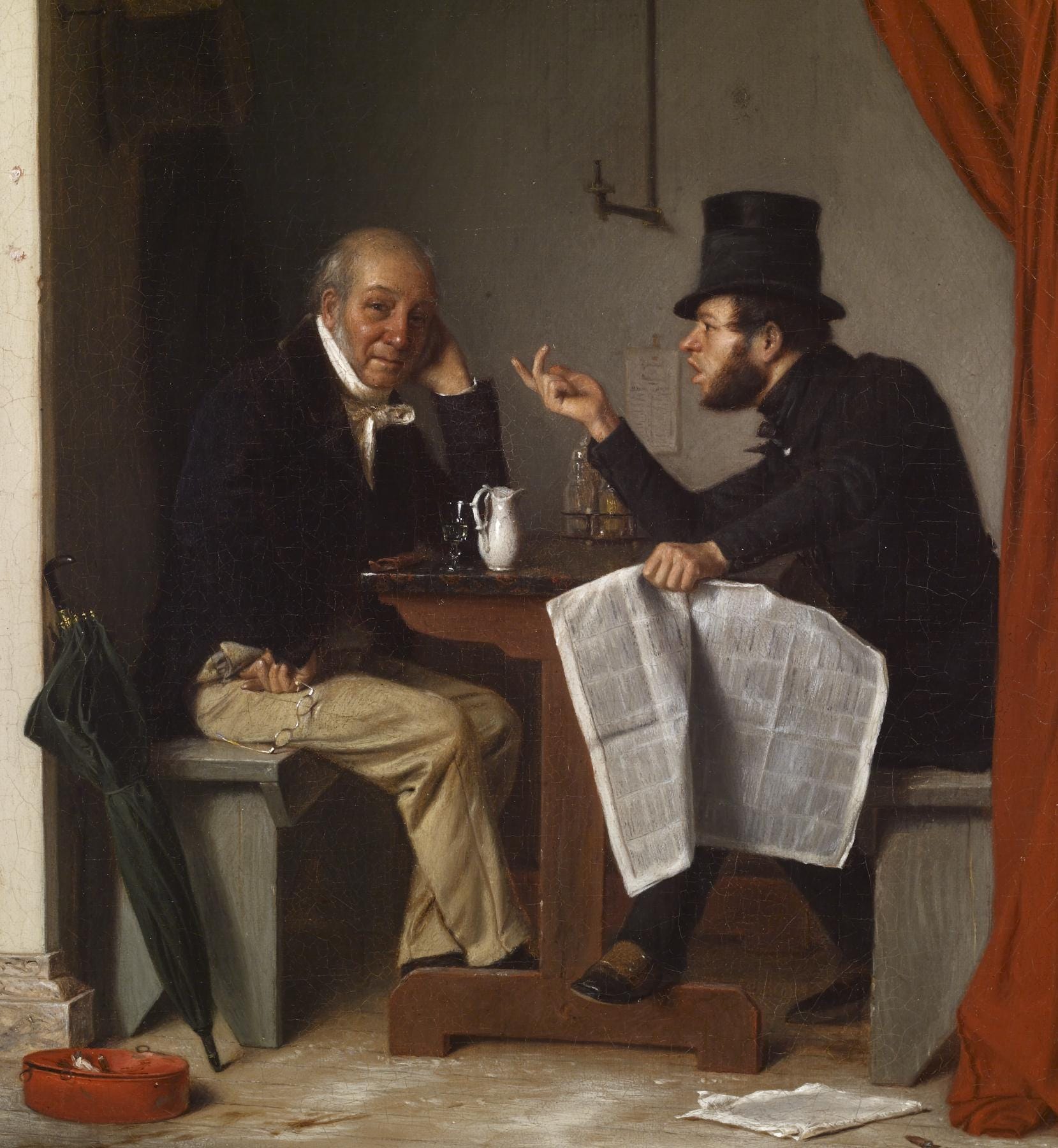
Richard Caton Woodinville, Politics in an Oyster House, 1848, Walters Art Museum, Baltimore, Maryland
Five years separate the first volume of Democracy in America (1835) from the second (1840). The first volume was concrete and focused on formal institutions: constitutions, local government, federalism, courts, parties. The second turns from democratic institutions toward democratic human beings, organized around an question that runs through nearly every chapter: how do people come to know what they know, once equality dissolves the old sources of authority?
Tocqueville is neither indicting nor endorsing democracy categorically. He believes the movement toward equality is irresistible and has no wish to reverse it, yet he spends most of his attention on its dangers. “It is because I was not an adversary of democracy that I have wanted to be candid about it, ...” (p. 399) a friend of democracy telling it honestly what its downsides are.
That candor grows from a temperament that identifies tensions and relishes contradictions: equality liberates the mind even as it exposes that mind to conformity, and teaches self-reliance while leaving the individual defenseless before the opinion of everyone else. After reading these chapters I see them as a study of that tension, worked out as an epistemology of democratic life—how people form beliefs, decide whom to trust, and determine what counts as knowledge once birth and rank no longer decide it for them.
Thinking for oneself, and with everyone else
Tocqueville opens with an apparent paradox: Americans show little interest in formal philosophy yet live by a recognizable philosophical method. “America is therefore the one country in the world where the precepts of Descartes are least studied and best followed” (p. 403). They need not read him to act like Cartesians. Distrustful of inherited formulas and class authority, they “take the rule of their judgment only from themselves” and “customarily rely on their own witness” (p. 404): as fixed social distinctions weaken, individuals grow less willing to accept a proposition merely because a particular person or class asserts it.
But Tocqueville immediately complicates this intellectual emancipation. The democratic individual wants to judge for himself, yet no individual can judge everything for himself. We lack the time and capacity to investigate every proposition we depend on, so we have to accept much of what we believe from others. “For without common ideas there is no common action, and without common action men still exist, but a social body does not” (p. 407). Every society requires beliefs individuals do not independently reconstruct from first principles: “every man who receives an opinion on the word of others puts his mind into slavery; but it is a salutary servitude that allows making a good use of liberty” (p. 408). Intellectual authority is not optional — “its place is variable, but it necessarily has a place” (p. 408).
Democracy changes the answer without eliminating the need, replacing inherited authority with public opinion itself. “Not only is common opinion the sole guide that remains for individual reason among democratic peoples,” Tocqueville writes, “but also it has among these peoples an infinitely greater power than among any other” (p. 409). Individuals see one another as fundamentally similar and so resist the authority of any one person, despite the fact that same similarity makes the judgment of the many enormously impressive. “This same equality that makes him independent of each one of his fellow citizens in particular,” Tocqueville observes, “delivers him isolated and defenseless to the action of the greatest number” (p. 409).
The tension sharpens into warning. Equality produces “two tendencies”: one pushes each person toward new thoughts, the other “readily reduces him to thinking no more” (p. 410). Tocqueville has no patience for the idea that oppression becomes freedom once enough people share in dispensing it: “I am no more inclined to put my head in the yoke, because a million arms present it to me” (p. 410). The democratic problem of knowledge runs deeper, then, than “think for yourself”. We have to trust others, but the harder problem is learning whom, why, and when. Tocqueville distinguishes this gradual, structural erosion from revolutionary rupture: “The independence of mind that equality suggests is never so great and never appears so excessive as at the moment when equality begins to become established” (pp. 406–407). Tocqueville identifies this as one reason Americans, who inherited a democratic social state without first overthrowing an aristocratic one, never faced the anarchic interval France did.
General ideas and learning by doing
Chapters 3 and 4 extend the epistemology into what Tocqueville calls “general ideas” — abstractions that compress many particular cases into a common proposition. Democratic people crave them: aristocratic societies train people to perceive distinctions among ranks and orders, equality trains them to perceive similarities instead. General ideas economize on scarce attention, letting busy people reason about a category collectively rather than working through a thousand particular cases. The danger is that the abstraction becomes more satisfying than the reality it claims to explain.
Political liberty supplies the corrective. Americans resist sweeping political theories because they actually practice politics: a merchant may accept elegant theories about subjects he knows little about while growing skeptical of generalizations about commerce, where experience shows him how many contingencies theory leaves out. Citizens who administer towns, serve on juries, and live with the consequences of political choices learn the same respect for particulars. Political participation does more than disperse power; it teaches people how to discipline reason. Note how reliant this argument is on participation in local politics.
Religion as democratic counterweight
Chapters 5 through 7 turn to religion, Tocqueville’s principal counterweight to equality’s epistemic weaknesses. Equality breeds individualism and materialism: it “tends to isolate [men] from one another and to lead each one of them to be interested only in himself alone,” and “opens their souls excessively to love of material enjoyments” (p. 419). Religion pushes the other way, directing attention beyond material existence and imposing obligations that extend beyond the self; “Religious peoples are naturally strong precisely in the places where democratic peoples are weak,” (p. 419).
Religion succeeds in America partly by adapting to democracy rather than opposing it. “By respecting all the democratic instincts that are not contrary to it and by using several of those instincts to help itself,” religion resists the individual independence that threatens it most (p. 424). This point is an instance of a broader Tocquevillean principle: an institution hoping to restrain democracy cannot just oppose it. It has to use some democratic habits to moderate others, as a system of counterweights.
Perfectibility and democratic restlessness
Chapter 8 turns to one of democracy’s most productive tendencies: the belief in human perfectibility. Self-improvement is practical and incremental — working, experimenting, adjusting to circumstance. The idea of indefinite perfectibility goes further: aristocratic societies make the limits of improvement appear fixed and visible, while democratic societies continually reveal supposedly permanent limits to be provisional. Equality thus encourages people to imagine not just that they can improve their condition, but that neither human capacities nor social arrangements have any clearly foreseeable endpoint. Psychologically and culturally, the two habits of mind are quite different, even though equality produces both. [Note: I have a lot more to say about this chapter, but I’ll leave it for later.]
Tocqueville illustrates the psychology with an American sailor. Asked why American ships are built not to last, the sailor answers that navigation improves so quickly that even “the most beautiful ship would soon become nearly useless if it lasted beyond a few years” (p. 428). That sounds remarkably modern: progress changes the expected value of durability, and knowledge itself becomes a moving target rather than a fixed inheritance. The belief fuels innovation but also creates permanent dissatisfaction; if improvement has no obvious endpoint, every certainty becomes temporary, an epistemological condition as much as a psychological one.
Science, usefulness, and democratic abundance
Chapters 9 through 11 apply the same logic to science and production. “The situation of the Americans is therefore entirely exceptional” (p. 430), Tocqueville cautions, since Americans enjoy unusual opportunities for industry and commerce while drawing on theoretical science produced elsewhere. Still, he identifies a democratic tendency: enlightened people discover that “nothing limits or fixes them and forces them to content themselves with their present fortune” (p. 431), and knowledge becomes a means of advancement rather than an end in itself. Americans favor practical science over theory because democratic society keeps everyone in motion; Tocqueville asks where, amid this “universal tumult,” anyone will find “the calm necessary for profound intellectual syntheses” (p. 434).
Here lies a political economy of knowledge production: democratic society rewards useful discoveries visibly and quickly, while the payoff to theoretical inquiry stays distant and uncertain, so talent flows toward application. Application produces extraordinary innovation but a long-run problem too, since applied knowledge rests on theory someone still has to sustain. The same dynamic reshapes production, trading some exquisiteness for volume and access — a small aristocratic audience willing to pay for perfection giving way to a mass one that prizes usefulness instead.
Democratic self-government
The first twelve chapters of Volume II range widely, but two threads hold them together. One is epistemological: equality changes not just what democratic people believe but how they come to believe anything — whom they trust, how they weigh abstraction against experience, theory against usefulness. The other is temperamental: Tocqueville refuses to resolve the tensions equality creates. It encourages independent judgment and delivers people defenseless to majority opinion. It weakens inherited authority while creating a need for new authority. It stimulates self-improvement while indefinite perfectibility breeds restlessness.
None of these tensions resolve neatly, and Tocqueville does not want them to — that is the project the foreword announces, a friend of democracy who refuses to flatter it. The task is democratic self-government in the broadest sense: not simply governing through elections, but learning how to govern democracy’s own habits of mind. Tocqueville asks a difficult question about democracy: what does it make easier for human beings, what does it make harder, and what institutions and habits let us gain more of the first without succumbing to the second?
On the closing question. Fromm agrees with Tocqueville's diagnosis and goes further. Tocqueville thought people conform because nobody has time to check everything for themselves. Fromm said many people conform because freedom itself is hard to live with. Being responsible for your own judgment, alone, is a weight, and plenty of people will hand it to anyone who offers to carry it. If he is right, then Tocqueville's remedies assume the very thing in question. Juries and town meetings only restrain a majority if the people in them want to stay free. If they want relief instead, those same institutions turn into the mob.
Schumpeter explains why this gets worse over time. Capitalism succeeds, and its success wears away the old loyalties that held society together, while producing an educated class with no property and a career interest in tearing things down.
I accept both diagnoses and neither remedy. Fromm blamed the market for the isolation, but people were fleeing freedom long before there were markets. Schumpeter said the outcome was inevitable. The real question comes before any institution. What produces people who can bear being free.