
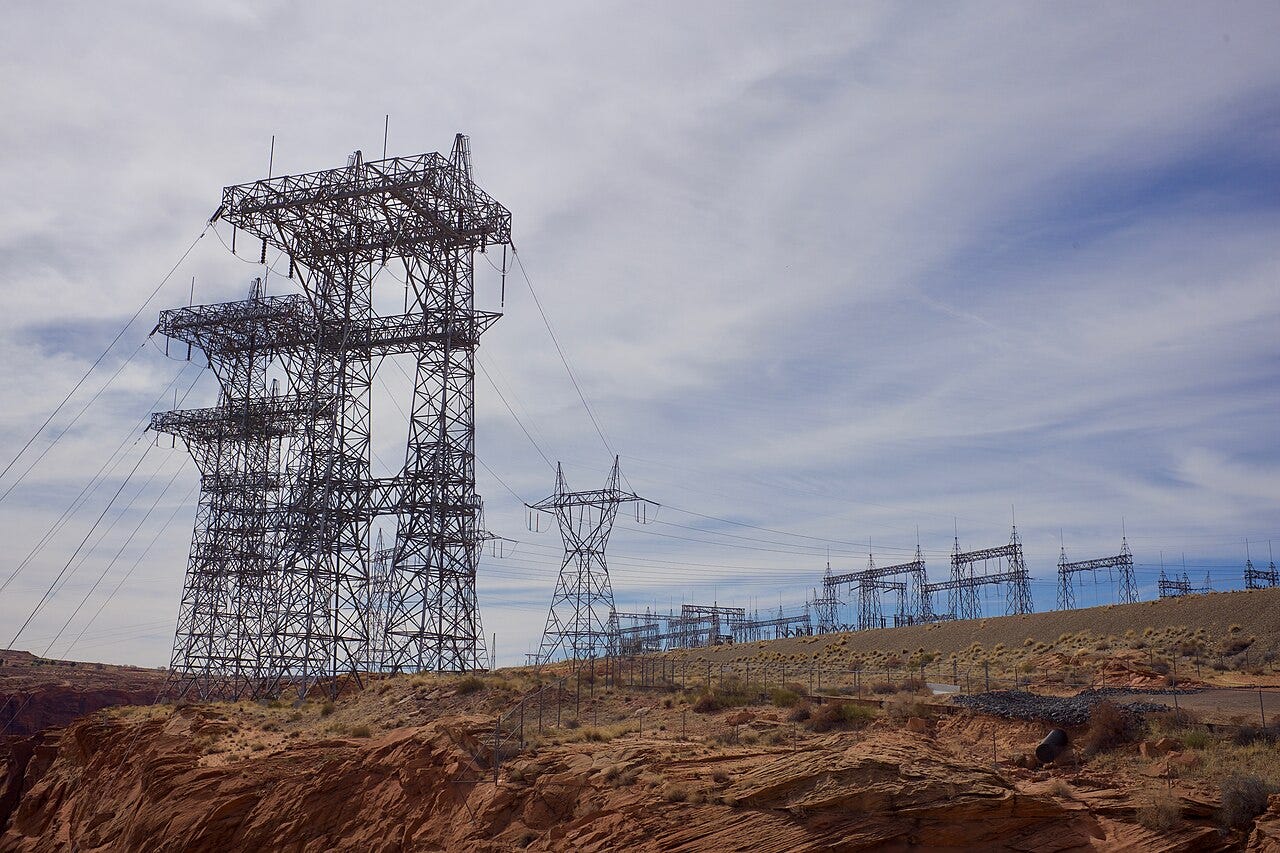
Source: Wikimedia Commons, “Special-shape pylons carry 345 kV transmission lines from Glen Canyon Dam to Glen Canyon substation (background right; 345/230 kV); Arizona”

In April 2013, gunmen opened fire on Pacific Gas & Electric’s Metcalf substation outside San Jose, apparently knowing exactly where to aim. After roughly 120 shots, 17 large transformers had been disabled, their cooling oil draining slowly enough that the attackers were gone before anyone grasped the damage. PG&E rerouted power and avoided a blackout — redundancy earning its keep.
Christopher Cox recounts the attack in an outstanding New York Times Magazine article this week on a vulnerability hiding in plain sight in the American power system: the transformer.
Large power transformers are extraordinary machines, weighing hundreds of tons, costing millions of dollars, and taking years to obtain. Much of their construction remains surprisingly artisanal. Workers wind copper coils by hand, stack specialized steel into enormous cores, and perform assembly work that manufacturers themselves describe as an “art form”. One manufacturer told Cox that it maintains more than 11,000 active transformer designs because individual substations’ requirements vary so much.
The technology is also remarkably old. William Stanley developed the first widely used commercial transformer in 1886 (after having moved to Pittsburgh to work with George Westinghouse and before Tesla got there), and the basic principle has endured because it works so well.
Yet this combination of reliability, specialization, and longevity has created a serious bottleneck. Cox reports that the average wait for a large power transformer has risen to 128 weeks, with some lead times reaching five years, even as electricity demand rises, data centers consume power on the scale of cities, the installed transformer fleet ages, and new generation waits for the equipment needed to move electricity through the grid.
Cox memorably calls the large transformer the industrial equivalent of a Fabergé egg that has somehow become the linchpin of civilization.
His article brought me back to a category of technologies that has fascinated me for years: power electronics. Power electronics rarely attracts the attention given to batteries, solar panels, nuclear reactors, or transmission lines, but increasingly it sits inside, beside, or between all of them, and its significance reaches well beyond making existing electrical equipment run more efficiently.
Power electronics is expanding the feasible choice set in electricity, making combinations of technologies and operating arrangements possible that once were impractical or prohibitively expensive. As that choice set expands, the power system’s own architecture itself becomes open to reconfiguration.
Electricity becomes controllable
At the simplest level, power electronics is the family of technologies that allows us to convert and control electricity electronically.
It changes AC electricity into DC and DC into AC, changes voltage, controls current and power flow. It connects batteries and solar panels to an AC grid, drives electric motors, and links asynchronous power systems through high-voltage DC transmission.
Increasingly, it also determines how electrical resources behave. A modern inverter, for example, does much more than convert DC electricity into AC. Its controls can determine how a battery responds to changes in frequency, whether it supplies reactive power, how quickly it changes output, and how it behaves during a grid disturbance. Grid-forming inverters can even help establish the voltage and frequency that other devices follow.
Power electronics therefore interests me as a system of technologies, rather than as a single technology.
A semiconductor switch sits near the center. Silicon has long dominated this world, while silicon carbide and gallium nitride are opening new possibilities. Around those semiconductors sit capacitors, inductors, transformers, gate drives, cooling systems, sensors, processors, control algorithms, communications, and protection.
Those components form converters, which become pieces of batteries, solar plants, wind turbines, EV chargers, data centers, microgrids, and transmission systems.
And all of those technologies operate inside another system of interconnection rules, engineering standards, electricity markets, utility practices, business models, and regulation. More on that next week.
This pattern is a familiar one in systems. Technological change alters the relationships among complements. A better semiconductor allows a different converter design. A different converter makes a new electrical configuration practical. That configuration changes the economics of the larger system around it. Institutional rules then determine how much of that new capability anyone can actually use.
Technological possibilities propagate through systems. So do constraints.
A five-layer power electronics stack
I think about this industry as a five-layer stack (of course I do, I have a stack for everything, have you met me ;-) ?!?!).
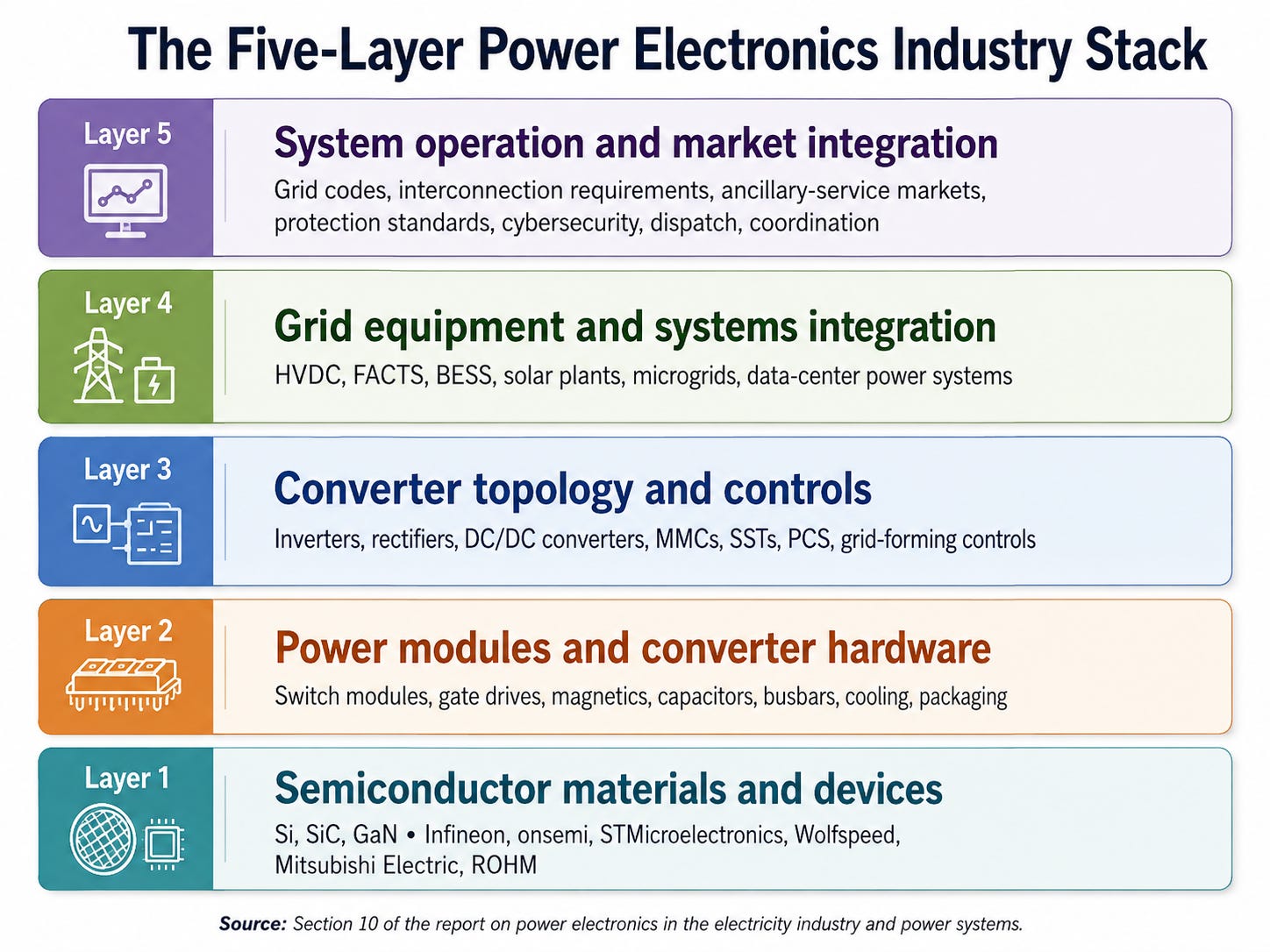
Source: ChatGPT generated this graphic based on a nifty research report on power electronics it generated so I could learn about the technologies in more detail.
At the bottom are semiconductor materials and devices: silicon, silicon carbide, gallium nitride, semiconductor switches like MOSFETs and IGBTs.
Above them are the modules and hardware that turn semiconductor switches into reliable equipment: gate drives, capacitors, magnetics, busbars, cooling, packaging.
The third layer contains converter architectures and controls: inverters, rectifiers, DC/DC converters, modular multilevel converters, and grid-forming algorithms.
The fourth layer is where those technologies become recognizable power-system equipment: battery storage, solar plants, HVDC systems, microgrids, data-center power systems, and perhaps increasingly solid-state transformers.
The fifth contains the institutions that govern their use: grid codes, interconnection requirements, protection practices, dispatch, markets, cybersecurity, and regulation. More on this next week.
Innovation can move upward through this stack; constraints, downward. A new semiconductor may enable a sophisticated grid-forming converter, while an interconnection rule written around yesterday’s equipment can prevent it from providing the very service that makes it valuable.
Batteries with agency
A small moment in Cox’s article captures how much power electronics can change the character of familiar technologies. During one conversation, former FERC chairman Jon Wellinghoff mentioned that his Reno utility was expecting outages. Cox remarked before hanging up that he was glad the power had stayed on.
It hadn’t.
Wellinghoff’s home battery had taken over so quickly that he hadn’t noticed the outage. The battery stores energy. Power electronics and controls give it agency in the system.
With the right inverter and controls, the same battery can consume electricity in one moment and supply it in the next, responding almost instantaneously to changing grid conditions, supporting voltage, buffering fluctuations in renewable generation, maintaining a microgrid during an outage, or helping establish the electrical waveform through grid-forming controls.
This shift changes the economic character of storage. A battery is not a reservoir of megawatt-hours; it’s a bundle of capabilities whose values depend partly on the converter connecting it to the rest of the system.
Batteries are no silver bullet, though; they have finite energy, and power conversion produces losses and heat. Similarly, semiconductor switches have strict current limits. More sophisticated controls add complexity. Electricity markets remain much better at paying for some capabilities than others. More on that next week.
The deep change I want to highlight is the expansion of possible uses.
What if the transformer became programmable?
Cox eventually arrives at three broad responses to the transformer problem: manufacture conventional transformers faster, reduce dependence on them, or develop better substitutes.
Then he travels to Reno to visit Amperesand, one of several companies trying to commercialize a solid-state transformer. This visit is where Cox’s power-electronics story becomes particularly interesting.
A conventional transformer changes AC voltage via electromagnetic induction through steel and copper, doing so with extraordinary efficiency and reliability (with credit to Michael Faraday for discovering and explaining induction). A solid-state transformer inserts electronic conversion and control into that process.
That capability can turn a passive voltage-changing device into an active electrical interface. It can change voltage while also converting AC to DC, controlling bidirectional power flows, connecting storage, managing power quality, monitoring conditions, and combining functions now performed by several separate pieces of equipment.
A more recent semiconductor material, silicon carbide (SiC), helps make these capabilities possible. SiC devices switch large amounts of power efficiently at higher voltages and frequencies, allowing engineers to shrink components, combine functions, and reconsider how electrical conversion is organized.
Transformer manufacturing has historically been a bespoke engineering business, so this change is important. Cox describes an industry built around thousands of custom designs, skilled hand assembly, and long production cycles. Amperesand is pursuing a different model: modular, standardized power-electronic building blocks that can be manufactured repeatedly and configured for different applications.
If that approach works, the consequences could reach beyond cheaper or faster transformer production. A solid-state transformer can combine voltage conversion, AC/DC conversion, bidirectional power flow, power-quality management, sensing, and control. The relevant performance and financial comparison therefore becomes the solid-state transformer against the larger collection of transformers, converters, switchgear, cabling, and other equipment that it might replace or reorganize.
That is the architectural possibility I find most interesting. Power electronics can turn infrastructure that has long been bespoke and fixed-function into infrastructure that is more modular, standardized, and programmable, in the process expanding the range of power-system architectures that are economically feasible.
Data centers as an innovation engine
The first major market for these new architectures may not be the traditional utility substation, but may instead be the data center. Amperesand told Cox that utility substations are a longer-term market. Hyperscalers offer a nearer opportunity. Investor interest accelerated after Nvidia published an 800-volt DC architecture for future AI data centers and included a solid-state transformer in its design.
Computing equipment consumes DC electricity. Yet electricity arriving from the grid may pass through several voltage transformations and AC/DC conversions before reaching processors. Every conversion stage occupies space, costs money, loses some energy, and produces heat.
At the power densities contemplated for AI data centers, those costs compound quickly. Power electronics creates opportunities to rethink where those conversions occur, how many stages are necessary, and whether higher-voltage DC should move deeper into the facility.
The implications extend to the grid connection, where large AI workloads can change power consumption quickly. Cox reports a description from Amperesand: a large model shifting out of training can resemble a city turning off its lights almost instantaneously. Combine a data center with batteries, sophisticated converters, onsite generation, and controls, and the facility becomes a managed electrical system.
Storage can absorb short-duration fluctuations, and converters can control reactive power. The facility can shape ramps, ride through some disturbances, island from the grid, and manage the net demand visible at its point of interconnection. Now, instead of asking only whether the power system can serve 500 megawatts of new load, utilities can increasingly ask what electrical performance that 500-megawatt facility can guarantee.
That is a much larger choice set, and to put an economics gloss on it, a potential for new equilibrium configurations of the system.
Reconfiguring the architecture
The modern grid emerged from an early expansion of the feasible set. Central generation and high-voltage transmission replaced a more fragmented world of local power plants because the new AC architecture delivered enormous economies of scale. Just four years after Edison’s Pearl Street station went live in 1882, transformers made voltage conversion cheap and reliable, allowing electricity to travel long distances and step down through a hierarchy of transmission and distribution networks.
Power electronics now relaxes some of the technological constraints around which power systems developed. Generation, storage, and consumption become less distinct categories. Electricity flows more readily in both directions. Some passive functions become controllable. AC and DC become architectural choices at more boundaries. Modular equipment becomes feasible in places historically dominated by custom machinery. A growing share of electrical behavior becomes programmable.
The result will probably combine centralization and decentralization. Large generators and transmission networks retain powerful scale economies. At the same time, electronically coordinated batteries, flexible loads, microgrids, distributed generation, and controllable interfaces create economies of coordination.
That combination points toward a more polycentric power system: large interconnected networks containing increasingly capable local systems, each operating at the scale where its particular advantages matter most.
Institutions will help determine how far that transformation goes. Interconnection rules, reliability standards, market products, utility incentives, and business models can either make use of the enlarged technological choice set or preserve assumptions inherited from an older architecture. More on that next week.
Back to Metcalf
Cox returns to Metcalf thirteen years after the attack. The substation now has a concrete wall, cameras, sensors, and lights. Yet from the surrounding hills he can still see the transformers through binoculars. A former Homeland Security official gives him the essential problem: with tens of thousands of substations and hundreds of thousands of miles of transmission, you cannot protect everything.
We should harden critical substations, expand transformer production, diversify supply chains, and keep useful spares. But resilience also has an architectural dimension.
A resilient system has multiple ways to absorb failure: more storage, more controllable interfaces, more local capability, more replaceable components, and more ability to keep a local disruption from becoming a systemwide one. Metcalf itself makes the point, with seventeen disabled transformers while the lights stayed on because operators rerouted power around the damage.
The transformer expanded the feasible set more than a century ago, and the grid reorganized around what it made possible. Power electronics is expanding that set again. How will we reorganize with it?
[AI note: ChatGPT generated a fantastic research report for me on power electronics, what the different technologies are, how they work, who the established and startup firms are; Claude gave me some edits on the final draft.]
As an electrical engineer, I was stunned at the way you turned windings and electromagnetism and converters and storage into an orchestrated set that when managed provide the flexibility everyone is yearning for. Solid state transformers were identified valuable by very few, only the double EE’s. Thanks for bringing power electronics front & center, Lynne.
Hello Lynne.
Excellent post on Power Electronics. However, I think that an AI-generated stack is a little out of touch with the reality of the evolution of Power Systems Assets. South Australia’s 6-layer deployment of SiC GFM/SI🔋 power electronics is a real-world stack that might interest you.
The Old Analog Grid has evolved since the end of the AC vs. DC Current Wars, with major asset benchmarks over the last 100 years.
Brief NEM Analog Grid Reactive Power (Q) Management History Lesson
1️⃣ SynCons were invented in the 1930s, before the invention of Transistors in 1947.
https://lnkd.in/gZ_G7ZXY
2️⃣ SVCs were invented in the 1970s, after the invention of high-power Silicon (Si) thyristors.
https://lnkd.in/gYa3EzKw
3️⃣ STATCOMs were invented in the 1980s, after Si IGBTS were invented.
https://lnkd.in/geYMEbfD
4️⃣ Silicon Carbide (SiC) Power Electronics, including Grid-following (GFL) inverters, were first made commercially viable in 2011. Advanced SiC grid-forming (GFM) control logic matured in the late 2010s to 2020s, giving rise to GFM/SI🔋.
The first NEM GFL🔋 commissioned was HPR in 2017. HPR was upgraded to GFM/SI🔋 in 2020. AEMO subsequently tested HPR GFM/SI🔋 for two years before awarding HPR the world’s first GFM/SI🔋 Contract for a variety of FCAS Services, including Black Start, in 2022.
https://lnkd.in/gCrApmXQ
Later in Oct 2023, Very Fast FCAS Services were introduced to the NEM after 3 years of AEMO testing on HPR GFM/SI🔋.
New Automated Digital Grid Q Management Assets are all based upon GFM/SI🔋
https://lnkd.in/gb6nUuYF
South Australia has developed the world’s first Digital Grid.
The secret to SA’s Net 💯% Distributed Variable Renewable Energy and Storage (DVRES) Digital Grid success is deploying automated GFM/SI🔋 across the 6-layer model of:
1️⃣ Front of the Meter (FTM) Utility-scale☀️,💨,& GFM/SI🔋:
Transmission-grid-connected
1⃣ Utility-scale ☀️&💨farms supported by GFM/SI🔋, and
https://lnkd.in/gkxkg-T7
Distribution-grid-connected
2⃣ Community-scale ☀️&GFM/SI🔋
https://lnkd.in/gi6Jvptb
2️⃣ Behind the Meter (BTM) Distribution-grid-connected Rooftop☀️&GFM/SI🔋:
1⃣ Industrial-scale
https://lnkd.in/gAjUkK_T
2⃣ Commercial-scale
https://lnkd.in/gXGDUjhz
3⃣ Residential-scale
https://lnkd.in/guypN6dj
4⃣ BEV-scale
https://lnkd.in/g6anc2Rq
SA redefines what frequency stability means in a NEM “Digital Grid” where:
🚀 Speed outperforms inertia,
🧠 Intelligence outperforms mass, and
🌐 Distributed automated response outperforms centralized manual control
https://lnkd.in/gXvmUGyb