
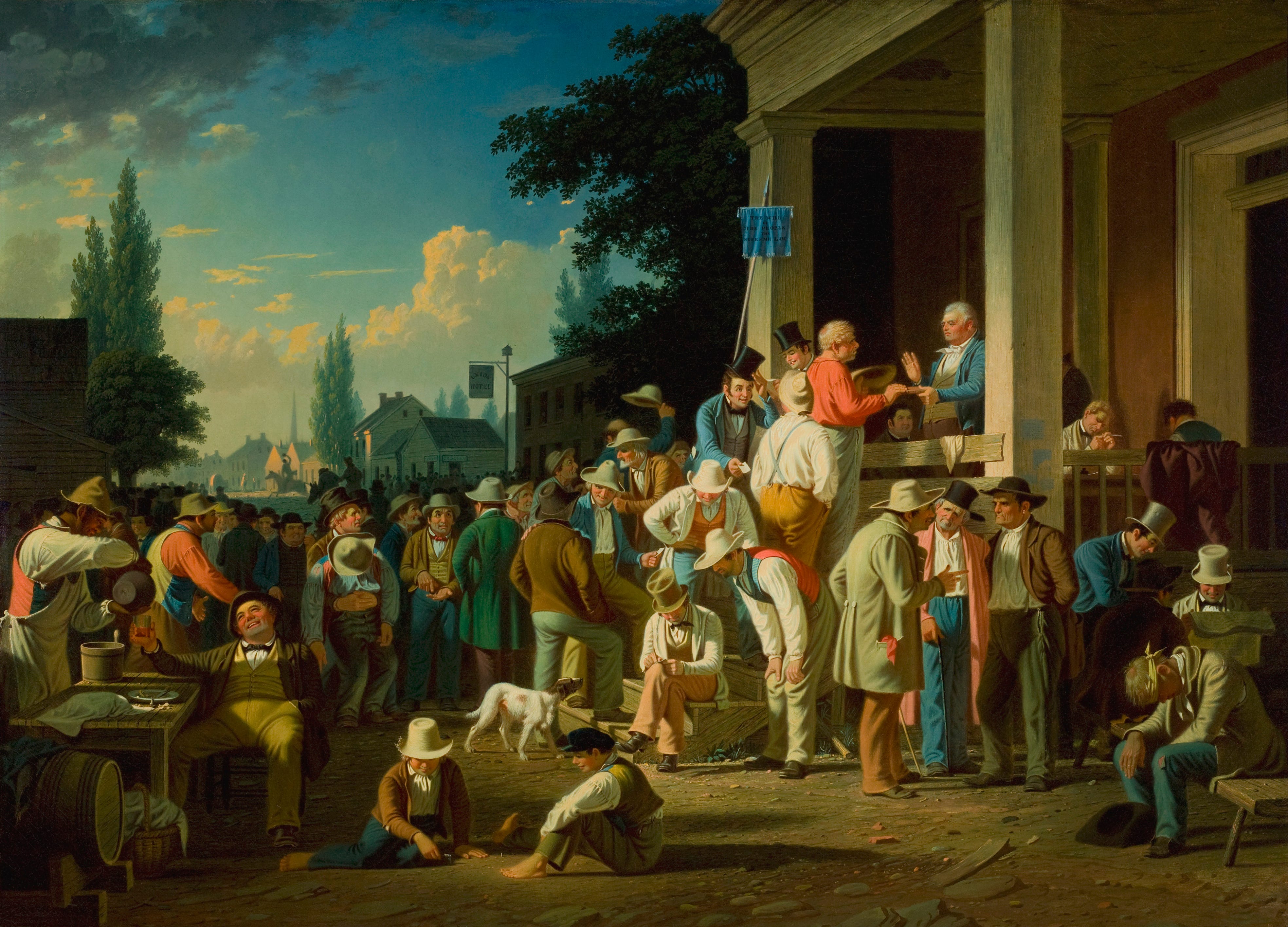
George Caleb Bingham, The County Election (1852). Source: St. Louis Art Museum
Reminder: I am using multiple translations; my main reading is from the hardbound copy of the Mansfield translation. When I refer to page numbers it’s to the Mansfield translation, and when I want to pull quotes that are longer I’ll use the online Schleifer translation, so the text may not match exactly but they are close (and I also read French so I calibrated across the translations to get comfy with Tocqueville’s word choice).
Democracy in America, Volume 2, Part IV
The final part of Democracy in America is best remembered for Tocqueville’s warning about a new form of despotism that democratic societies might produce. His argument reaches beyond “soft despotism,” though. In these closing chapters he gathers the themes that have run through the whole book, including equality, individualism, centralization, local self-government, associations, rights, and political participation. He then asks what kind of political society democracy will create, and what kind of people.
He begins with what we now see after 600+ pages as a characteristic Tocqueville paradox. Equality makes people independent. Once inherited ranks disappear, individuals regard themselves as the equals of those around them, deferring less to authority and trusting their own judgment more. Equality therefore creates a genuine taste for political liberty.
Yet equality also pulls in a second direction. “I am convinced nevertheless,” Tocqueville writes, “that anarchy is not the principal evil that democratic centuries must fear, but the least.” One road leads toward independence and, at its extreme, anarchy. The other leads “by a longer, more secret, but surer road toward servitude” (p. 640). Everyone sees the first danger coming, while the second arrives surreptitiously.
That tension animates the book’s final part: democratic people can be fiercely independent as individuals while becoming politically dependent as a society. Tocqueville resolves the paradox by shifting his perspective from the individual to the whole. As conditions equalize, inherited ranks, corporate bodies, and other intermediate powers fall away, so each person appears smaller and society appears larger. “This naturally gives men of democratic times,” he writes, “a very high opinion of the privileges of the society and a very humble idea of the rights of the individual” (p. 641).
The democratic individual refuses to bow to another individual, yet submits willingly to an immense power that claims to represent everyone. Americans insist that authority flows from the people, but once they have created that authority they struggle to imagine principled limits on it.
Centralization follows. Equality before the law is one of liberal democracy’s great achievements, but the desire for equal treatment slides easily into a desire for uniformity. Exceptions and privileges look suspect, and society starts to resemble a collection of similar individuals governed by one set of rules from one center. Central governments welcome such uniformity because it simplifies administration, sparing them the work of adapting rules to local circumstances. Citizens and government thus develop what Tocqueville calls a “secret and permanent sympathy.” Democratic peoples may dislike particular officials or policies, but “they always love this power itself” (p. 645).
His conclusion is stark: “I think that, in the democratic centuries that are going to open up, individual independence and local liberties will always be a product of art. Centralization will be the natural government” (p. 645).
That statement is among the most important in the book. Under democracy, neither liberty nor decentralization sustains itself; people must create and continually reproduce both through institutions and habits. Federalism, local government, courts, juries, associations, and newspapers preserve places where people act for themselves. Without them, the state becomes “the sole visible and permanent representative of collective interests” (p. 643). Citizens retreat into families, occupations, and private pursuits while collective action migrates upward, the state growing more capable as individuals grow less practiced at governing themselves.
That dynamic culminates in Tocqueville’s famous description of democratic despotism, a phenomenon he struggles even to name. “The old words of despotism and of tyranny do not work,” he says. “The thing is new” (p. 662). This new power governs through administration rather than violence, and it feels more paternal than terrifying. It covers society with “a network of small, complicated, minute, and uniform rules.” It “does not break wills, but it softens them, bends them and directs them,” until citizens resemble “a flock of timid and industrious animals, of which the government is the shepherd” (p. 663).
The danger Tocqueville fears most is diminution, a citizenry that shrinks from disuse. For him, political liberty is a way of living as much as a method for choosing rulers. People become capable of freedom by exercising it: deliberating, associating, solving common problems, accepting responsibility, and sometimes making mistakes. If they hand those activities to an administrative state, periodic elections cannot restore capacities that everyday political life has let atrophy. Citizens made dependent on central power gradually lose “the ability to think, to feel and to act by themselves,” thereby “falling gradually below the level of humanity” (p. 665). A nation can retain popular sovereignty while losing the substance of self-government, its people choosing their rulers yet living as subjects.
Of course, Tocqueville does not end in despair. His remedy is neither to reverse equality nor to restore aristocracy, because equality is the defining social condition of the democratic age. The task is to build democratic institutions that perform the liberty-preserving functions aristocratic ones once performed, which means scattering political agency. Local governments give citizens responsibility for common affairs. Associations let otherwise powerless individuals combine into effective collective actors. Courts and rights draw boundaries around power. A free press helps dispersed citizens find one another and act together. Federal institutions keep authority from flowing to a single center.
The result is a polycentric democracy, a political order with many centers of initiative, knowledge, responsibility, and action. Its purpose is a human one: “to preserve for the individual the little of independence, of strength and of originality that remain to him; to raise him up beside society and sustain him in the face of it” (p. 672).
That aim ties together the whole of Democracy in America. Townships, associations, juries, newspapers, federalism, religion, mores, and habits of cooperation matter because democratic institutions require people capable of using them. Tocqueville closes by rejecting fatalism: “The nations of today cannot make conditions among them not be equal, but it depends on them whether equality leads them to servitude or liberty, to enlightenment or barbarism, to prosperity or misery” (p. 676).
After fourteen installments, that seems like the right place to stop. Democracy preserves liberty by giving equal people places to practice being free.
Thank you for this series. After reading your posts, I have come to the conclusion that this book is as important as Plato's Republic, to which it is similar in its emphasis of paradoxes, even if it highlights different important mechanisms of success and degeneration.