
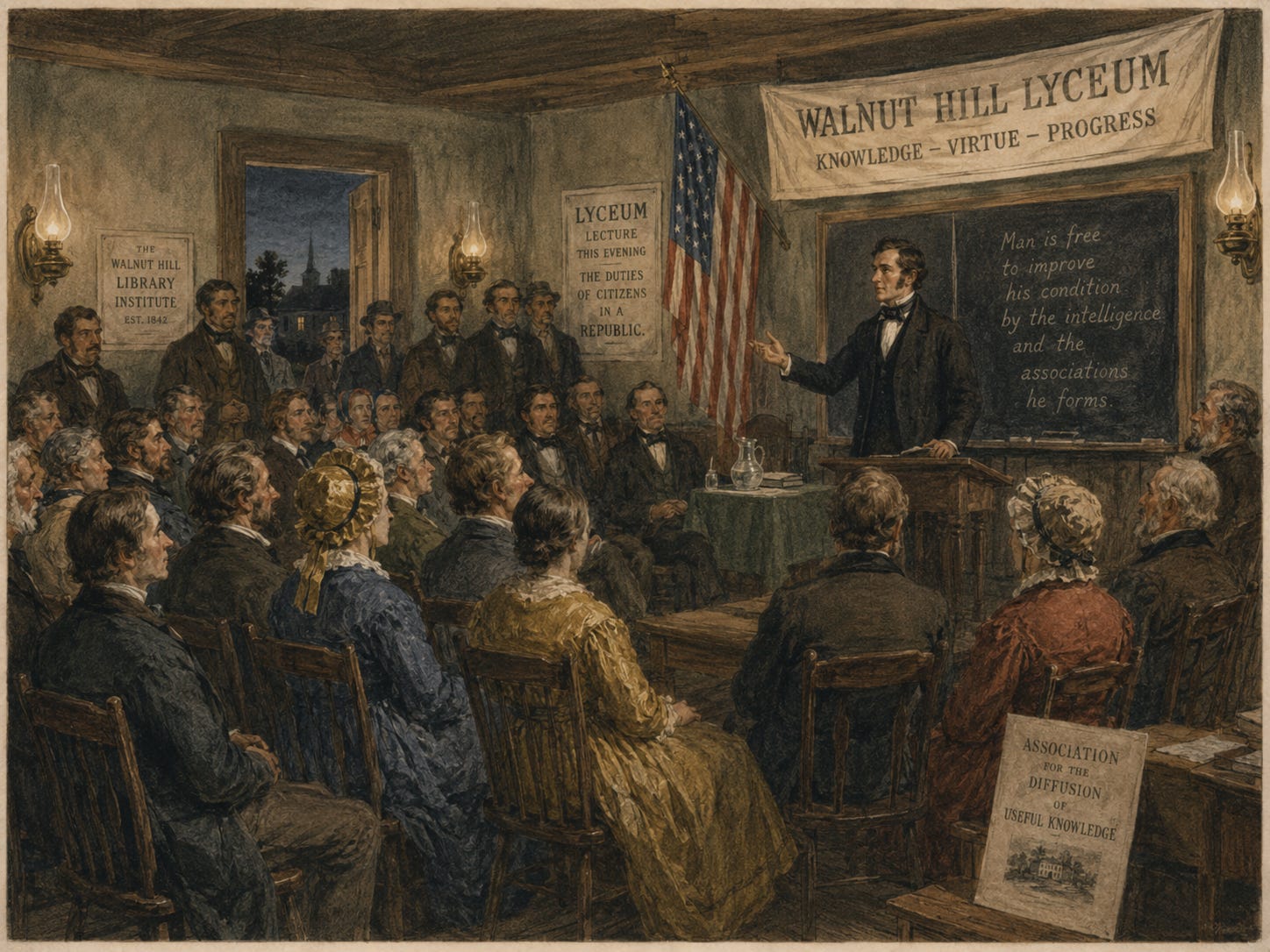
Source: I had ChatGPT read this draft and asked it to generate an historical image of American civil association, and this is one of the three it generated (Association for the Diffusion of Useful Knowledge ❤️💯!). The other two were pretty good too, I may share them in a separate Substack Note.
Reminder: I am using multiple translations; my main reading is from the hardbound copy of the Mansfield translation. When I refer to page numbers it’s to the Mansfield translation, and when I want to pull quotes that are longer I’ll use the online Schleifer translation, so the text may not match exactly but they are close (and I also read French so I calibrated across the translations to get comfy with Tocqueville’s word choice).
Democracy in America, Volume 2, Part II, Chapters 1-20
In Volume 2, Part II of Democracy in America, Tocqueville turns from institutions to psychology in chapters that are some of his best-known work. His subject is what he calls the “sentiments of the Americans”, which are the desires, habits, and ways of relating to one another that equality produces.
This shift in scale is also a shift in subject. Having spent most of the book examining institutions — federalism, local government, courts, public opinion, religion, democratic habits of mind — Tocqueville now asks a different question: what does democracy do to the people who live inside it?
For Tocqueville, democracy means equality of conditions above all else, and equality creates a distinctive psychology. Part II opens by revisiting a claim from Volume 1: liberty can arise under many social arrangements, but equality is democracy’s own. Democratic people value liberty, but equality touches their daily lives more directly and more often.
Liberty and equality differ in how people experience them. As Tocqueville puts it, “the evils that liberty sometimes brings are immediate... the good things that liberty brings show themselves only over time.” Equality works in reverse: “the advantages of equality make themselves felt immediately, and every day you see them flow from their source” (pp. 480–81). Equality “furnishes a multitude of little enjoyments daily to each man” (p. 481).
Liberty demands effort — participating in politics, tolerating friction, sacrificing private time to public business — while equality asks little, working quietly through the fabric of daily interaction. This asymmetry explains Tocqueville’s famous conclusion: democratic peoples possess “a natural taste for liberty” but “an ardent, insatiable, eternal, invincible passion for equality” (p. 482). That passion shapes how democratic people understand themselves and each other, leading Tocqueville directly into one of his central concepts: individualism.
Individualism and Selfishness in Democracy
Tocqueville distinguishes individualism carefully from selfishness (egoism, in the Schleifer translation). Selfishness is “a passionate and exaggerated love of oneself.” Individualism is calmer and more deliberate: “a considered and peaceful sentiment that disposes each citizen to isolate himself from the mass of his fellows and to withdraw to the side with his family and his friends” (p. 482).
Tocqueville’s individualism is not atomistic but it can be isolating. Attachment to family and friends expands, but engagement with the wider society narrows. Equality produces this individualistic disposition by breaking the aristocratic great chain of being. Aristocratic societies bind people together through inherited status, obligation, dependence, family, and class — hierarchical and often oppressive relationships, for sure, but ones that tie individuals to something beyond themselves. Democracy dissolves many of those bonds, and that dissolution is part of its liberation. Destroying compulsory relationships, however, doesn’t automatically create voluntary ones.
“Equality places men side by side, without a common bond to hold them,” Tocqueville observes. This condition pairs dangerously with political despotism: “a despot readily pardons the governed for not loving him, providing that they do not love each other” (p. 485).
Tocqueville claims that this isolation is the problem Americans learn to counteract through liberty. Participating in public affairs, especially locally, teaches people that they are less independent than equality had led them to believe. “From the moment when common affairs are treated together,” Tocqueville writes, “each man notices that he is not as independent of his fellows as he first imagined, and that, to gain their support, he must often lend them his help” (p. 486).
Here Tocqueville returns to the decentralized institutions examined earlier in Volume 1. Federalism and local self-government divide political authority vertically, but their deeper function is formative: administering small affairs brings neighbors into repeated contact and gives them reasons to cooperate: “local liberties constantly bring men back toward each other despite the instincts that separate them, and force them to help each other” (p. 487). The process compounds over time as people begin cooperating out of necessity and end up choosing to do so. “By working for the good of your fellow citizens, you finally acquire the habit and taste of serving them” (p. 488).
Voluntary Association and Freedom of Association
This dynamic brings Tocqueville to the institution for which he is perhaps most famous: voluntary association. “The political associations that exist in the United States form only a detail amid the immense tableau that associations as a whole present there,” he writes. “Americans of all ages, of all conditions, of all minds, constantly unite” (p. 489).
Americans form commercial and industrial associations, religious and charitable ones, educational, moral, and social organizations. They build churches and schools, establish hospitals, distribute books, organize celebrations, support missions, pursuing every conceivable shared purpose big or small.
What strikes Tocqueville is the reflex behind them: association as the default means of accomplishing anything. “It often happens that the English individually carry out very great things,” he observes, “while there is scarcely so small an enterprise for which the Americans do not unite” (p. 490). Aristocratic societies contain powerful individuals capable of organizing large undertakings alone; democratic societies, leveled by equality, have no such figures left.
The result is another of the tensions running through Tocqueville’s argument, one I’ve discussed previously: equality makes individuals more independent of each other, but leaves most of them too weak, relatively speaking, to accomplish much alone because of the distribution of power. They have to learn to combine their efforts.
“In democratic peoples,” Tocqueville writes, “associations must take the place of the powerful particular persons whom equality of conditions has made disappear” (p. 492). Association becomes democracy’s substitute for hierarchy, which is why he calls it “the mother science,” adding that “the progress of all the others depends on the progress of that one” (p. 492).
That general point extends beyond any single association or purpose. Association as an institution functions as a social technology, teaching equal individuals to pursue shared ends without giving up their independence: formulating a common purpose, persuading others, identifying tradeoffs and compromising, dividing responsibilities, communicating, acting together.
Political and civil association reinforce each other. In Tocqueville’s bottom-up account, people start with small common affairs and, working together, “become familiar little by little with association.” Civil associations make political ones easier; political life, in turn, “generalizes the taste and habit of association” and “teaches the art of associating” (p. 496). While I see his point in this correlation, I do wonder if his argument has stood the test of time, or if we can reinvigorate this associational impetus.
Freedom of association is essential to Tocqueville’s democracy: people must be free to organize around “the different ends they propose for themselves” (p. 497). Freedom of association is enshrined in the Bill of Rights, but often overlooked because it’s paired in the First Amendment with freedom of speech and expression. Democratic pluralism depends on letting people pursue many purposes together, rather than having government or a handful of powerful figures define those purposes for them.
Tocqueville also sees the danger when government takes the place of associations. A government can perform functions that citizens might otherwise perform together, but doing so can weaken the underlying capacity for association. “The more it puts itself in the place of associations,” he warns, “the more individuals, losing the idea of associating, will need it to come to their aid” (p. 491).
The problem resembles what economists call crowding out: government action changes citizens’ incentives and habits while reducing associational activity. When people stop practicing association, they grow less capable of organizing themselves, and that incapacity generates further demand for government to step in. For Tocqueville, the stakes are about social capacity, and government size is only part of the picture. This idea is one of the things in Tocqueville that I’ve had to grapple with, because here he’s challenging my small-government individualist classical liberal inclinations.
Later chapters in Part II broaden this psychological portrait: self-interest well understood, the pursuit of material well-being, American restlessness, religion, work, industry. Equality expands independence and opportunity while narrowing attention toward private life and material concerns. Democratic people can become so absorbed in “the serious interests of life” that political participation starts to feel like a distraction. In one sharp passage, Tocqueville warns that people chasing their fortunes may neglect “the principal” affair, “which is to remain their own masters” (p. 515).
Remaining our own masters brings us back to association. Tocqueville never imagines democratic individuals as self-sufficient. Equality has broken many of the inherited bonds that once held people together, and he has no interest in restoring the hierarchies that produced them. The democratic challenge is to replace those bonds with different ones: voluntary, horizontal, pluralistic, cooperative.
Liberty works when people recognize that independence doesn’t eliminate dependence on others. Through local government, political participation, and the civil associations that sustain them, Americans learn what Tocqueville calls the “science of association”, which is how free and equal people can act together without ceasing to be either.
"Liberty works when people recognize that independence doesn’t eliminate dependence on others. Through local government, political participation, and the civil associations that sustain them, Americans learn what Tocqueville calls the “science of association”, which is how free and equal people can act together without ceasing to be either."
The motto of the high school I went to was: 'Democracy begins with self-control.' Which today seems to have been forgotten.
I found this really interesting — especially the idea of association as a kind of social technology that builds capacities people would otherwise lack. I did wonder, though, whether the relationship between association and the state can sometimes be more complicated than substitution or crowding out.
Thinking especially of corporations and business associations in Italy — historically, for example, under Fascism — it seems that organized private actors and the state can be simultaneously cooperative and competitive. Firms and associations may depend on the state for regulation, enforcement, infrastructure, protection, etc., while the state in turn relies on them for information, coordination, implementation, and productive capacity. So rather than simply displacing one another, they can end up co-producing governance while bargaining over its terms and over how much autonomy each retains.
In that sense, I wonder whether “coopetition” — or some form of conflictual interdependence — might complement the Tocquevillian crowding-out story. The state can weaken associational capacity, certainly, but it can also organize, incorporate, privilege, or rely upon associations in ways that make the boundary between public and private collective action much less clear.
Then again, I might be biased by Italian history 😊 There is most likely an element of path dependence and cultural milieu at play here as well.