
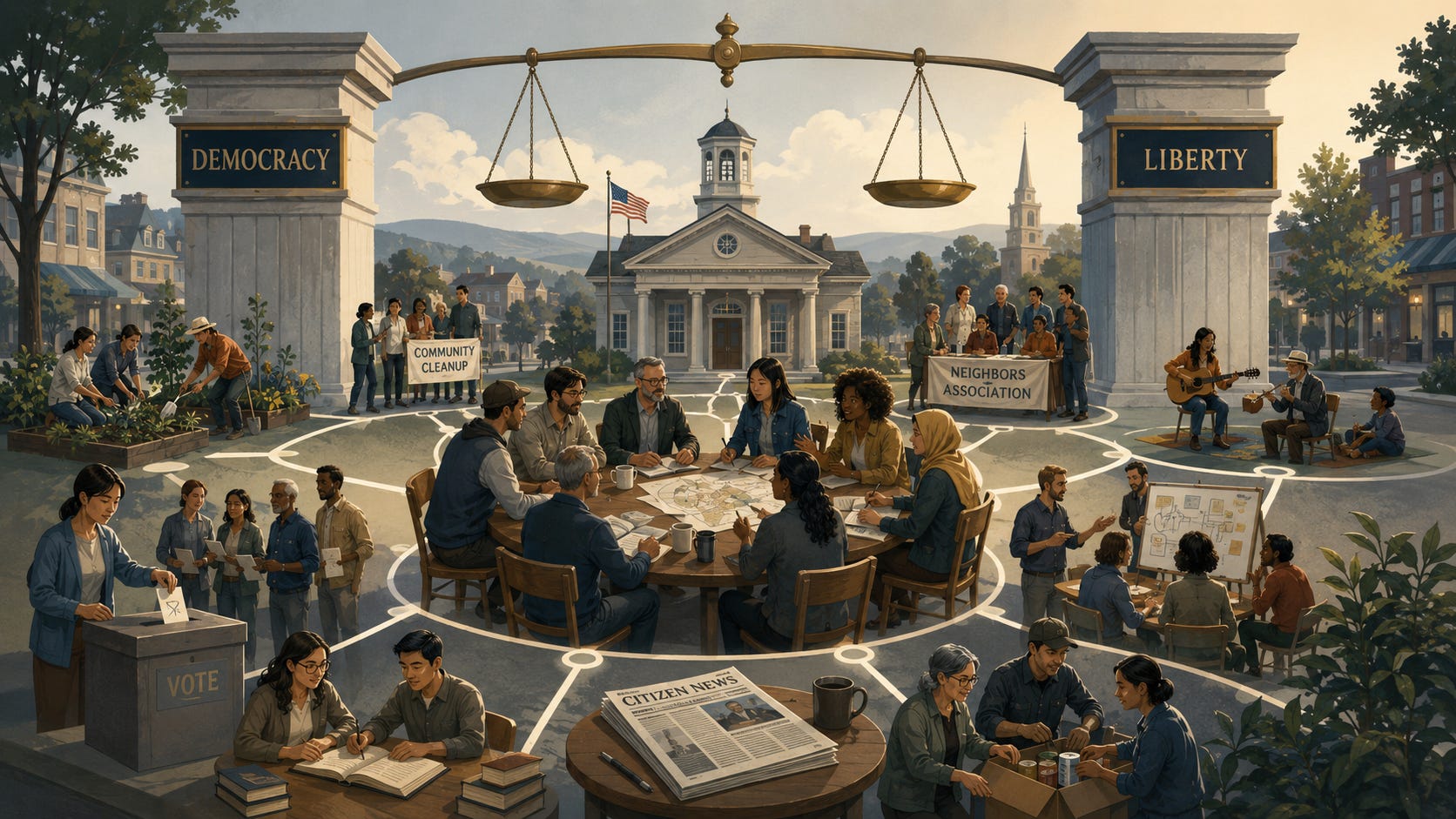
Source: ChatGPT’s conception of Tocquevillian association
Reminder: I am using multiple translations; my main reading is from the hardbound copy of the Mansfield translation. When I refer to page numbers it’s to the Mansfield translation, and when I want to pull quotes that are longer I’ll use the online Schleifer translation, so the text may not match exactly but they are close (and I also read French so I calibrated across the translations to get comfy with Tocqueville’s word choice).
Democracy in America, Part II, Chapters 4 & 5
Democracy works, when it works, not because citizens choose wisely but because participation forms citizens capable of governing themselves despite not always choosing wisely. This insight runs through Tocqueville’s chapters on political association and democratic government, and it feels evergreen, like the kind of thing each generation forgets and has to relearn.
Reading these chapters as descriptive is tempting: parties, associations, universal suffrage, public officials, administrative instability, public expenditure. But Tocqueville is analyzing democracy to learn what democratic participation makes of the people who practice it. These chapters are prime Tocqueville as observer, ethnographer, political scientist, theorist.
True to form, he refuses to romanticize the answer. Universal suffrage has advantages, he argues, but guaranteeing good choices is not one of them. Democracy may select mediocre officials, reward short-term thinking, multiply offices, underpay excellence, and produce administrative instability. Aristocracy, by contrast, can offer continuity, skill, grandeur, and long time horizons. Tocqueville sees the advantages and disadvantages of each clearly, and does not pretend democracy is costless. His comparative stance weighs democracy’s costs against aristocracy’s, with its benefits assessed not only in policy outputs but also in the citizens democracy forms.
That comparative analysis is essentially economic, treating forms of government as bundles of tradeoffs. Aristocracy governs with refinement by concentrating power, status, and competence in a narrow class, which produces excellent rulers while politically infantilizing everyone else. Democracy governs less elegantly but diffuses agency, drawing ordinary citizens into public life and giving them practice in judgment. Its output transcends laws and budgets to include habits.
A French liberal inheritance
Tocqueville is heir to a French liberal tradition—Jean-Baptiste Say, Benjamin Constant, Charles Comte, Charles Dunoyer, François Guizot — that fused political economy with historical psychology and judged institutions by the forms of activity, dependence, knowledge, and character they produce. He brings that lens to America, thinking historically about competing social powers (monarchy, aristocracy, church, courts, public opinion) the way Guizot did, while attending to incentives and unintended consequences the way the liberal economists did. Tocqueville also adds a civic psychology sharper than most political economy offers: institutions do not just constrain behavior, they educate desire, ambition, judgment, and self-command.
Political association is the chief mechanism through which that education happens (Chapter 4). Tocqueville treats association as dangerous but indispensable, allowing citizens to organize around shared opinions, publicize claims, and contest majority opinion without violence. In Europe, association often turned revolutionary because it developed under regimes that excluded most citizens from legal participation. In America, association operates inside a framework of broad suffrage: its goal is to persuade the majority, divide it, or eventually become it, not to overthrow it.
That contrast between the Union (America) and Europe leads to different outcomes. Political association converts disagreement into organized persuasion. A minority in the Union can count itself, discipline itself, and seek allies without pretending to embody the whole people, because democracy offers it a path to become more than a minority. Association thus pluralizes popular sovereignty, keeping “the people” from hardening into a moral abstraction.
Association as a substitute for aristocracy
Association is also democracy’s remedy for its own individualism (which Tocqueville understands as a very atomistic concept). Equality loosens inherited bonds, weakening class hierarchy, family authority, and aristocratic patronage. But it can also leave individuals isolated and politically small, formally free yet practically powerless before the majority or the centralized state. Association lets citizens recover collective strength and coordinated action like the capacity for large projects, and without restoring hereditary privilege. Associations are post-aristocratic institutions, substitutes for the social power democracy has dissolved.
The institutional economics here is straightforward: associations lower the cost of collective action among equals. They aggregate dispersed interests, produce information, coordinate effort, and generate civic knowledge unavailable to passive spectators. Political and civil association develop together, Tocqueville later observes: where political association is forbidden, civil association is rare, and where citizens learn the art of association in politics, they carry it into ordinary life.
In other words, democracy has an institutional production function. Under some conditions, participation produces capable citizens; under others, it produces agitation, conformity, or dependence. The better question asks what kind of participation, embedded in what institutions, produces what kind of citizen.
Seen this way, aristocracy and democracy each solve some problems while creating others (again with the tradeoffs ...). Aristocracy coordinates through durable hierarchy and cultivates public men by training a class of men for command. Democracy, lacking hierarchy, must build voluntary mechanisms of coordination and cultivate citizens through use rather than birth. This process creates powerful collective actors through association instead of powerful individuals through lineage.
Institutions that make democratic equality compatible with individual liberty become the central problem Tocqueville asks democracy to solve.
Capacity, not just choice
The tradeoffs and the downsides of democracy show why Tocqueville treats universal suffrage so carefully [Note: The conception of universal suffrage here is far from universal, excluding women, Native Americans, and enslaved people. Tocqueville will discuss slavery and Native Americans extensively later, but takes as given the absence of women from formal political participation.]. He does not believe suffrage reliably selects the most capable rulers. Friends of democracy must solve a harder problem: helping the people choose capable governors while preserving enough popular authority to guide them without administering in their place. That problem sounds, and is, remarkably modern. Democracy needs popular control, but also competence, mediation, and institutional filtering. Tocqueville wants practical participation without the fantasy that direct popular impulse settles every question well.
Guizot’s liberalism struggled with the problem of political capacity: who is capable of governing, and how can a modern society recognize competence without freezing hierarchy into privilege? Tocqueville democratizes that problem rather than abandoning it. He characterizes capacity as a habit institutions produce, meaning that democracy has to both find capable citizens and make them.
That formative point is the deep connection between chapters 4 and 5. Chapter 4 shows democratic participation at its most constructive; Chapter 5 shows democratic government at its most ambiguous. Political association educates citizens in common action, while universal suffrage does not guarantee wise choice. Democratic equality produces agency, but it can also produce envy and impatience. Neither side cancels the other. Democratic self-government lives inside this tension, and doing so successfully requires citizens to practice the habit of self-rule.
Our own moment
That tension speaks directly to our current politics. Much contemporary participation does not look Tocquevillian in the formative sense—it is intense, expressive, nationalized, and identity-laden, but detached from practical self-government. Citizens experience politics more as national drama than local action, and political identity becomes less a habit of shared problem-solving than a badge of belonging and moral sorting.
In The Increasingly United States, Daniel Hopkins has argued that American political behavior has become increasingly nationalized, with citizens interpreting state and local politics through national partisan frames. Hopkins asks what happens to a constitutional order premised on meaningful state and local allegiances once those allegiances fade. Pew’s research on public attitudes finds that large majorities describe politics in negative terms and often feel exhausted or angry thinking about it. The Carnegie Endowment’s review of polarization research adds a related finding: Americans may not be as ideologically polarized as they believe, but they are deeply affectively polarized, disliking and distrusting members of the other party.
Tocqueville would not be surprised. He feared that once detached from robust local and associational life, democratic citizens would become weak where they could act and inflamed where they could not. National politics offers vast moral scale but little practical agency, inviting citizens to identify with abstractions — the nation, the people, history, decline, restoration. Politics cannot avoid such abstractions entirely, but when they displace local action and voluntary association, they deform participation. The citizen becomes a spectator with strong feelings.
Tocqueville’s analysis also helps explain populism’s appeal. Populism offers a shortcut through the hard work of association, telling citizens that “the people” already exist as a unified moral body and that the central task is empowering whoever truly speaks for them. Tocquevillian association begins from the opposite premise: the people are plural, scattered, and unfinished, becoming politically capable only through organization, argument, and repeated action.
Polarization looks different through this lens too. Tocqueville understood association itself as organized conflict, so disagreement is not the issue per se. The problem arises when disagreement loses its intermediary institutions. Parties, local governments, churches, unions, and civic organizations become schools of democratic conduct by forcing citizens to work with others in concrete settings. When politics is mediated chiefly by national media and presidentialized conflict, citizens absorb the emotional intensities of politics without the formative disciplines of participation. We learn to denounce rather than deliberate, to sort rather than associate, to consume politics rather than govern.
Institutional ecology, not nostalgia
Tocqueville’s remedy is thus better participation. Democracy needs institutions that keep politics local, associational, practical, and plural. Local self-government matters because it gives citizens real, substantive, meaningful things to do. Associations teach citizens to act together without waiting for centralized authority. Newspapers connect dispersed citizens and make association possible; juries educate judgment; federalism multiplies the scales of public action. Division of sovereignty plus right of association creates an institutional ecosystem (and a polycentric one at that) that can get the best of democratic equality and individual liberty.
The institutional dimensions of his analysis make Tocqueville such a productive interlocutor for economists. He thinks in tradeoffs, incentives, and institutional effects, but he does not stop where economic analysis usually stops: preferences are not simply given, they are formed in use, and institutions do not simply aggregate interests, they shape the people who hold them. Democracy thus serves as an allocation mechanism and an educational regime, allocating authority more broadly than aristocracy while promising that broad participation can form citizens capable of using that authority well.
That promise is fragile. Democracy can choose badly, centralize power, flatten excellence, and give public opinion tyrannical force. More beneficially, it can also awaken energy in ordinary people, make public life common rather than exclusive, and replace privilege with association. Can democracy build institutions that compensate for what it lacks while cultivating what only it makes possible? That’s the deep and profound question at the heart of these chapters.
Political association, in Tocqueville’s hands, is one of democracy’s central technologies of liberty, supplying coordination without command, power without privilege, and civic education without hierarchy. It teaches democratic citizens to use freedom together, which may be the most important lesson in these two chapters. Democracy is sustained by institutions that help the people become capable of ruling themselves.
Previous articles in this series: I’m not appending these to every one because that just gets annoying, but here we are 1/3 of the way through, so it’s a good time to capture links to the previous articles.


