
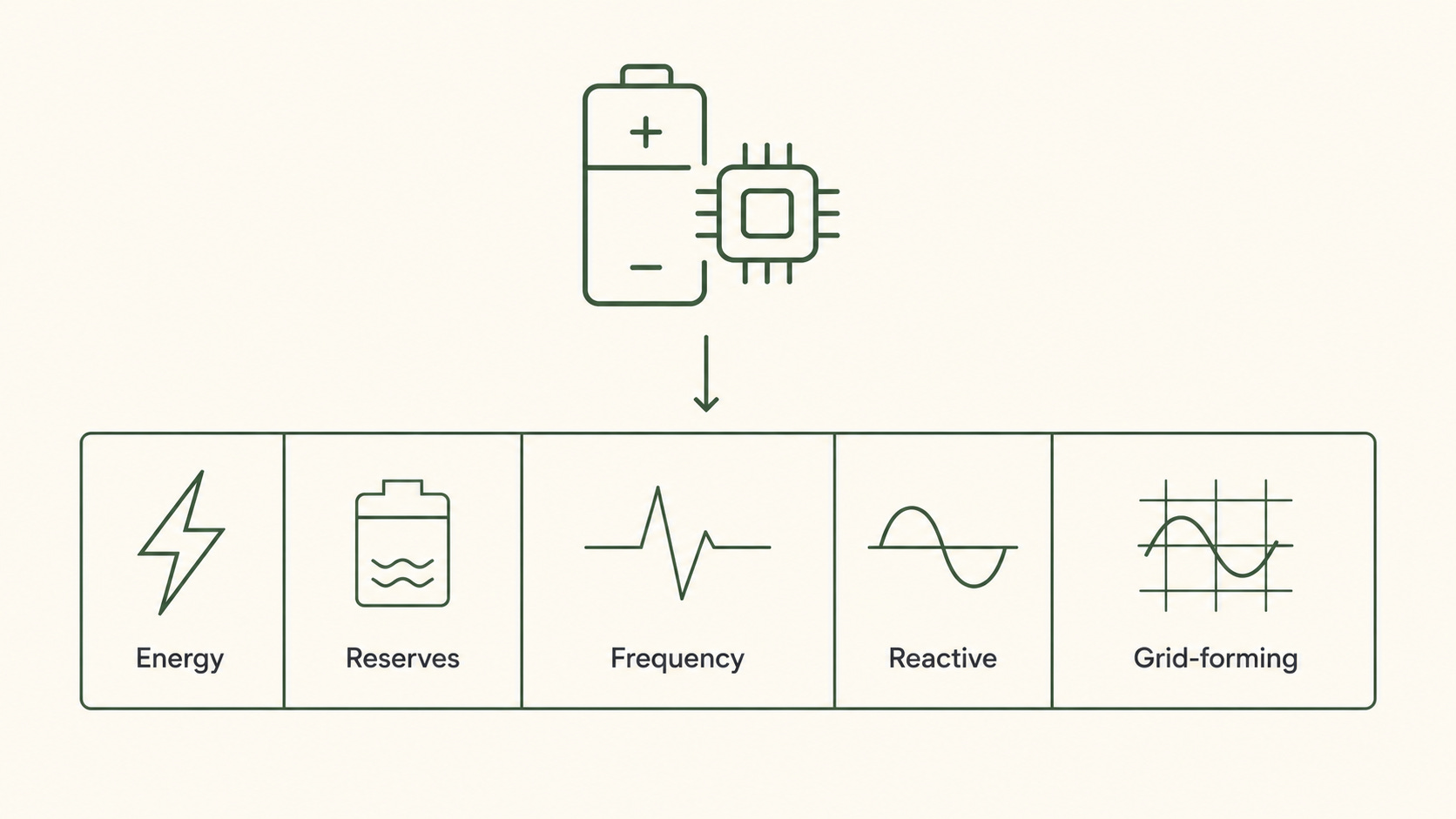
Last week I wrote about how power electronics is expanding the feasible choice set in electricity: better semiconductors, converters, sensors, and controls are making electrical resources more modular, bidirectional, and programmable.

One image from that piece stuck with me: former FERC chairman Jon Wellinghoff’s home battery took over so seamlessly during an outage that he didn’t notice the power had gone out. Knowing that Wellinghoff owns a battery tells you almost nothing about how it did that. Power electronics turned a box of stored energy into something with agency in the system. That shift, from a resource defined by its capacity to a resource defined by what it can do, is what expanding the feasible set actually means in practice.
For most of the industry’s history, the vertically integrated utility bundled generation, transmission, distribution, system operation, and reliability into one firm, an arrangement that mirrored its bundled physical resources. A large synchronous generator produced energy, but its spinning mass also supplied inertia, and so on throughout the system. The utility planned and operated the whole as one portfolio.
Wholesale restructuring unbundled many of these functions in the 1990s, and organized markets separated energy, capacity, and several ancillary services. Yet the institutional legacy remained: planning still revolves around a familiar organizing concept, physical capacity. How many megawatts of dependable generation will be available when demand peaks? Power electronics is incrementally making that question harder to answer in full, and that’s a good thing.
From technologies to capabilities
Historically, knowing what kind of generating plant you were looking at told you a lot about what it could do. A coal plant, hydroelectric generator, combustion turbine, and nuclear plant each had characteristic operating properties, so technology and capability were closely connected. These resource categories were a useful shorthand for system planners and operators, both in the traditional vertically integrated utility and in organized power markets.
Power electronics weakens that correspondence. Consider a battery, for example. Calling something a “100-megawatt battery” tells us surprisingly little about its contribution to the power system. How much energy can it store? One hour? Four hours? Eight? How large is the inverter? How quickly can the battery respond? Can it provide reactive power? Can it operate as a grid-forming resource? Can it support black start? What is its state of charge right now? What operating range has its owner committed to make available? The same underlying battery technology can produce very different grid resources depending on its power electronics, controls, configuration, and operating strategy, not to mention the market institutions under which it operates.
This point extends well beyond batteries. Increasingly, solar and wind plants acquire grid capabilities through their inverters, which perform the AC/DC conversion. A data center paired with batteries, onsite generation, and sophisticated controls can change the character of the load that appears at the grid interface. Electric vehicles can become flexible demand and potentially sources of electricity. Power-electronic transmission devices can alter flows and support voltage.
As I argued in Part 1, power electronics is turning familiar resources into bundles of capabilities. That shift from capacity to capability creates a mismatch with institutions built to count megawatts of stable, well-defined resource categories (more on that next week). The economically relevant question increasingly becomes: What can this resource do, where can it do it, when can it do it, and what else could it be doing instead?
Programmability creates opportunity costs
Power electronics makes a resource programmable in ways that prior electro-mechanical resources were not. A programmable resource presents us with options. Suppose a battery can supply energy, hold contingency reserves, respond rapidly to frequency deviations, provide reactive power, support local voltage, and operate in grid-forming mode.
It is tempting to describe this as “value stacking”: identify six services, find six prices, and add up six revenue streams. But those services share the same physical asset, which can’t provide all of them simultaneously. A battery discharging at the full rating of its inverter may have little remaining headroom to increase output following a contingency. Preserving 20 megawatts for reserve means giving up the revenue those 20 megawatts could have earned in the energy market.
State of charge creates another constraint. Saving stored energy for a reliability event means forgoing some opportunity to discharge earlier. Charging in anticipation of a future need may require buying energy today.
The inverter itself creates tradeoffs. Active and reactive power can compete for finite inverter capacity. A resource designed to provide stronger grid-forming performance may require additional equipment, oversized components, or operating headroom. In each case, one capability has value partly because the resource could have been doing something else. That is opportunity cost.
The value of frequency response, for example, cannot always be separated neatly from the value of energy, reserves, reactive power, or stored energy. These services draw on common equipment and common physical constraints.
Their values also change over time and space, sometimes within minutes. A stored megawatt-hour may be worth little at noon and a great deal during an evening scarcity event. Voltage support may be extremely valuable at one node and nearly irrelevant at another. Grid-forming capability may matter most in electrically weak areas or unusual system conditions. The value landscape thus becomes multidimensional:
capability × time × location × system condition × alternative use.
Economies of coordination
This distinction also helps clarify something I described in Part 1 as economies of coordination. The twentieth-century grid created enormous economies of scale by making individual production units larger and connecting them across large networks. Power electronics and digital controls create another source of value: making heterogeneous resources work together more effectively.
Interoperability is part of this story, but only part. Interoperability asks whether devices can communicate and operate together across an interface. Economies of coordination ask what additional value becomes possible because their decisions can be coordinated.
A useful way to express the idea is:
Coordination value = V(jointly optimized system) − ΣᵢV(independently operated resourceᵢ) − C(coordination)
The gain might come from coordinating a solar plant with a battery so that otherwise-curtailed energy can be stored for later. It might come from coordinating thousands of flexible loads so that together they provide a reliable response that none could provide individually. Or it might come from preventing several institutions from simultaneously claiming the same battery capability for incompatible purposes.
It’s kind of like a network variant of economies of scope. The individual resources do not need to become physically larger for their combined behavior to become more valuable.
That distinction can and should shape the grid’s architecture. Economies of coordination let decentralized resources capture some of the same benefits historically associated with centralized scale: large generators and transmission networks keep exploiting scale where it remains valuable, while batteries, flexible loads, and distributed generation create value through increasingly sophisticated coordination instead.
Power electronics also lowers the transaction costs of that coordination, so it can happen through markets and contracts rather than inside a vertically integrated firm. Letting more and different participants produce grid services and compete to do so, which is the same process that has driven innovation and lower cost throughout the history of market exchange.
Co-optimization for a programmable grid
Electricity markets already contain the basic institutional idea needed to manage these tradeoffs: co-optimization.
Rather than dispatching energy first and then separately finding resources for reserves, a co-optimized market can consider both uses together. The market may discover that the system receives more value by having one resource produce another megawatt of electricity while another holds a megawatt in reserve.
Power electronics makes this logic more important: as the menu of possible services grows richer, so does the value of comparing them rather than assigning each type of resource a fixed role.
ERCOT’s recent market redesign illustrates this logic. In December 2025, ERCOT launched Real-Time Co-optimization Plus Batteries (RTC+B), which co-optimizes energy and ancillary services every five minutes while representing batteries as single resources whose state of charge constrains what they can provide. Instead of assigning a battery to a fixed role, the market can continually compare the value of using it for energy, reserves, regulation, or other services as system conditions change.
The larger principle
Some behavior should simply be required for reliable interconnection. Some services are sufficiently standardized and scarce to trade in organized markets. Other capabilities may be highly locational, infrequently needed, or dependent on long-lived investment and therefore better suited to contracts or competitive procurement.
The larger institutional principle takes precedence over the precise mechanism: Specify the performance the system needs wherever possible, then allow competing resources and combinations of resources to reveal how economically they can provide it.
That principle means leaning toward technology-neutral requirements. If the system needs a resource that can respond within a given interval, sustain that response for a specified duration, and perform under defined conditions, the requirement should describe that performance rather than assume which technology must supply it.
It also means allowing resources to combine compatible services while recognizing physical constraints and opportunity costs, and reflecting location when location changes value. And it means allowing scarcity values to change with system conditions rather than freezing them permanently into administrative assumptions.
We do not need to know in advance whether the best future configuration will involve more batteries, flexible loads, grid-forming solar, synchronous condensers, enhanced transmission, data-center microgrids, or combinations we have not yet imagined.
A programmable resource’s contribution to the grid is a set of competing possible uses, valued differently across time, location, and system condition, that the resource can’t supply all at once. Economies of coordination let heterogeneous resources combine that value in ways individual scale never could. Co-optimization is the institutional mechanism already built to compare those competing uses and choose well among them.
That combination puts pressure on a question electricity institutions have asked, in essentially the same way, for decades: does the system have enough to keep the lights on? More on that next week.
Power electronics enlarges the search space. Good institutions help us explore it.
Lynne,
There is a literature standing behind this essay, and then you take the argument somewhere it has not gone.
Coase asked why coordination happens inside a firm rather than across markets, and answered, transaction costs. The vertically integrated utility was Coase's firm at maximum scale, coordination internalized because coordinating a thousand independent resources by contract was impossibly expensive. Your observation that power electronics lowers the transaction costs of coordination, so it can happen through markets and contracts rather than inside the firm, is the Coasean boundary moving in real time. The grid is running the theorem.
Hayek asked how dispersed knowledge could be coordinated at all. Capability by time by location by system condition by alternative use is the knowledge of the particular circumstances of time and place, and your performance-specification principle is his answer stated for engineers. Specify the end, let resources compete to reveal the means, because nobody, including the planner, knows which combination wins.
Demsetz explains why the moment has arrived. New rights emerge when technology makes them worth defining, and power electronics is creating grid capabilities valuable enough that someone must finally own them, price them, and commit them. Lee Anne Fennell supplies the piece that comes next. Slices and Lumps treats configuration itself as an economic problem, when value comes from dividing a resource and when it comes from holding it together. The programmable battery is her problem electrified. The 100-megawatt battery is the lump; energy, reserves, regulation, reactive power, and grid-forming are the slices. But the same inverter and state of charge constrain them, so the slices are neither independent nor costless. That is your opportunity-cost argument viewed through property architecture. The question is not merely what each capability is worth, but which configuration of the underlying resource creates the most value. Unbundling itself has an opportunity cost.
Maskin's mechanism-design work takes the problem from there, and Hurwicz built its foundation. The message space, the very concept your co-optimization turns on, is Hurwicz's construction. Once the slices are defined, the rules determine whether self-interested participants reveal what they privately know, and the battery owner's knowledge, opportunity costs, state-dependent capabilities, degradation, alternative contractual uses, is a textbook mechanism-design problem. On this view the co-optimizer is not objectionable for being centralized. An auction is centralized too. If the information driving it is generated by decentralized bids under rules designed to elicit private information, the computer is not Hayek's planner. Vernon Smith spent a career testing exactly these designs in the laboratory, electricity markets included, and his career finding was your principle in experimental form. Institutions discover more than their designers understand.
But there is a question the mechanism cannot answer about itself. Co-optimization solves an allocation problem within a specified feasible set, and someone specifies the set. The optimizer can discover the best use among the capabilities its designers permitted it to see. It cannot discover the capability for which the mechanism has no message. Power electronics creates exactly this problem, and capability number seven is not merely a service the designer forgot to list. It may be a new way of slicing or recombining the resource that nobody had recognized as an economic object at all. Kirzner named the person who finds it, the entrepreneur, whose function is alertness to the opportunity no mechanism solicited. So the question underneath your essay is what disciplines the design of the mechanism itself, which is Buchanan's question, the choice among rules rather than within them. Your own principle points at the answer, and Ostrom gave the answer its name. Polycentricity. Make the institutional boundary contestable too. Let bilateral contracts, private networks, and microgrids compete with the organized market in discovering forms of coordination the optimizer did not anticipate. Performance specification, applied one level up.
Coase asked why the firm. Hayek asked how knowledge coordinates. Demsetz explained why new capabilities become property. Fennell explained how the slicing works and what it costs. Hurwicz and Maskin asked which rules make private knowledge reveal itself. Smith tested the rules and found them wiser than their authors. Kirzner named who finds the slice that is not in the message space. Buchanan and Ostrom asked who governs the governors. Your essay raises the question none of them quite answered: what happens when innovation changes the feasible set faster than any designer can specify it? That may be the most interesting question in the series.
Really enjoying this series, Lynne. What struck me here is the shift from getting more value by making individual resources larger to getting more value from coordinating many different resources more intelligently. The idea that the same battery, load, or generator can have different value depending on time, location, system conditions, and what else it could be doing makes the economics much more interesting.
One thing I’d be interested to hear more about is how that coordination value actually gets discovered and divided among the participants. If several independently owned resources become more valuable when they are coordinated, how do markets and contracts determine who gets paid for what—and provide enough incentive for everyone to participate in the combination?