
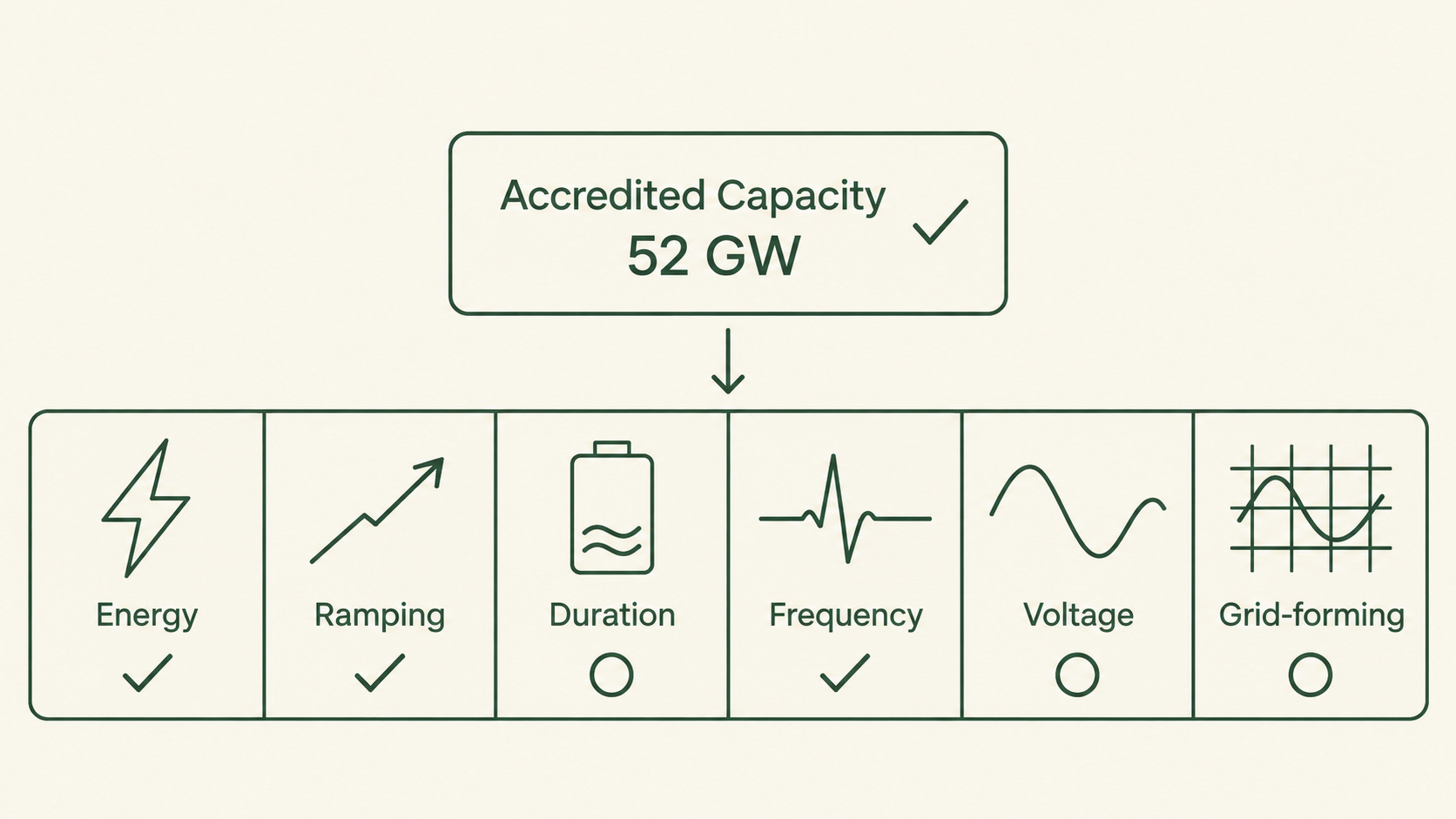
Source: ChatGPT after I talked through resource accreditation using the framework from Part 2 of this series.
In December 2022, Winter Storm Elliott arrived in PJM with the system carrying a comfortable reserve margin. By the standard the industry has used for seventy years, the system had enough resources to weather the storm. Then roughly 46,000 megawatts of generation failed to show up — gas units that could not start, plants that tripped, resources that underperformed their accredited capacity substantially. Despite that failure, PJM’s skillful operations managed to avoid any load shedding. The increasingly relevant question is not whether the reserve margin was set too low, but whether a reserve margin answers the question we should be asking.
Resource adequacy asks whether the system will have enough dependable supply to serve demand during scarcity. For most of the twentieth century, capacity served as a powerful summary statistic for that question. Dispatchable generators had characteristic, stable operating properties, so knowing that a resource was a coal plant, a combustion turbine, or a nuclear unit told a planner most of what mattered about how it would behave. Peak demand was 50 gigawatts, planners needed 50 gigawatts of dependable generation plus a reserve margin, and the arithmetic sufficed because that one number carried a great deal of embedded knowledge about the machines behind it.
Parts 1 and 2 described what has happened to that embedded knowledge. Power electronics is loosening the correspondence between technology category and system capability, turning resources into bundles of competing possible uses whose values shift, sometimes quickly, with time, location, and system condition. A megawatt has stopped being a sufficient statistic because the machine behind it has stopped being predictable from its nameplate alone.


Accreditation as partial adaptation
The industry has been drifting toward this recognition for a decade without quite saying so. Effective load carrying capability, marginal ELCC, and performance-based accreditation all concede the same point: a megawatt of solar, wind, storage, or thermal generation does not contribute equally to reliability at every hour or under every condition. Four-hour storage earns a different accreditation than eight-hour storage; solar accreditation falls as solar penetration rises.
The methods behind those numbers have grown considerably more sophisticated. Contemporary resource adequacy analysis runs chronological simulations across thousands of weather years, represents state of charge and fuel limitations as binding constraints, and models correlated outages rather than treating unit failures as independent draws from a probability distribution. ESIG has argued for exactly these practices, and the analytical work now underway is genuinely multidimensional. Assessment has caught up with the resource fleet in ways the industry deserves credit for.
The output has not. Those simulations, however rich, terminate in a single number of accredited megawatts, and that number is what enters the reserve margin test, the capacity auction, and the interconnection queue. The chronological detail that produced it — which hours were binding, which capabilities were scarce, which failures correlated — informs the number and then disappears from decision-making. Meanwhile, the requirements governing ramping, frequency response, voltage support, and grid-forming behavior live in separate proceedings, with separate standards and separate timelines.
Adequacy analysis has kept pace with the fleet. The institutions downstream of it have not, and they receive a single number from a study that had a good deal more information to contribute.
The questions capacity cannot answer
Suppose a system holds enough accredited capacity to meet peak demand under the applicable standard. Does it also have enough ramping capability to follow a steep evening net-load rise? Enough stored energy to survive a multi-day scarcity event rather than a four-hour one? Enough fast frequency response after the largest credible contingency? Enough voltage support at the particular nodes where voltage support matters? Enough grid-forming capability as the share of synchronous generation falls? Enough resources able to restore the system after a widespread outage?
A single measure of accredited megawatts can’t answer these questions fully, and the reserve margin comparison it feeds can’t either. Adding megawatts of a resource that cannot ramp produces no ramping capability. Adequacy in one dimension buys nothing in another, and the dimensions keep proliferating because power electronics keeps creating resources that score differently across them. The power system needs adequate resources, but now it also needs an adequate portfolio of capabilities.
Capability adequacy
I propose a move toward capability adequacy: assessing whether the resource portfolio can deliver the full set of performance attributes the system requires across the range of conditions it may plausibly face.
Capacity remains part of the concept, because we will always need enough ability to supply electricity when consumers want it. But the planning problem changes character. A scalar question — do we have enough megawatts, yes or no? — becomes a portfolio question: which combination of resources gives us adequate energy, capacity, ramping, voltage support, frequency response, restoration capability, and other essential attributes across plausible system conditions?
Capabilities correlate too, and in ways the outage models do not capture. A cold morning that strains energy adequacy also strains ramping, stresses gas-fired voltage support, and thins the grid-forming fleet at the same hour. Assessing capability adequacy means examining joint performance across dimensions under stress rather than summing individual contributions.
Opportunity cost, which Part 2 introduced as an operational matter, reappears here as a planning constraint. A battery counted toward both reserve adequacy and ramping adequacy may deliver only one of them in the hour when both are scarce. A capability portfolio that double-counts a shared physical asset is not a portfolio, it’s an accounting error with consequences for reliability.
Operations as the discovery process for planning
Planning and operations usually get treated as separate problems, proceeding on different clocks, through different institutions, using different models. A capability-oriented framework connects them, and the connection runs through prices (you knew I would say that, right?).
Co-optimized operations reveal which capabilities bind and what their opportunity costs are, hour by hour and node by node. Those scarcity signals carry information about the value of investment in the capabilities that bind most often and most expensively. Investment changes the future portfolio. Planning then asks whether the resulting portfolio remains adequate across the conditions the system may face, and operations test that judgment against reality in five-minute increments.
Discovery is the right word for the process. Nobody holds the knowledge required to specify the optimal capability portfolio in advance, because that knowledge sits dispersed among resource owners who know their own costs, degradation, alternative uses, and contractual commitments. Good institutions elicit it.
I made a version of this argument seventeen years ago in my 2009 book, criticizing capacity markets (Chapter 7). RTOs possessed no estimate of what customers actually value in reliability, so they substituted an engineering-determined reserve margin and called the result a demand curve. The good being exchanged had an unknown intrinsic value to the people paying for it, which left me asking how we could be confident the capacity market sent a meaningful price signal at all (which I reiterated here a while back). Power electronics has sharpened the question. An administratively specified quantity of capacity was once a crude proxy for a reasonably well-understood thing. It is now a proxy for something we no longer understand well enough to specify.

Who gets paid for coordination?
Todd Royer raised the natural next question in the comments on Part 2: if several independently owned resources become more valuable when coordinated, how do markets and contracts determine who gets paid for what?
Coordination value is jointly produced, which makes attribution genuinely hard. Common ownership resolves the division internally; bilateral contracts and aggregation allocate it through negotiation and margin.
Performance specification helps in all three cases by making the delivered performance the tradeable object rather than the participating device. When the market buys a response of a given magnitude, speed, and duration at a given location, the question of which devices combined to produce it becomes the supplier’s problem to solve and the supplier’s gain to capture. Specifying the end and letting participants discover the means is how the division problem gets answered by the people who know the most about it.
Who writes the list?
Jeffrey Wernick asked a harder question that determines whether capability adequacy is an improvement or a repetition. A co-optimizer allocates within a feasible set that somebody specified. It can discover the best use among the capabilities its designers permitted it to see, and it cannot discover the capability for which the mechanism has no message. Capability adequacy has the same vulnerability. An administratively defined list of capabilities, fixed in a reliability standard and updated on a triennial cycle, becomes the new capacity: a summary statistic that embedded good knowledge when written and ages badly as the technology moves underneath it.
Power electronics guarantees the aging. The feasible set is expanding faster than any designer can enumerate it, so new capabilities will keep arriving, and one of them may be a new way of slicing or recombining a resource that nobody had yet treated as an economic object.
The answer is procedural, not substantive. If we can’t specify the right capability list once, we need institutions that revise it: a defined process with a low threshold for adding attributes, entry paths that let unlisted performance prove its value through pilots and bilateral arrangements, and continuing competition from private networks, microgrids, and data-center campuses that internalize their own coordination. Arrangements discovering value the optimizer did not anticipate need to survive long enough to demonstrate it. Polycentricity, in other words: technology neutrality applied to the institutions rather than to the resources.
My 2009 chapter closed on a related worry, phrased more bluntly. Imagine if 1850s law had dictated the existence in perpetuity of a capacity market for the production of whale oil. We do a poor job in this industry of letting dinosaurs go extinct, and the extinction of obsolete constructs as better ones evolve is one key to industry robustness.
Capability adequacy is a better construct than capacity adequacy. It will also, eventually, be a dinosaur. Building in the conditions for its own revision is the difference between an improvement and a new cage.
The question underneath
Moving from resource adequacy to capability adequacy describes the system’s needs more honestly, and keeping the description revisable is what keeps it honest as the feasible set expands.
Power electronics enlarges the search space. Good institutions help us explore it, until they don’t, which is why the rewriting has to be part of the design.